

The period between plantings is a better indicator of a garden’s effectiveness than its square footage. Due to the way most seed packets and instructions instruct beginners, a traditional row garden spends a surprising amount of its life doing nothing. There are broad walkways only for the convenience of the tiller. Between rows, weeds grow faster than vegetables. A bed that is cleared in July and left bare until August, when it is replanted. There was a significant amount of land that never produced any crops over the course of a season.
A raised bed approach solves this in a different way. Build beds that are four feet wide, narrow enough that you can reach the center without stepping in, and plant each square foot. There are no walkways inside the bed. Foot traffic compaction keeps the soil sufficiently loose so that roots can easily push downward rather than sideways. Since the bed is never walked on, it remains productive with less amendment, and since each square is taken into account, the question is not whether to plant, but rather what to plant next.

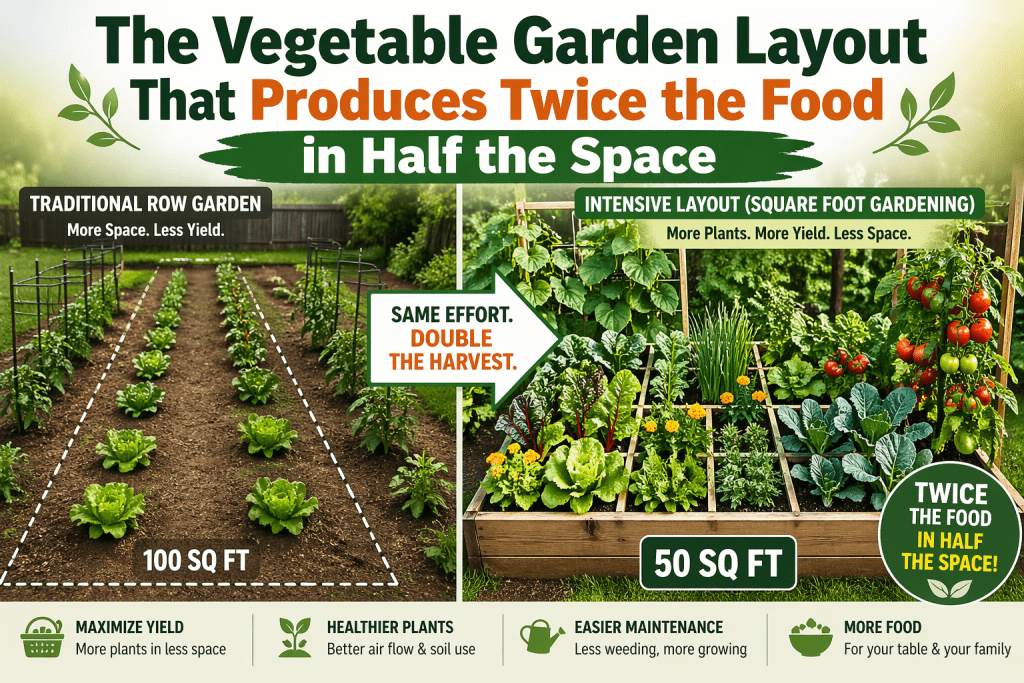
A seed packet’s row spacing is intended for a tractor, not a backyard, as Mel Bartholomew popularized square foot gardening in the early 1980s. One square foot can easily fit sixteen carrots when arranged in a grid rather than a row. Four heads of lettuce can fit in the same space. As the plants get close enough to the soil, the canopy shades the soil, preventing weed growth and minimizing water loss. To gardeners who learned the traditional method, the planted density seems incorrect at first. There is a lot of stuff in there. By midsummer, it is readable as abundance.
Vertical space is the other half of the calculation, which most gardeners ignore. Cucumbers, pole beans, peas, and indeterminate tomatoes will climb if given a surface. They take up ground space that could be used for something else at ground level as they grow upward. An Arkansas home gardener calculated a 75 percent reduction in ground footprint by trellising vining crops instead of letting them sprawl. Using a cattle panel arch over a four-foot bed, cucumbers have eight vertical feet of growing surface, while lettuce and radishes benefit from partial shade. North-facing trellises prevent shadows from falling on shorter crops. This results in the entire system resembling a stacked system, which is basically what it is.
Intercropping, which requires both time and space consideration, is the third element. Slow starters, pumpkins and watermelons are planted late and grow slowly for the first month before exploding. In the period between transplanting and canopy spread, a full crop of rapidly maturing cabbages or radishes can be grown. Since the fast crop is harvested before the slow crop requires the space, nothing is wasted. Whenever lettuce is planted around the base of peppers, it fills up the open soil, inhibits weed growth, and is harvested long before the peppers are ready for harvest. During its useful life, the bed can support two or three crops, offset in time, each using what the others haven’t.
Quick Reference: Intensive Raised Bed System at a Glance
| Category | Details |
| Method Name | Intensive Raised Bed / Square Foot Gardening |
| Pioneered By | Mel Bartholomew (Square Foot Gardening, first published 1981) |
| Standard Bed Width | 4 feet (accessible from both sides without stepping in) |
| Standard Bed Length | 4–8 feet (commonly 4×4 or 4×8) |
| Grid Spacing | 1×1 foot squares; plant density follows grid, not rows |
| Example Density: Carrots | 16 per square foot |
| Example Density: Lettuce | 4 per square foot |
| Example Density: Tomatoes | 1 per square foot (indeterminate) |
| Vertical Space Saving | Up to 75% space saving vs. ground sprawl for vining crops |
| Trellis Placement | North side of bed to avoid shading shorter plants |
| Key Intercropping Principle | Pair slow/large crops with fast/small crops in same bed |
| Succession Planting | Replant each square immediately after harvest; no empty soil |
| Productivity Claim | Up to 10x more yield per square foot vs. traditional row gardening |
| Reference | Old Farmer’s Almanac – Raised Bed Gardening Methods |
Succession distinguishes a truly high-yielding garden from one that appears intensive only in the spring and gradually runs out by August. As soon as onions appear in July, the cleared ground is amended and replanted with dry beans, which mature before the first frost and fix nitrogen in the soil. When a first planting of tomatoes succumbs to late blight in late summer as they consistently do in humid climates, a second planting already established carries the harvest into autumn. Well-managed intensive beds give the impression that the garden is always in the middle of the season.
This system may be undervalued when it comes to variety selection. Some gardeners who have spent years cultivating indeterminate tomatoes have discovered that nine determinate paste plants can outproduce three times as many mixed varieties. A well-managed intensive layout enables productive varieties to do something neither component can do alone: stack. There are other benefits as well as a more productive garden. Despite the same amount of space, the relationship is fundamentally different.
As a Senior Editor at Mini Greenhouse Kits, Hannah Kinsley is a passionate supporter of small-space gardening and urban gardening. Hannah, who is currently majoring in Environmental Policy through the University of Michigan’s Environmental Studies program, infuses her writing with a solid academic foundation and a sincere enthusiasm for the environment. You can find her playing soccer or exploring the city’s green areas with friends when she’s not researching the newest trends in city gardening or creating content for minigreenhousekits.com.