
Everyone who has ever worked in a garden with a child will recognize this moment. Child who has spent weeks pushing peas to the edge of the plate squats down in a vegetable patch, grabs a sugar snap pea from the vine, and devours it before an adult can say anything. Persuasion is not necessary. There is no haggling. A crunch followed by curiosity. Research has shown that it occurs frequently enough that it cannot be dismissed as a coincidence.
Despite the fact that contradictory results are common in this field, research has been conducted on the relationship between kids growing food and kids eating food for more than ten years. A systematic review found that children who participated in garden-based programs consumed more vegetables than those who did not. It is not a marginal outcome. A twelve out of fourteen result usually settles a dispute or at least significantly calms it down. In reviewing the data, the Community Preventive Services Task Force concluded that gardening initiatives can successfully raise vegetable consumption, especially when coupled with nutrition education.
Intriguing, not just comforting, is the question of why. The obvious explanation that kids eat what they grow out of pride or because they’re hungry after working outside isn’t entirely correct. Researchers and feeding experts believe that a child’s relationship with a vegetable has a deeper significance. A pepper on a dinner plate is an unfamiliar object without a specific context. A seven-year-old watched a pepper grow from a tiny flower, monitored it every day, and harvested it when it turned red. There is a narrative behind it. The child is part of that story. Eating it is like finishing something in a tiny way.
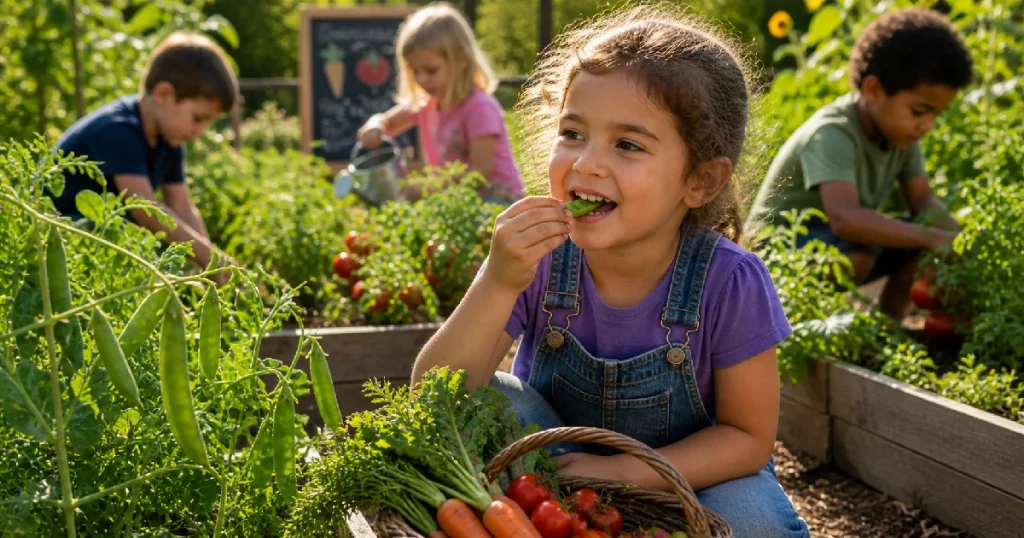
Ownership seems powerful even to a four-year-old. When compared to children in a control group, preschoolers who participated in a garden intervention in childcare settings and were studied under randomized controlled conditions consumed more fruits and vegetables during snack time. Almost immediately, the practical experience was transferred to the table. Michigan State University Extension summarizes research that shows an increase in willingness to try new foods across garden programs of different types and ages. In other words, it doesn’t seem to be specific to any particular approach or setting. Growth itself seems to be what matters.
There’s no denying how different this is from most tactics used to get kids to eat healthier. In the classroom, nutrition education has its place, but research shows that it is more effective when combined with real soil, real plants, or real harvesting. Taking part in the entire cycle-from planning to planting to watering to cooking-is crucial, according to the Academy of Nutrition and Dietetics. Kids who come only for the harvest lose out on the investment that makes eating feel like a reward. Children who plant but never taste miss out on the reward of the experience. It appears that the cycle must be completed.
Numbers help make the difference more tangible. Children in garden-enhanced nutrition programs consumed about one serving of fruits and 1.5 servings of vegetables more frequently than children in classroom-only nutrition programs. Regardless of any other intervention, it is challenging to get a child to consistently eat 1.5 servings of vegetables each day. Dietitians and pediatricians have tried it for generations with varying degrees of success. A raised bed with cherry tomatoes and a watering can seem to accomplish more than reward charts and lectures.
After reading all of this, you might think the impact is diminishing. It is likely that a child who grows tomatoes at age six will be just as wary of vegetables as any teenager after a few years. Possibly; the evidence for short-term effects is more comprehensive than for long-term effects. It has been shown, however, that early familiarity and positive associations may influence eating habits into adulthood. According to Cornell’s research on garden-based learning, gardening encourages adults and children to try new foods and sustains broader changes in eating habits over time.
The mechanism is more impressive than the data when observed in action. Kids aren’t eating more vegetables despite being told they are healthy. Vegetable consumption has increased since the vegetables became theirs. It is important to make this distinction. Knowledge or taste were never the real issues. Relationships were involved. It is impossible to create the bond between a child and a carrot that can be created by education. As a whole, the research only confirms what was evident from the sugar snap pea moment.
As a Senior Editor at Mini Greenhouse Kits, Hannah Kinsley is a passionate supporter of small-space gardening and urban gardening. Hannah, who is currently majoring in Environmental Policy through the University of Michigan’s Environmental Studies program, infuses her writing with a solid academic foundation and a sincere enthusiasm for the environment. You can find her playing soccer or exploring the city’s green areas with friends when she’s not researching the newest trends in city gardening or creating content for minigreenhousekits.com.