
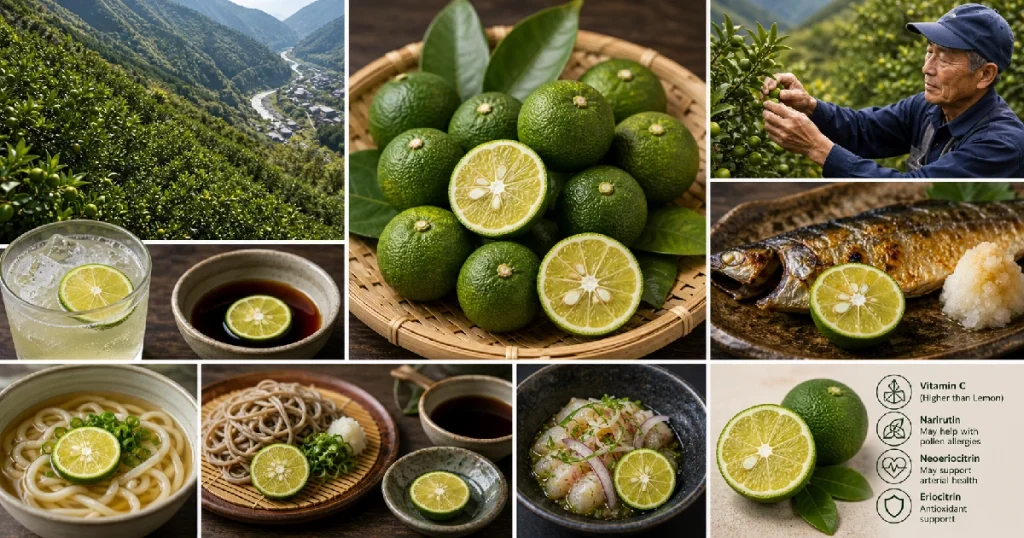
You realize why this fruit has remained local for so long in the mountains of Tokushima Prefecture on Shikoku. Trees covered in tiny, waxy green orbs that don’t stand out from a distance grow in clusters across steep hillsides. After someone gives you a half-slice, the aroma takes over before the taste, which is complex, floral, and sharp in a way that a wedge of lime is not. That’s what Sudachi is. Japan has been doing that covertly for centuries.
Sudachi, a small citrus fruit native to Japan, is associated with Tokushima, the prefecture that produces about 98% of the nation’s supply. Sanagouchi-son and Kamiyama-cho produce almost half of that production. The soil, the climate, and the generations of farmers who had little incentive to grow outside the island all combine to create this type of local monopoly. In Tokushima, sudachi is inexpensive and widely available. Tokyo considers it a delicacy. While most people outside of Japan have never experienced it, this is gradually changing.
Genetically, the fruit is a hybrid with one parent identified as yuzu and the other as an unidentified relative of two native Japanese cultivars: tachibana orange and koji. Its parentage greatly influences its character. This version has a sharper, more intense tartness and carries a yuzu scent without quite the same floral softness. It has more calcium and vitamin C than lemon, as well as being zestier and more fragrant. The antioxidant flavonoid eriocitrin, found in lemon and lime, is also found in sudachi; its relative citrus, yuzu and kabosu, do not contain the same amount. A 2006 Tokushima University study found evidence that sudachi zest may help lower glucose levels in diabetic subjects, but it would be premature to draw broad conclusions from a study that used rats over one year.
Sudachi Fruit: Taste, Uses, and Reasons to Include It
No part of the fruit is consumed. Before entering, it’s important to understand that. A sudachi is a seasoning, not a snack; it can be pressed into sauces and beverages, sliced as a garnish, or squeezed over food. In traditional Japanese cuisine, a half-slice is served with grilled fish, udon, soba noodles, and hot pot dishes. As one of the most expensive and highly valued ingredients in Japan, it is considered an essential partner for matsutake mushrooms. In Japan, sudachi is often served with yuzu, kabosu, and daidai in ponzu, a citrus-based dipping sauce. Due to the small size of the fruit and modest juice yield, the contribution is intensity rather than volume. It goes further than expected.
It’s hard not to feel a little curious when Western chefs reach for sudachi the same way they reached for yuzu ten years ago. Yuzu has become a mainstay in upscale kitchens throughout North America and Europe during the 2010s, moving from specialty Asian grocery stores to mainstream restaurant supply chains. In eateries that take pride in sourcing unique ingredients, sudachi appears in cocktail programs, citrus-forward desserts, and ceviche preparations. Several Californian farms started cultivating sudachi commercially around 2008, after trees were made available to nurseries. Peru has since expanded cultivation. Since most Western consumers are still unfamiliar with the fruit and its supply is still limited, it is unclear whether it will gain the same popularity as yuzu.
What the Research Says About Sudachi Fruit’s Health Benefits
Sudachi’s health claims are more compelling than those for citrus. In addition to its well-established vitamin C content, which is higher than lemon, which is already a respectable baseline, sudachi also contains narirutin, a flavonoid which has been studied for its potential to lessen the effects of pollen allergies and has also been found in jabara citrus. Sudachi juice contains three times more narirutin than Yuzu juice. The rind contains neoeriocitrin, which inhibits the production of specific enzymes involved in allergic reactions and arterial inflammation. This nutritional profile is genuinely dense for such a small fruit, even though it is from Japanese research teams and has not been widely replicated elsewhere.
| Category | Details |
| Fruit Name | Sudachi (スダチ / 酢橘) |
| Scientific Name | Citrus x sudachi |
| Origin | Tokushima Prefecture, Japan |
| Size & Weight | Small, round — 20 to 40 grams, golf ball-sized |
| Rind Color | Harvested green; ripens to yellow-orange |
| Flavor Profile | Sharp, tart, intensely aromatic — zestier than lemon or lime |
| Genetic Parentage | Hybrid of yuzu and a relative of koji and tachibana orange |
| Primary Producer | Tokushima Prefecture — approximately 98% of Japan’s supply |
| Key Nutrients | Higher calcium and vitamin C than lemon |
| Common Uses | Fish dishes, soba, udon, ponzu sauce, cocktails, desserts |
| Also Grown In | Parts of California and Piura, Peru |
| Reference Website | www.justonecookbook.com |
Flowers bloom on the trees in May and June before the fruits form in bunches throughout the summer. It is harvested in the fall when the aromatic compounds are concentrated and the rind is still green. Left on the tree, Sudachi would eventually turn yellow-orange, but its original flavor and intensity would have been lost by then. Sudachi is all about catching it before it mellows. There might be a lesson there.
As a Senior Editor at Mini Greenhouse Kits, Hannah Kinsley is a passionate supporter of small-space gardening and urban gardening. Hannah, who is currently majoring in Environmental Policy through the University of Michigan’s Environmental Studies program, infuses her writing with a solid academic foundation and a sincere enthusiasm for the environment. You can find her playing soccer or exploring the city’s green areas with friends when she’s not researching the newest trends in city gardening or creating content for minigreenhousekits.com.