
An almost unexpected thing happens when you open the lid of a well-kept compost bin on a chilly morning. It emits warmth. It takes billions of microorganisms to break down banana peels, coffee grounds, and autumn leaves into something that eventually resembles and smells like the richest, darkest soil you have ever worked with a trowel. There isn’t much to notice. Nonetheless, it provides all the information you need to determine whether the pile is alive or simply decaying.
Many people don’t consider their compost bin to be a living system. They use it to store items they feel guilty about discarding. Add the leftover vegetables. Insert the cardboard. Maybe some grass clippings. After months, something beneficial has either occurred or it hasn’t, and in most cases, the reason is simple: the organism inside wasn’t properly fed in the first place.
To compost organic matter, a microbial community uses carbon and nitrogen as its main fuel sources to break it down aerobically, which requires oxygen. Carbon comes from dry leaves, shredded cardboard, wood chips, straw, and torn newspaper. Nitrogen is provided by the “greens” – fruit and vegetable scraps, grass clippings, coffee grounds, and fresh garden prunings. There is a need for both. The proper ratio of brown to green keeps the microbial population fed, warm, and productive. Whenever the balance is off in either direction, the entire system stalls or becomes unpleasant.
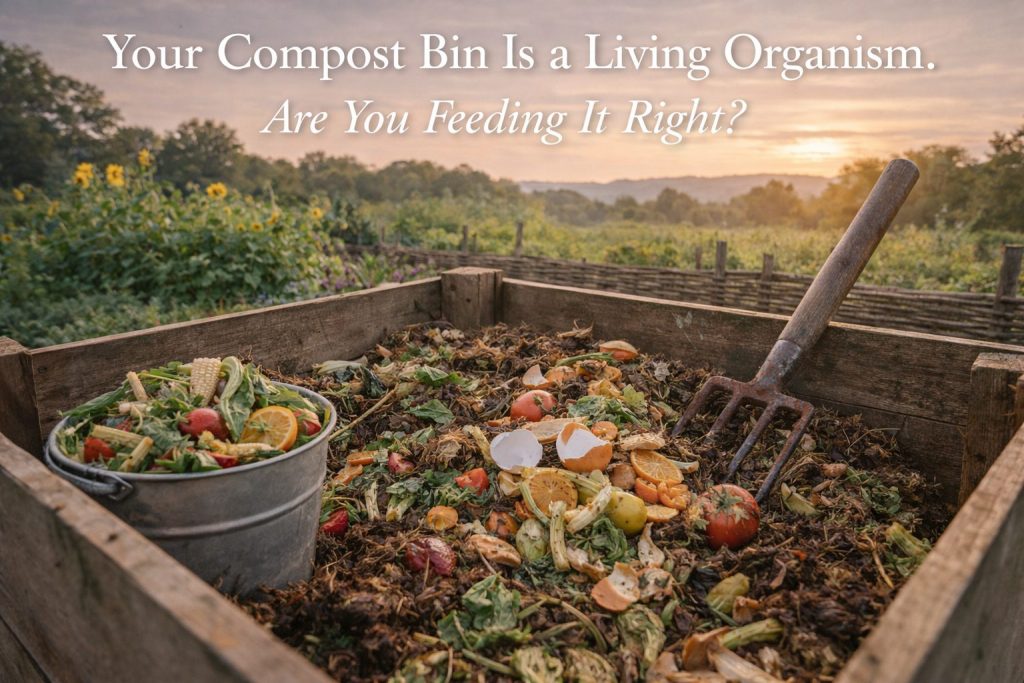
Having too many greens is probably the most common mistake. Due to this, the pile becomes wet, dense, and anaerobic, releasing a pungent ammonia odor that makes neighbors approach the fence line with alarm. In an oxygen-free environment, microorganisms are less effective decomposers and emit foul-smelling gases. In most cases, the pile can be saved by adding a thick layer of dry leaves or shredded cardboard then turning it. However, enthusiasm can be damaged if you feel that you failed to accomplish something that should have been easy. Having too many browns results in a cold, dry pile that does very little.
Furthermore, the moisture question is less obvious than it appears. The EPA describes the pile as damp but not dripping, like a wrung-out sponge. Microorganisms require water to survive, but a soggy pile destroys the air spaces that keep the ecosystem aerobic. Typically, rotten eggs smell sulfurous because they are overly wet and oxygen-starved. It’s the same solution as for ammonia odors: turn the pile, add browns, and let it breathe. It is surprising how much overlap there is between the solutions in most guides.
The turning of the pile is perhaps the most underappreciated part of the entire process. By moving the pile every week or two, we distribute moisture, reintroduce oxygen, and move cooler outer material into the warmer center where decomposition is most active. It is possible to reach temperatures of 130°F to 160°F in a well-maintained backyard pile, which are hot enough to destroy pathogens and weed seeds. That heat isn’t a side effect. Clearly, the microbial community is functioning at its best. When the pile stops heating up after turning, it is almost done.
Some items should not be placed in a home compost bin, and the list is practical rather than arbitrary. Besides attracting rodents, meat, fish, dairy products, and cooked fatty foods don’t consistently decompose at backyard temperatures. Diseased plants may endure the procedure and spread the infection to other plants. There are persistent pathogens in the waste of dogs and cats. Not bureaucratic regulations, but observations about what happens when the system encounters materials it wasn’t intended to handle.
There is a subtle satisfaction associated with a well-functioning pile. Under the cover, there is warmth. Several months later, the smell changed from kitchen scraps to something clean and earthy. As the volume decreases to about one third of what was initially added, all that organic matter is concentrated into something truly useful. Providing the organism inside what it truly needs makes the entire process more forgiving and slower than most people expect.