

An overlooked gardening frustration is when you walk out to your raised bed on a warm June morning and discover that your lettuce has taken on an architectural form. A tall person. Slim. It is somewhat accusatory. The leaves used to be soft and gentle, but now they taste like the inside of an aspirin bottle. What was once a dependable salad crop turned into a bitter scientific experiment so quickly.
Bolting continues to surprise gardeners partly because the explanation, when it comes, is easier to understand and more preventable than it first appears. Lettuce is a cool-season plant. It’s a biological fact with real implications, not just a gardening concept. When the temperature rises above 75 degrees Fahrenheit during the day or stays above 60 degrees Fahrenheit at night, the plant’s internal logic changes. Rather than focusing on leaf production, it begins to consider survival. It produces a flower stalk. Seed production is accelerated. From the plant’s perspective, this makes perfect sense. According to the gardener, it’s a ruined salad.
Heat is the primary trigger, but it is not the only one. Water stress is its accomplice. The roots of lettuce are shallower than most people think, and it is extremely sensitive to the cycle of drying out and flooding. Watering heavily after a few days of dry soil doesn’t balance things out the way it would for squash or tomatoes. Whenever lettuce detects an irregularity, it interprets it as a stress signal, and stress speeds up flowering. Overcrowding has a similar impact. Plants that are fighting for nutrients and space in a dense bed are more likely to bolt early than those given sufficient space to grow.

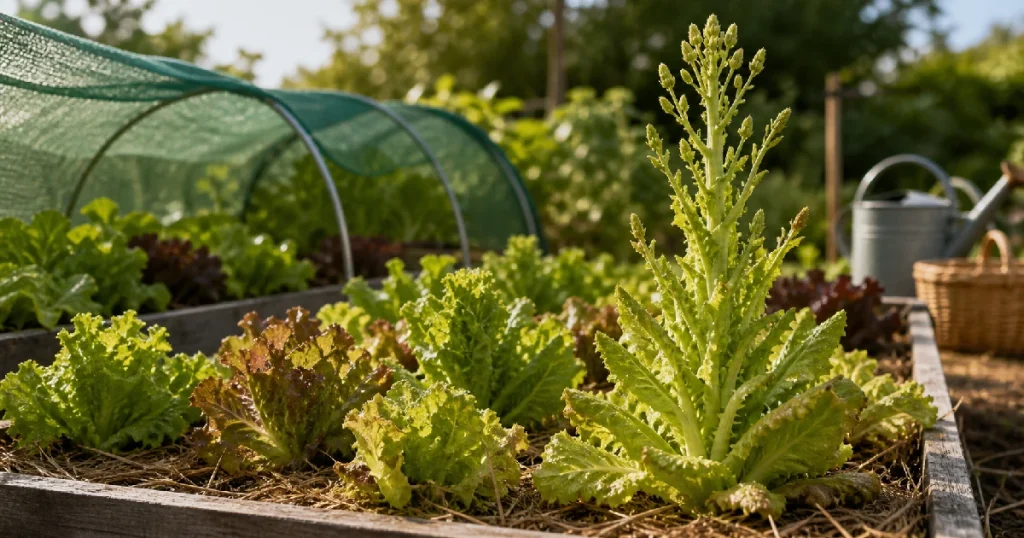
Before you can stop lettuce from bolting, you need to know why it bolts
Bolting feels abrupt because a lot of it has already begun before the obvious symptoms appear. During a cold spell, defined as temperatures in the 40s for several days in a row, young lettuce seedlings may develop internal flower buds. In spite of this, the stalk won’t really grow until the weather warms up. Gardeners who plant early and take pride in their timing sometimes have the earliest bolting plants in their communities. It was the cold that instructed the plant, and the heat that followed carried out its instructions. A lot of “mystery” bolting may be caused by this sequence.
It is fairly easy to read the warning signs once you are aware of them. The center of the plant begins to elongate instead of filling out. The leaves become smaller and more pointed at the top of the plant. A certain leanness has been introduced to the entire structure. By the time a stalk with buds appears, the flavor is typically already compromised, but not always. When bolting is suspected, it is always worth tasting a leaf. Because some varieties remain mild into the bolting process longer than others, catching it early can mean the difference between harvesting dinner and pulling the entire plant.
How to Extend the Lettuce Season
Many home gardeners still don’t use shade cloth, which is likely the most effective single intervention. Shade cloth filters UV rays while allowing rain and partial sunlight to pass through. In contrast to solid covers, it lowers the surrounding air temperature by several degrees without creating an airless environment. By hanging over hoops above lettuce beds, it purchases significant time as summer progresses. A cardboard tent placed over the patch during the hottest part of the day applies the same concept, albeit less elegantly. Before the plant responds to the heat signal, the signal must be stopped.
By heavily mulching each plant’s base with three inches of straw or shredded leaves, shade cloth alone cannot solve the root temperature issue. Even though the leaves above appear fine, roots sitting in hot soil are already stressed. The wet-dry cycle reliably triggers bolting, which is smoothed out by the mulch layer’s insulation and moisture retention. Regular watering is equally important as reactive watering. During warm seasons, checking the soil’s moisture content at least twice a week and keeping the top inch consistently damp instead of alternately dusty and muddy can have a significant impact.
| Category | Details |
| Topic | Lettuce Bolting — Causes, Prevention & Season Extension |
| Crop Type | Cool-season leafy green (Lactuca sativa) |
| Primary Bolting Trigger | Temperatures above 75°F daytime / 60°F nighttime |
| Key Prevention Methods | Shade cloth, heavy mulching, consistent watering, slow-bolt varieties |
| Recommended Slow-Bolt Varieties | Nevada, Jericho, Muir, Summer Bibb, Slobolt |
| Season Extension Potential | Several additional weeks with proper management |
| Difficulty Level | Beginner-friendly; most fixes require minimal tools or cost |
Selecting the right varieties is an upstream process when browsing seed catalogs in the winter. There are several cultivars specifically designed for slow-bolting, such as Nevada, Jericho, Muir, and older varieties like romaine and cos. For gardeners with short or hot seasons, they can result in weeks of extra harvest since they postpone bolting significantly. The reasons why these varieties aren’t more prominently labeled in mainstream garden centers are still unclear, given how frequently home gardeners encounter this issue.
Well-kept lettuce beds continue to produce well into July when neighbors’ patches fail in early June, giving the impression that shade cloth and regular watering are disproportionately successful. Most of the work is not challenging. A careful observer will notice the early signs of flower buds and pinch them as soon as they appear to slow the process by a week or two. Harvesting outer leaves regularly to keep plants in leaf mode rather than seed mode is another example. Most of it delays bolting for long enough to be significant, but none of it stops it once it has begun.
Alyssa Bennet is a Senior Editor at Mini Greenhouse Kits and a passionate advocate for urban gardening and small-space growing. Currently pursuing her major in Arts at the University of California, Alyssa brings a distinctly creative eye to the world of city gardening – blending artistic sensibility with a genuine love for green living. She writes regularly at minigreenhousekits.com, and when she’s not crafting her next gardening piece, you’ll find her with a paintbrush in hand, watching sports, or exploring the city with friends.