
In the middle of January, you’re likely to notice something unexpected when you walk into almost any serious home greenhouse: a faint purple-pink glow that is visible even before you open the door and spills through the polycarbonate panels. This artificial dawn hanging over rows of tomatoes and herbs while everything outside is covered in frost is a strangely lovely sight. Additionally, it reveals a significant aspect of where greenhouse gardening has subtly emerged.
Although grow lights have been around for many years, the discourse surrounding them has evolved considerably. Backyard greenhouse owners are now taking seriously what was once a specialized issue for hydroponic hobbyists and commercial growers, and for good reason. Despite all of its benefits, natural sunlight is unpredictable. Winter daylight can drop to five or six hours, especially in northern climates, which is insufficient for most crops to do much. Plants communicate through pale, stretched stems, sluggish growth, and fruit that never fully develops, but they don’t express their displeasure loudly. It’s difficult to unsee once you grasp what you’re seeing.
Although the marketing surrounding grow lights can make it seem that way, the fundamental science behind them isn’t all that complicated. Certain light wavelengths, mostly in the blue and red portions of the spectrum, are used by plants to carry out photosynthesis. Blue light, which has a wavelength of about 425 to 450 nanometers, promotes leafy, vegetative growth, which is what you want in a young plant. Fruiting and flowering are triggered by red light, which has a wavelength of 600–700 nanometers. By simulating the wider arc of natural sunlight throughout the day, full-spectrum lights aim to provide both. Depending on what you’re growing and at what stage, you may require one or the other, or both.
The majority of growers are interested in three primary types of greenhouse grow lights: LED, fluorescent, and high-intensity discharge, or HID. Each has a unique personality, and selecting between them is more about matching the technology to your real circumstances than it is about which is objectively the best. Many novices begin with fluorescent lights, especially T-5 fixtures. They work well with low-light leafy greens, herbs, and seedlings, and they are forgiving and cool. A mature pepper or cucumber plant will eventually outgrow what a fluorescent fixture can provide, but the trade-off is that they lack the strength for larger, light-hungry plants.
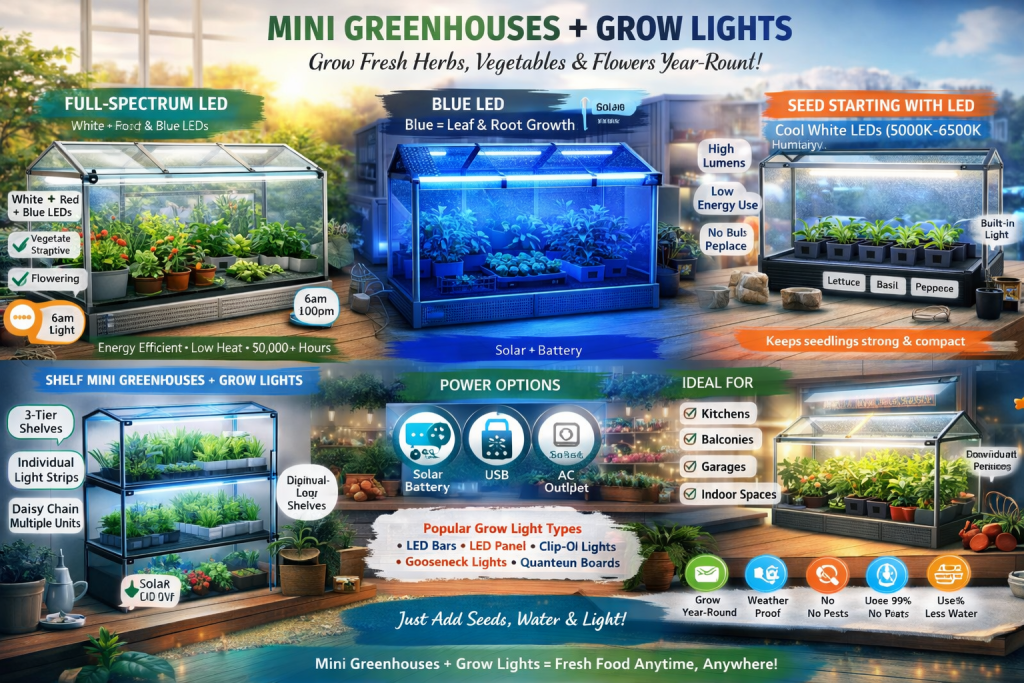
It’s easy to see why LED grow lights have taken center stage in recent discussions. They are more efficient than grow lights from previous generations. When you run lights for 12 to 16 hours a day during a six-month winter, a high-quality LED setup can use up to 85 percent less energy than a similar HID system. Better models, such as the Mars Hydro TSL-2000, which has gained a quiet following among serious home growers, provide low heat emission, dimming capability, and full-spectrum output in a package that doesn’t require a second mortgage. Although there is a real upfront cost, the math over the course of a season usually works out.
HID lights are on a completely different level. The mainstays of commercial greenhouse operations are high-pressure sodium and metal halide fixtures, which are strong, dependable, and actually successful in advancing big plants through their growth cycles. HPS lights are typically used during the flowering stage because of their warm, orange-tinted output. Metal halide manages vegetative growth while operating bluer and colder. In addition to higher energy consumption and a shorter operational lifespan than LEDs, the drawbacks include heat—large, occasionally problematic amounts of it. The economics rarely work out for a small hobby greenhouse. They are still difficult to outperform in terms of pure output for a large-scale growing operation.
Grow light setup is just as important as type selection. It’s one of those situations where minor choices have far-reaching effects. When lights are placed too close to plants, they burn and bleach the leaves, first causing a faint yellowing and then more noticeable scorching. If it’s too far away, you’re effectively squandering electricity as your plants reach upward for an unreachable source—a phenomenon known to growers as etiolation. Depending on the intensity of the light, the generally accepted range is between six and thirty inches; however, as plants grow, this guidance needs to be regularly adjusted. Adjustable hanging hardware or a pulley system are genuinely useful, not a luxury. By reflecting light back onto lower foliage that would otherwise remain in shadow, reflective surfaces on greenhouse walls can also have a significant impact.
Additionally, there is the issue of timing. Like the majority of living things, plants react to rhythm. For most full-sun crops, running lights for 13 to 16 hours a day is effective; however, some plants require more precise calibration, especially those that depend on certain day lengths to initiate flowering. The uncertainty and forgetfulness are eliminated with a programmable timer. It’s one of those minor upgrades that usually pays off quickly in terms of plant performance as well as the convenience of not having to remember to turn on a switch at the same time every morning.
This is where many greenhouse growers receive an unexpected surprise, so it’s worth taking a moment to consider energy costs. Although the math isn’t particularly striking, it adds up. At a typical electricity rate of about $0.12 per kilowatt-hour, a 300-watt light running 12 hours a day costs about $0.43 per day, or roughly $78 over the course of a six-month winter season. When you multiply that by the number of fixtures in a larger greenhouse, the annual figure becomes noteworthy. This is the exact reason why the efficiency argument for LEDs is so strong; it’s a line item on an energy bill rather than an abstract performance claim.
The intriguing thing about greenhouse lighting right now is that while technology has mostly stabilized, awareness hasn’t kept up. Many growers still use fluorescent lighting in areas where a carefully selected LED array would yield noticeably better results, frequently at a lower cost over time. That observation is unbiased; the initial sticker price of high-quality LEDs can be truly intimidating, and there is a learning curve. However, the discussion about lighting is probably worth having sooner rather than later for anyone who is seriously considering what their greenhouse could produce throughout the winter. It’s not just an atmospheric glow behind the panels. It’s acting.