

If you walk through a well-run hobby greenhouse in the upper Midwest in February or a serious commercial greenhouse in Morgan Hill, California, you will find that the plants occupying the benches are not always what you expect. Options that aren’t obvious. Garden centers do not automatically carry catalog varieties. The growers who are actually making money-or consistently producing the best results-have formulated a fairly specific set of blooms based on a combination of trial and error, experience, and honest accounting of what sells, what survives, and what makes the entire endeavor worthwhile.
Many of these discussions mention six plants, each of which deserves a position beyond mere aesthetics.
Professional landscapers and greenhouse producers love Sakata Seed America’s hybrid impatiens, SunPatiens. By midsummer, these conditions result in lanky, sparse, burned-looking plants that thrive in the kind of heat and stress that causes regular annuals to deteriorate. SunPatiens don’t do that. As an annual, they produce flowers throughout the three seasons and maintain a dense, full habit. According to Sakata’s global marketing manager, Mark Seguin, growers can produce a crop from unrooted cuttings in six to seven weeks, giving them significant flexibility. With its speed and retail durability, the plant is extremely useful for greenhouses trying to fill bench space efficiently in a way that more attractive but fragile alternatives cannot.
It’s easy to underestimate the unique niche that stocks, or Matthiola incana, occupy if you haven’t been to a local cut flower market. Despite the handling and transportation that imported flowers endure, fresh-cut stock has a distinctive scent, a dense, clove-like sweetness that is hard to describe to someone who hasn’t experienced it. Local growers are the only ones capable of bringing stocks to market with that scent intact, regardless of scale or logistics. With newer series like “Early Iron”, growers can reach the high-value spring window that florists and event planners are actively purchasing for by extending bloom time earlier in the season.

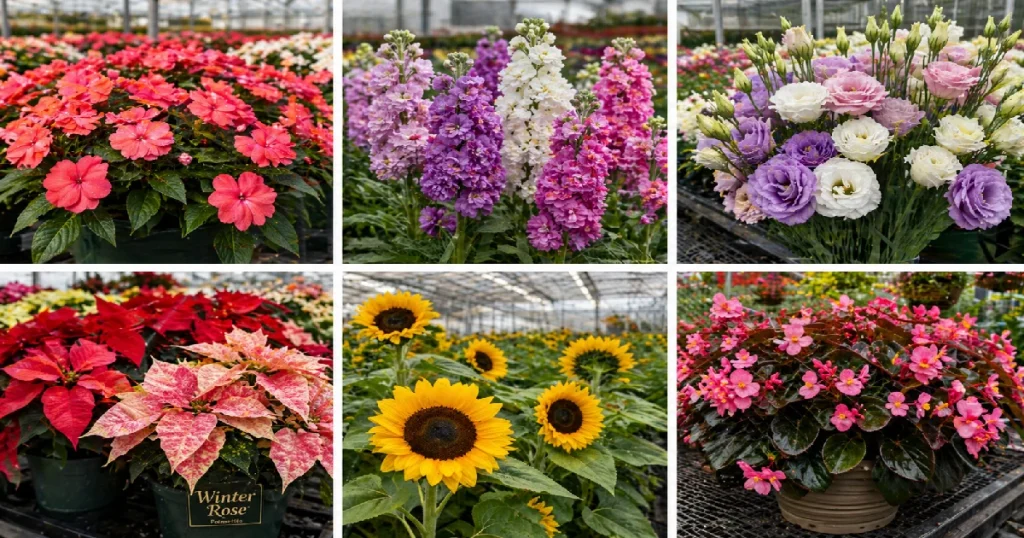
The most discussed plant on this list is Lisianthus because it is so challenging to grow. It takes a long time for seeds to germinate and produce a marketable flower, the seedlings are delicate, and the seeds are notoriously slow and erratic. In spite of this, growers who have mastered it are often fiercely protective of their knowledge due to the significant reward. It appears that Lisianthus flowers are expensive. With their long vase life and layered, ruffled elegance, they are a top choice for weddings and events. Florists grow local lisianthus for real money, especially in the early summer when demand is highest. If growers can consistently produce it, there may not be a more profitable cut flower on a greenhouse bench.
A specialty poinsettia series, such as “Prestige” or “Winter Rose,” bred with particular structural and aesthetic qualities, represents the concept of owning a season in a greenhouse. During the holiday season, poinsettias are in high demand, consistent, and concentrated into a very short window. The specialty series offer reduced shrink, the industry term for broken branches, uneven growth, or plants that don’t look appealing by the time they reach retail. With its curled, peony-like bracts, the ‘Winter Rose’ series is a good example of a poinsettia that commands a higher price and loses fewer units from greenhouse to checkout. As a result of premium pricing and decreased losses, the holiday crop’s economics are significantly altered.
This list includes hybrid greenhouse sunflowers like “Vincent’s Choice” because they are so useful. Sunflowers with upward-facing blooms are easier to pack and present than those with downward-facing blooms, grow well on greenhouse benches, and are resistant to fungal diseases. Multi-headed varieties increase yield per plant significantly at scale. Seeing rows of neat, uniform stems at a consistent stage of development on a well-kept sunflower bench is almost gratifying. It is much easier to schedule and sell when there is predictability.
| Plant | Key variety | Best use | Difficulty | Stand-out trait |
| SunPatiens (hybrid impatiens) | SunPatiens (Sakata) | Retail bedding plant | Easy | Heat-tolerant; crop ready in 6–7 weeks from cuttings; fills bench space efficiently |
| Stocks | Early Iron series | Cut flower / events | Moderate | Intense clove-like scent only preserved by local growers; blooms early for the spring market |
| Lisianthus | Various | Premium cut flower / weddings | Hard | Highest profit potential of the six; long vase life; ruffled elegance commands top florist prices |
| Specialty poinsettia | Prestige, Winter Rose | Holiday retail | Moderate | Reduced shrink; premium pricing; peony-like bracts on Winter Rose justify higher retail price |
| Hybrid greenhouse sunflower | Vincent’s Choice | Cut flower / retail | Easy | Upward-facing blooms; disease-resistant; multi-headed varieties boost yield per plant |
| Dragon wing begonia | Dragon Wings | Mixed planters / landscaping | Easy | Sun and shade tolerant; continuous bloom spring–fall; disease-resistant in humid conditions |
Despite being the least glamorous plant on the list, dragon wing begonias may be the most useful. They grow in the sun. Shade is ideal for them. From spring to fall, they bloom continuously without deadheading or other major intervention. Most diseases that affect begonias are resistant to them in humid greenhouse conditions. Moreover, they work equally well in mixed planters as in standalone containers, making them useful to a variety of consumers, including commercial landscapers and home gardeners. Many seasoned growers continue to use Dragon Wings year after year, not because the flower is particularly impressive when grown alone, but rather because it consistently delivers.
A greenhouse allows growers to control timing, environment, and quality in contrast to outdoor growing and imported supply chains. Well-managed greenhouse operations produce blooms that make the most of the control, such as those that bloom off-season, withstand disease under glass, and maintain their quality from bench to market.
Olivia Murphy is a Senior Editor at Mini Greenhouse Kits and a fervent supporter of small-space and urban gardening. Alyssa, who is currently majoring in both literature and biology at Michigan State University, infuses her writing about city gardening and small-space growing with a unique blend of scientific curiosity and storytelling instinct. Her love of literature influences how she tells the stories behind the plants, and her background in biology gives her content a grounded, research-informed edge. When she’s not working on her next gardening piece, you can find her curled up with a good magazine or watching a movie that she’s been meaning to watch for weeks. She writes with passion at minigreenhousekits.com.