
There is one type of garden that stops you in your tracks. Unlike the show gardens with imported stone and expert planting crews, where beauty is literally the budget. The kind that stops you is more surprising: a tiny walled plot tucked away in a corner of an urban backyard or behind a farmhouse, with purple basil pressing up against frilly green lettuce, and climbing beans threading through a rusted iron arch. Almost. When you take a closer look, it’s obvious that someone knew what they were doing.
Productivity and aesthetics are closely related in a kitchen garden. In comparison to aesthetics, it is more profound. Having done all those things correctly, a garden that produces well-one with soil that is rich and dark, with every inch containing edibles, and without pests controlled with chemicals-tends to look exceptional. Typically, when one is removed, the other suffers as well.
Planting densely is the best design logic. By packing plants closely together, kitchen gardeners fill spaces that would otherwise be bare or mulched. Practical results include higher yields per square foot, moisture retention, and weed suppression. There is, however, a level of lushness that well-kept ornamental gardens often lack, and this is the first thing visitors notice. It is a beautiful garden full of nasturtiums tumbling over the edges, kale leaves overlapping delicate carrot fronds, and a feeling of life and purpose. There is no brown earth patch anywhere. The whole thing is green and textured.
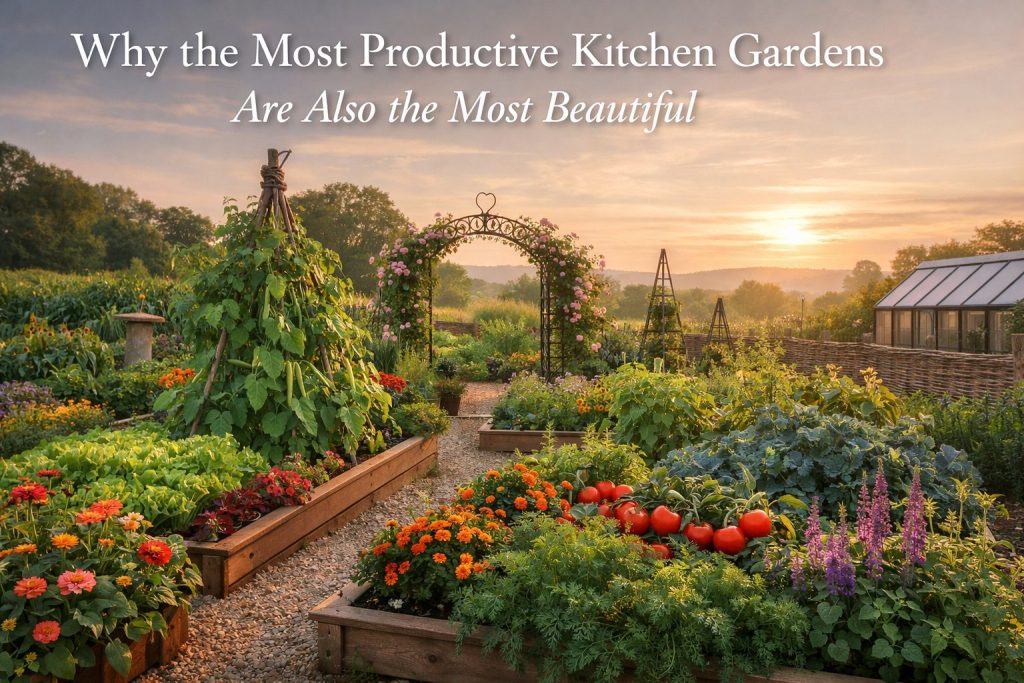
A vertical structure serves a different purpose once again. The addition of obelisks, arched frames woven with climbing plants, and trellises is not purely aesthetic. Besides maintaining infrastructure, they improve air circulation, enable dense planting at ground level without crowding, and provide climbing beans, cucumbers, and sweet peas with a place to grow. Garden designers refer to them as backbones because they provide structural elements that are still noticeable in the winter after the annuals have died off, preventing the area from becoming a muddy nothing. Visitors still enjoy the walled kitchen gardens of English country estates, such as Heligan or Chatsworth, centuries after they were built. Both food and beauty were produced using the same set of choices.
Companion planting also carries a dual identity. A functional strategy in which each plant helps its neighbor by confusing pests and attracting beneficial insects is planting marigolds in between tomatoes, threading purple basil through lettuces, or allowing borage to grow along cucumber beds. It makes sense to use chemical reasoning. The cottage-garden chaos, however, is difficult to replicate and ornamental gardeners often fail miserably. The most productive kitchen gardens are the result of good practice. Perhaps this is why it is so difficult to replicate the look.
Considerate kitchen gardeners demonstrate their true sensibility when deciding what to plant. There is almost something surreal about the red and yellow stems of Swiss chard. Purple kohlrabi. There is a living quilt of crimson and butter-green frilly lettuces. The plants were selected not only because they taste good and produce consistently, but also because of their appearance in the afternoon light. Decorative plants are referred to as “edimentals” in gardening circles, and these are the plants that deserve their place on the plate and in the kitchen. Even though the coinage is awkward, it conveys a truth.
The importance of hardscaping in keeping everything together is often underestimated. Brick borders, raised beds with cedar edges, and gravel pathways prevent intensive planting from devolving into chaos. Dense and intricate gardens can only be achieved when the underlying geometry is evident. The paths must have a destination. Beds need edges. There must be a logic to the layout, even if the planting is gloriously chaotic. Formal garden design’s best features are driven by the same tension: controlled structure, wild interior. Infrequently, it is applied to the vegetable patch.
Food gardens were supposed to remain hidden for a very long time, which is hard to ignore. It is tucked away behind the house, separated from the “real” garden by a fence or polite distance. Gardeners who are leading this change always yield the best results, since this way of thinking has changed significantly. The goal of being both beautiful and functional has always been the same.