

When you stand at the entrance to Sissinghurst Castle Garden in Kent on a gloomy November morning, the borders are trimmed back and the roses have been reduced to prickly sticks. Yew hedges rise sharply and darkly against a pale sky. Brick walkways maintain their lines. Anchoring the far end of the garden, the tower serves as a punctuation mark. There is nothing in bloom. It does, however, feel like a place. This isn’t a coincidence. Long before the first seed was sown, a conscious decision was made.
The idea at play in Sissinghurst, Versailles, Kyoto’s Zen gardens, and any other garden that halts people and prompts them to snap a picture is structural. The bones of a garden are everything that is not living or evergreen, such as hedges, walls, paths, topiaries, pergolas, water features, carefully placed urns, and statuary. These are what remain when everything else has died back, been chopped down, or just gone to sleep for the winter. Furthermore, they are almost always original designs.
It is likely that most people who visit a lovely garden are not even aware of what they are experiencing. When they see a wildflower meadow, roses, and lavender borders, they attribute the effect to the plants. Even if you remove those plants and replace them with new ones or nothing at all, a garden with sturdy bones will still stand. Geometry remains. Sight lines still exist. Still, it feels like you are navigating thoughtful, purposeful space. Unstructured gardens appear chaotic even when the flowers bloom, and simply overgrown when the flowers fade because there is nothing to anchor the eye.

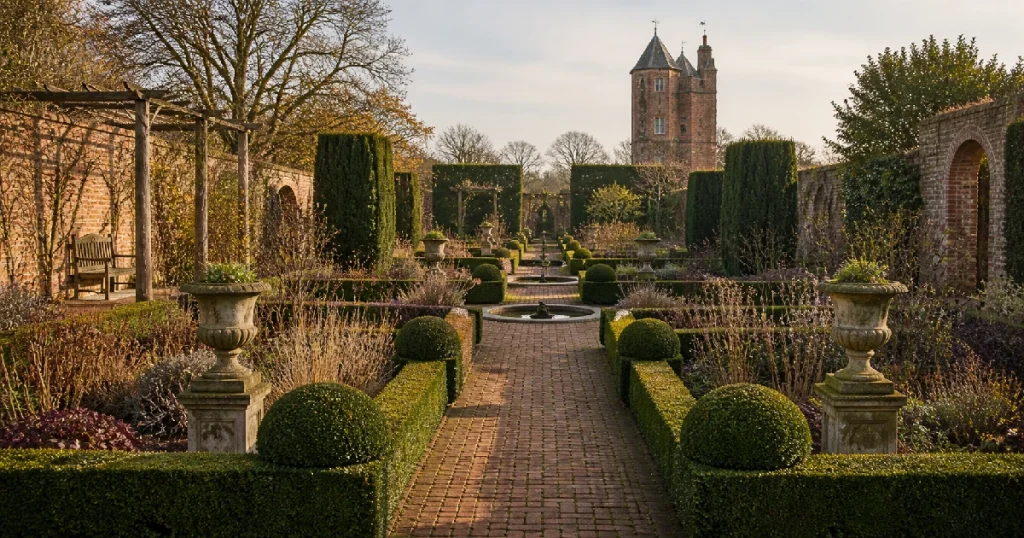
Landscape designers at the serious end of the field tend to spend more time on the bones than plants when clients come expecting plant discussions. Forms on paper, such as the ratios of paths to beds, the rhythm of open areas versus planted ones, and where the eye should go first and arrive, are often the first steps. Versailles, for instance, arranged large areas into geometric precision that could be viewed from above like a floor plan. On a smaller scale, the same reasoning applies. A well-proportioned patio, a path with a confident curve instead of a hesitant squiggle, or a hedge that creates a moment of enclosure before opening up into a wider area are structural choices that endure.
There is a layering logic that is evident in the best gardens once you start looking for it. First, the hard components, clipped evergreens, and permanent framework are installed. Some designers refer to the trees, shrubs, and perennials as the “flesh.” Last but not least is the dressing: the annual climbers trained up a wall, the bulbs nestled between the perennials, and the ever-changing details. There is a direct relationship between every layer and the layer below it. The dressing only works because the flesh provides context. The flesh can only function because the bones give it a shape to occupy. In the absence of bones, the upper layers collapse into something more ornamental than functional.
This structural principle is genuinely intriguing and counterintuitive due to the amount of freedom it creates. Exceptionally loose planting is possible due to strong, distinct borders and clearly defined areas. Perennials and roses spill over walkways at Sissinghurst’s romantic, nearly tumbling gardens. That abundance is only possible because the underlying structure is robust enough to contain it. It reads as lush rather than neglected because there is something specific to be wild against. The most captivating gardens have the same dynamic: Someone has clearly done the geometric work first, and then they let the plants do what they want within that framework.
Most home gardeners make the opposite mistake. Rather than discussing the space they will occupy, plants are selected, bought, and placed based on their immediate appeal. As there is no structure to support the design when flowering stops, the result is a garden that looks great during peak season but genuinely uninviting the rest of the year. In order to fix it, we must go back to the beginning, and nobody wants to do that very often. The designers of the world’s great gardens understood this from the beginning.
Alyssa Bennet is a Senior Editor at Mini Greenhouse Kits and a passionate advocate for urban gardening and small-space growing. Currently pursuing her major in Arts at the University of California, Alyssa brings a distinctly creative eye to the world of city gardening – blending artistic sensibility with a genuine love for green living. She writes regularly at minigreenhousekits.com, and when she’s not crafting her next gardening piece, you’ll find her with a paintbrush in hand, watching sports, or exploring the city with friends.