
Visit any garden center to see how people shop for greenhouses. The footprints are measured. They debate whether twelve feet is a better width or eight feet is sufficient. For their backyards, they use their phones to calculate sun angles and compass orientations. These are reasonable considerations. Although most purchasers do not spend much time considering the true materials of their greenhouse, some do. Most greenhouse disappointments begin with that omission.
Size and location are given the most attention because they are easy to visualize. The capacity of larger structures seems to be greater. A south-facing location is logical from a scientific perspective. It’s more difficult to see, until it’s too late, that neither of those choices will determine whether your tomatoes receive enough diffused morning light without burning at noon, whether your covering material will still be functional in three years or has already turned an opaque, light-blocking yellow, and whether your plants survive a February frost. The material accomplishes all of that. Every hour of every day, it silently does it.
Often, experienced growers talk about glazing in the same way that builders talk about foundations. Twin-wall polycarbonate, for example, traps heat in a way that single-pane glass cannot. According to research comparing greenhouse materials, polycarbonate significantly reduces heating costs compared to glass, not by a few percent, but by a significant enough amount to change greenhouse economics. In northern Michigan, a grower reported that his greens survived spring frosts without additional heating after switching from single-layer polyethylene to an air-inflated double-layer system. This isn’t a trivial matter. A productive structure differs from an expensive cold frame.
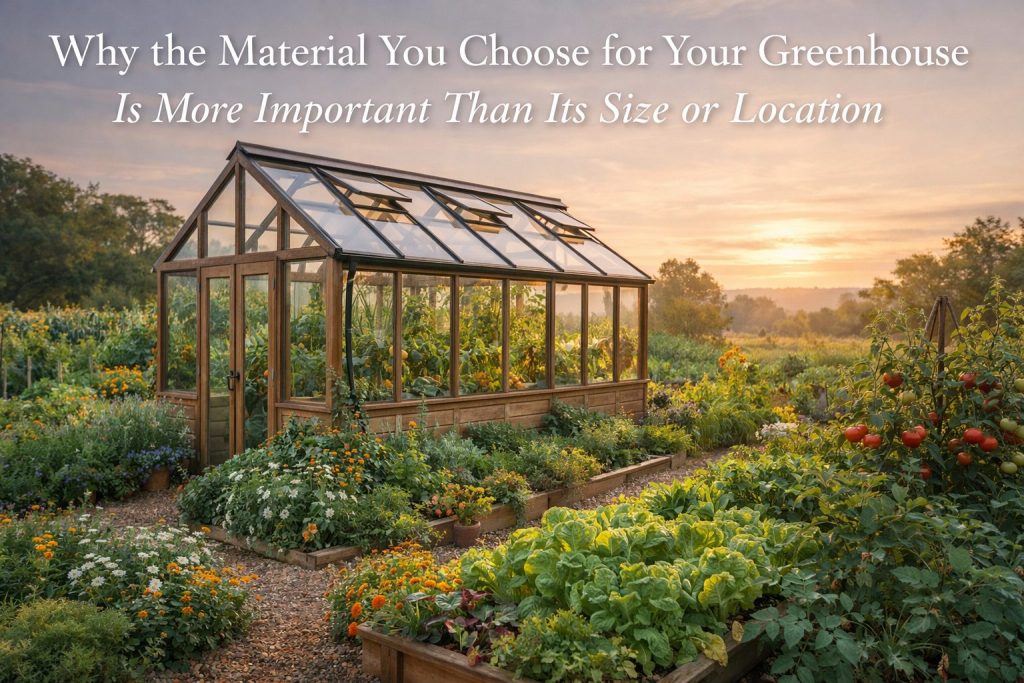
Despite its allure, glass is a more challenging option than it appears. Its light transmission is truly remarkable, exceeding that of any rival material by over 90%, but that doesn’t tell the whole story. The direct, intense sunlight that passes through glass causes hot spots, and plants placed close to the glass on a sunny afternoon may suffer significant damage if shade cloth is not used, increasing the cost and complexity of the project. Polycarbonate and some specialty plastic films scatter light instead of directly transmitting it; most crops benefit from this diffusion. It produces more uniform growth, reaches the lower leaves, and reduces the risk of burns. Until you give it some thought, it seems counterintuitive.
Polyethylene film has its own category. When it’s UV-stabilized and at least 6 mil thick, it’s affordable, lightweight, easy to install, and effective-for seasonal or budget-conscious growers. Thinner, untreated plastic starts decomposing surprisingly quickly when exposed to sunlight. Additionally, yellowing or clouding plastic directly reduces crop yields by obstructing light transmission, sometimes even before the deterioration is evident. Polyethylene has an honest lifespan of four to six years. Budget shoppers often overlook this cost when weighing their options up front when weighing their options.
Framing material is often undervalued, which is difficult to ignore. The frames of aluminum retain their shape over decades of temperature fluctuations, do not rust, and do not need to be maintained annually. Wood that has not been treated rots, but it feels more traditional and appears warmer. The maintenance burden builds silently until the structure itself becomes unreliable as a result of small repairs here and warped sections there. It is not possible to fix a failing frame based on its location or size.
Many buyers choose a material based on price or appearance, but the climate in which the greenhouse is located should be the most important consideration. In the frigid Midwest and Northeast, twin-wall polycarbonate or dual-layer polyethylene is not a luxury, but rather a practical option to retain heat without incurring excessive energy costs. If you live in a humid environment like Arizona or the deep south, white polyethylene or covers with anti-drip coatings are effective for controlling temperatures and lowering fungal pressure. These are not aesthetic preferences. Depending on the region, a thermometer can quickly confirm these functional requirements.
A big greenhouse loses heat even with inadequate covering. A perfectly oriented south-facing site will still fail if the glazing breaks in the first hailstorm or deteriorates by the third year. Other than geography and square footage, the material is what makes a greenhouse functional. Every other greenhouse decision depends on carefully selecting it and matching it to the climate and use.