

Late February brings a certain vibe to commercial greenhouses: the smell of wet soil and peat, the gentle drip of irrigation lines, and the low hum of fans. There is a sense of purpose, control, and almost tranquility to everything. Then March arrives, and something changes. Work doubles. There is an increase in erratic weather. Over those rows of seedlings and cuttings, the first grey fuzz of Botrytis spreads quietly across a stem that no one had time to examine.
Most people would agree that winter is the most hazardous time of year for greenhouse plants. It seems obvious that there is low light, short days, and frost. Winter can be predicted with heaters, thermal screens, and weather forecasts. Spring is the season that truly kills things, and it does so in ways that are difficult to predict, manage, and sometimes impossible to undo once you’ve missed the early warning signs.

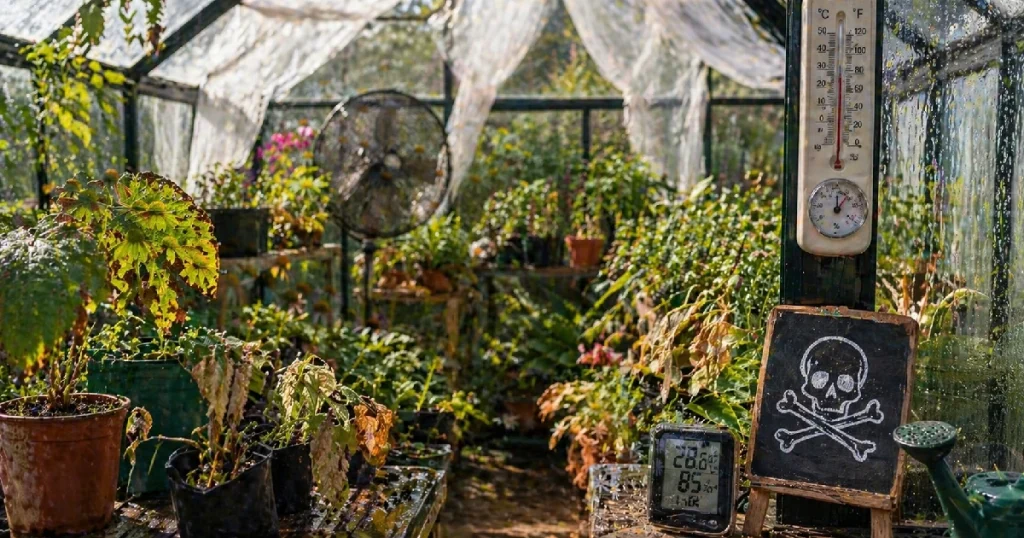
The main problem is the temperature. During the winter, a greenhouse settles into a routine of cold, controlled temperatures, and regular routines. Spring destroys that stability almost instantly. In a sealed glass or polycarbonate building, temperatures at plant level can rise well above what a wall-mounted thermometer indicates. Night falls, the sun sets, and the temperature drops back below freezing. The plants, which have already started to soften, sprout new growth, and lose their months-long cold-hardening, are suddenly faced with circumstances that they cannot handle. When you walk in and discover a flat of young annuals that have collapsed overnight, blackened at the base, growers refer to this as the “false spring” problem.
This is prior to the onset of illness. Spring is especially favorable for Botrytis cinerea, a grey mold that grows on leaves, stems, and flowers as a soft, ash-colored fuzz. The plant grows best in spring greenhouses that are heated during the day, sealed against chilly nights, and have irrigation running. In spring, botrytis may be the pathogen that costs commercial growers the most money each season. For propagation houses with many seedlings, damping-off — the sudden, soil-level collapse of young plants caused by fungal pathogens in damp conditions — can destroy an entire tray before anyone notices a problem.
The pest problem makes all of this worse. In the winter, aphids, thrips, whiteflies, and spider mites overwinter in the building, in the soil, and in plant debris that has been left in corners. As springtime temperatures rise, these numbers skyrocket. Usually before natural predators have accumulated in significant numbers, they procreate quickly and feed on new soft growth produced by plants in response to longer days. When a grower discovers a few aphids on Monday, the colony may have moved to the next bench by Thursday. It happens so fast.
Seasonal vulnerability is perceived to be greatly exacerbated by the commercial calendar. In North America, the weeks leading up to Mother’s Day are practically a controlled crisis for ornamental greenhouse operations. Plantpeddler’s owner, Mike Gooder, says about half of his wholesale earnings are generated during those two weeks. All labor, attention, and resources are focused on production volume, or getting the product out the door. Phones ringing and orders need to be filled, so tasks like checking for pests, monitoring humidity levels, and examining the undersides of leaves become less important. There is no negligence involved. It’s the math of the season.
| Category | Winter Greenhouse Conditions | Spring Greenhouse Conditions |
|---|---|---|
| Overall Risk Level | Predictable, manageable risks | Highest risk, unpredictable and fast-moving |
| Environmental Stability | Stable, controlled temperatures | Rapid fluctuations (warm days, freezing nights) |
| Temperature Behavior | Consistently cold, managed with heating | Extreme swings causing plant stress (“false spring”) |
| Plant Condition | Dormant, hardened, slow growth | Soft new growth, highly vulnerable |
| Primary Threats | Frost, low light | Temperature shock, disease, pests |
| Disease Pressure | Lower, slower development | High – ideal for fungal diseases like Botrytis and damping-off |
| Key Disease Examples | Limited spread due to cold | Botrytis (grey mold), damping-off in seedlings |
| Pest Activity | Dormant or minimal | Rapid population explosions (aphids, thrips, mites, whiteflies) |
| Monitoring Needs | Routine checks sufficient | Constant vigilance required |
| Workload | Steady, predictable | Intense, fast-paced, often overwhelming |
| Operational Focus | Climate control and maintenance | Multi-tasking: ventilation, watering, pest & disease control |
| Commercial Pressure | Moderate | Peak demand (e.g., pre–Mother’s Day rush) |
| Common Failures | Heating issues | Missed early warning signs, rapid spread of problems |
| Watering Strategy | Flexible timing | Must water in mornings to reduce fungal risk |
| Ventilation Needs | Lower priority | Critical (vents, fans to reduce humidity) |
| Sanitation Importance | Important but manageable | Essential and continuous to prevent outbreaks |
| Light Management | Limited light is the issue | Excess heat/light requires shade control |
| Grower Challenge | Managing cold | Managing complexity and timing under pressure |
| Why It’s Dangerous | Conditions are known and controllable | Multiple threats overlap with little margin for error |
Managing spring effectively requires doing multiple tasks simultaneously with little room for error. A combination of roof vents, side vents, and running fans is needed to break up humid air pockets before pathogens can settle. The foliage will dry before nighttime temperatures drop by watering in the morning instead of the afternoon. This prevents one of the primary routes for fungal spread. Shade netting is also necessary to prevent midday heat spikes that stress plants and impair their natural defenses. Additionally, sanitation (removing standing water, dead plant matter, and debris that provide a haven for disease or pests) must be conducted continuously rather than sporadically.
As climate variability prolongs the unpredictable window of spring, timing the switch from winter to spring protocols and from heating to ventilation becomes more difficult. Growers who have been doing this for decades generally agree that spring demands a level of attention to detail that no other season can match. The winter season can be challenging. Spring, however, is the time of year that keeps you awake.
Alyssa Bennet is a Senior Editor at Mini Greenhouse Kits and a passionate advocate for urban gardening and small-space growing. Currently pursuing her major in Arts at the University of California, Alyssa brings a distinctly creative eye to the world of city gardening – blending artistic sensibility with a genuine love for green living. She writes regularly at minigreenhousekits.com, and when she’s not crafting her next gardening piece, you’ll find her with a paintbrush in hand, watching sports, or exploring the city with friends.