
It’s hard to describe what happens when you walk into Portland Japanese Garden on a gloomy October morning. The path bends before you can see its destination. Grass grows slowly into the hillside, covering stones that appear to have been in that exact arrangement for a century. The sound of water is audible somewhere, but it is subtle. Slowing down without really deciding to do so. The entire area seems unplanned, contrary to common sense. Of course, that’s the point. To accomplish this, it took a professor from Tokyo Agricultural University, six decades of Japanese curators, and a great deal of discipline.
Over the past century, Western horticulture has subtly borrowed from Japanese gardening customs without fully understanding why or how. Modern landscape architecture is characterized by asymmetrical stone configurations. Moss lawns are replacing grass in shade gardens throughout the Pacific Northwest. Often attributed to Scandinavian influence, minimalism’s “less is more” style has a longer eastern heritage. Western design culture appears to be circulating fragmented, sometimes jumbled concepts that are familiar enough to be copied yet misinterpreted enough to be poorly executed.
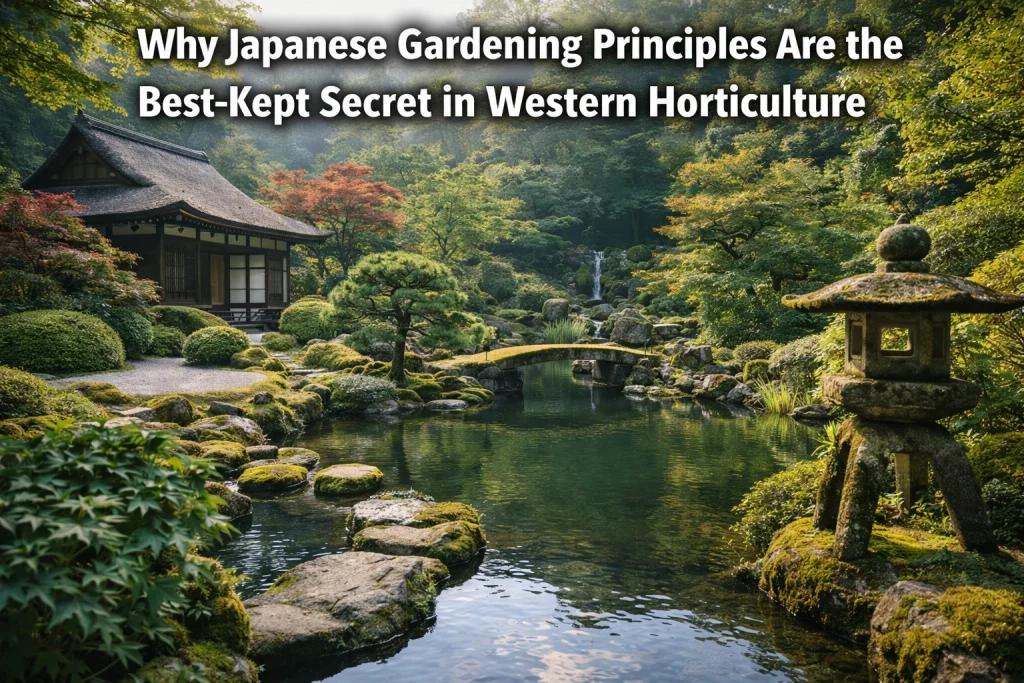
It’s easier to summarize design elements than what makes a Japanese garden unique. According to Sadafumi Uchiyama, Curator Emeritus at Portland Japanese Garden, Chinese and Japanese gardens may have the same ingredients, but their seasonings differ. The same reasoning applies when comparing European and Japanese customs. The English garden is known for its love of color and abundance, with perennials packed into borders, seasonal bedding changed three times a year, and a sense of controlled exuberance. Color is used sparingly, deliberately, and almost grudgingly in Japanese gardens. Rather than competing for attention, one camellia attracts it. Seeing the contrast is instructive. One tradition is performing; the other is self-control.
One of the most exportable concepts that Western garden designers haven’t fully embraced is miegakure, or “hide and reveal.” The idea is simple: a garden shouldn’t be understood solely from one perspective. Each turn should reveal a new viewpoint that had been hidden by the one before. By looping and doubling back, Portland Japanese Garden’s historic walking paths repeatedly reframe the same trees, stones, and water from various perspectives. From a terrace, this approach differs from, say, the view across a formal French parterre, where the entire composition is immediately readable. The first encourages reflection, while the second encourages awe. In favor of the admirable, Western designers may have neglected to fully explore the contemplative.
Asymmetry is another principle that does not translate well into the crossing. Plant numbers in traditional Japanese gardens are kept odd since nature does not produce even numbers or mirror symmetry, such as three mounded clipped evergreens rather than four, five stones instead of two balanced pairs. It appears organic rather than planned, spontaneous rather than manufactured. Neither carelessness nor a lack of control are involved; this requires more thoughtful judgment than symmetry. Anyone can balance a design across an axis. To determine where an asymmetric placement achieves equilibrium without balance is a different and more difficult skill; Uchiyama suggests that it takes almost a lifetime to master.
The therapeutic value of Japanese gardens has garnered the most attention in the West recently. It is due to the wellness industry’s discovery of this aspect, as well as scientific validation of what gardeners and monks have long known. Nature has physiologically quantifiable restorative effects. As the curators of Portland Japanese Garden constantly stress, the garden’s restorative purpose is not coincidental. Its uniqueness sets it apart from other natural areas. A visitor’s inner state is supported by the design, the enclosure, the sound of the water, and the feeling of being surrounded rather than exposed. The Adachi Museum Gardens in Japan are living museum pieces, preserved with the same care as artworks.
You can’t ignore the fact that a beautifully designed Japanese garden demands the attention of its visitors as you stroll through it. With no knowledge of botanical names, design history, or cultural context, just the willingness to move slowly and pay attention. In a society that values speed and surfaces, that is a subtly radical invitation. The West is still figuring out how to expand horticulture.