

As you stroll through any productive kitchen garden in late spring, you begin to notice patterns. Most gardeners who spend the most money don’t own the beds that produce with almost unfair generosity, such as deeper leaf colors, heavier fruit, and root vegetables that practically crawl out of the ground. They usually belong to the group of people who have realized that feeding the plant is only half the battle. Half of the process occurs in the six inches of soil beneath it.
For a very long time, compost was all we had. No one who knows what they’re doing ignores compost as the cornerstone, the indisputable starting point. A growing number of gardeners, particularly those who are drawn to no-till and regenerative techniques, have subtly changed their practices. It’s more traditional and less trendy, but the science behind it is far from straightforward. In 2026, humic acid might be the most underappreciated soil amendment available to home gardeners.

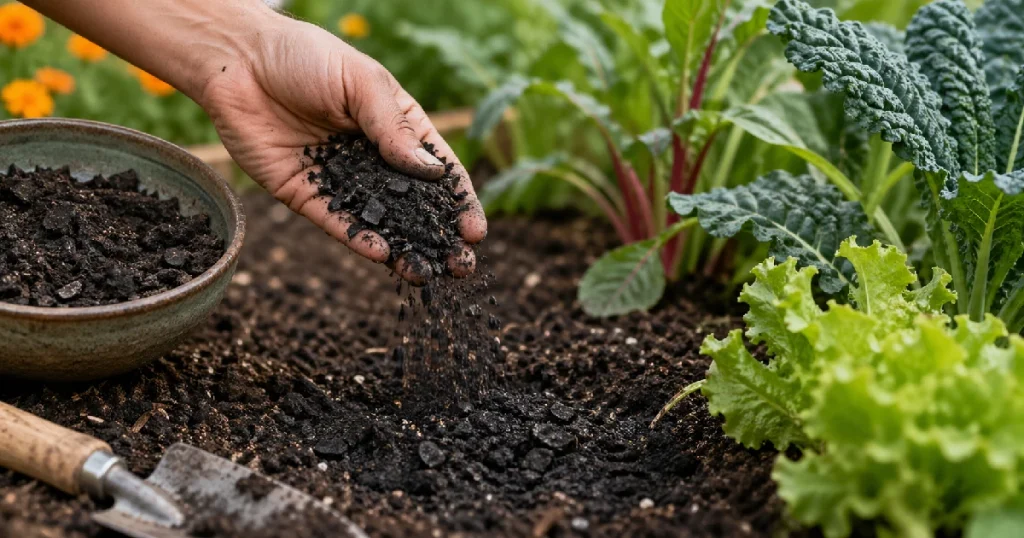
Humic acid is not a fertilizer. It is important to make this distinction. By providing plants with direct access to nutrients, fertilizers cause a quick, transient reaction that may result in soil dependence rather than self-sufficiency over time. The function of humic acid is different. The biostimulant works simultaneously on the soil’s chemistry and biology. You can use it as potassium humate or extract it from leonardite deposits. It does not bring nutrients. Plants can now access the ones already in the ground that were previously inaccessible.
Especially those with a long history of conventional gardening, many soils are paradoxically both nutrient-rich and nutrient-poor. Iron and phosphorus are frequently bound to soil particles in a way that prevents plants from absorbing them. Humic acid chelates micronutrients by forming a chemical bond with them and escorting them into a bioavailable state. It is likely that this mechanism explains more unexplained plant underperformance than most gardeners realize.
The effects of humic acid on the microbial world below the surface are even more significant. For healthy soil, billions of bacteria and fungi decompose organic matter, cycle nutrients, and support the entire food web. Degraded or over-tilled soils benefit from humic acid, which serves as a concentrated source of food for bacteria. A previously thin, compacted bed comes to life over the course of one season after regular applications, even though you can’t see it directly.
It is evident, however, that structural improvements have been made. A crumbly, chocolate-cake texture is created when humic acid binds soil particles into stable aggregates, which seasoned gardeners instantly recognize as ideal growing conditions. The structure enhances moisture retention and aeration, allowing roots to breathe instead of being suffocated by compacted soil. The behavior of a treated bed is distinctly different during the increasingly harsh summer dry spells that are now typical of most growing regions. By holding water longer and releasing it more gradually, it reduces the frequency of watering at the exact moment when demand would spike.
Moisture is not the only factor affecting stress resistance. Studies have repeatedly demonstrated that plants in humic acid-treated soils are more tolerant to salinity and heavy metal toxicity, which are common in urban plots, reclaimed land, and areas with aging infrastructure. As conditions become less predictable, such as hotter summers, longer dry spells, and irregular rainfall, serious growers are beginning to realize that amendments that create true resilience are more important than those that simply increase short-term yields.
The yield figures cannot be ignored. Studies measuring humic acid applications at planting have shown increases ranging from 20 to over 50 percent in root-developing vegetables. In reality, the relative contributions of nutrient chelation, microbial boost, and structural changes remain unclear. In spite of this, the outcomes in gardens from California to Connecticut continue to be remarkably consistent.
| HUMIC ACID — ESSENTIAL INFORMATION | |
| Amendment Type | Bio-stimulant / Organic Soil Conditioner |
| Common Forms | Potassium Humate, Leonardite, Liquid & Granular Humic Acid |
| Primary Action | Chelates locked nutrients; feeds beneficial soil microbes |
| Yield Increase | 20% to 50%+ documented in root vegetable studies |
| Ideal Soils | Sandy, heavy clay, compacted, no-till & regenerative beds |
| Pairs Well With | Compost, worm castings, biochar, alfalfa pellets |
| Application Forms | Liquid (fast-acting) or Granular (long-term conditioning) |
| Added Benefits | Drought tolerance, salinity resistance, heavy metal buffering |
| Reference & Source | https://www.humicacid.org |
When speed is crucial, most gardeners who work with humic acid choose the liquid form since it integrates quickly and the microbial response begins within weeks. In sandy soils that quickly lose amendments or heavy clay, granular formulations perform better for long-term conditioning. These fertilizers are less expensive than the branded fertilizers that fill garden center shelves every spring. The most subtle appeal of humic acid may be its lower price and more powerful effects, according to the majority of people who use it regularly.
The dissemination of gardening knowledge is undergoing a more general trend. Changes and strategies brought about by advertising rarely have the greatest long-term impact. Seed catalogs are passed over back fences, through neighborhood forums, and in the margins of seed catalogs. Humic acid has been documented in scientific literature for decades, gathering agricultural data that, for some reason, never reached the shelf tags of neighborhood garden centers. Gardeners who treated soil as a living system, rather than an inert growing medium, were needed to bring soil into the mainstream conversation. The discussion is now well underway. In addition, the beds on the other side of the fence are making a pretty compelling case to gardeners who are still outside.
Olivia Murphy is a Senior Editor at Mini Greenhouse Kits and a fervent supporter of small-space and urban gardening. Alyssa, who is currently majoring in both literature and biology at Michigan State University, infuses her writing about city gardening and small-space growing with a unique blend of scientific curiosity and storytelling instinct. Her love of literature influences how she tells the stories behind the plants, and her background in biology gives her content a grounded, research-informed edge. When she’s not working on her next gardening piece, you can find her curled up with a good magazine or watching a movie that she’s been meaning to watch for weeks. She writes with passion at minigreenhousekits.com.