

Seed packets are one of the most informative items in any garden. Front and back are carried planting depth, spacing, germination time, days to maturity, light requirements, frost tolerance, and occasionally a small map of the nation color-coded by growing zone. Most gardeners only pay attention to one or two of these details. Therefore, the experiment was straightforward: if you followed every instruction exactly and without deviation from the moment you opened the packet until the day you harvested, what would happen?
To be honest, I find the response to be genuinely instructive throughout, humble in some aspects, and better than I expected in others. A seed packet’s back contains more thoughtful horticultural advice than most people realize, written by people who have grown the variety under controlled conditions and are aware of its requirements. Most of us view it as a general recommendation rather than a technical specification, and then wonder why the results are inconsistent.
Most gardeners consider planting depth. The guidelines are in place for a reason: seeds planted too deeply deplete their energy reserves before breaking the surface, resulting in either no germination or weak seedlings. Measurements on the packet are determined by the size of the seed in relation to its energy content, which is usually a fraction of an inch or a few millimeters. The seeds are close to the surface. Larger ones can handle more soil above them. Compared to the looser method most gardeners use, following this precisely and gently tamping to ensure contact without compaction resulted in noticeably more even germination.

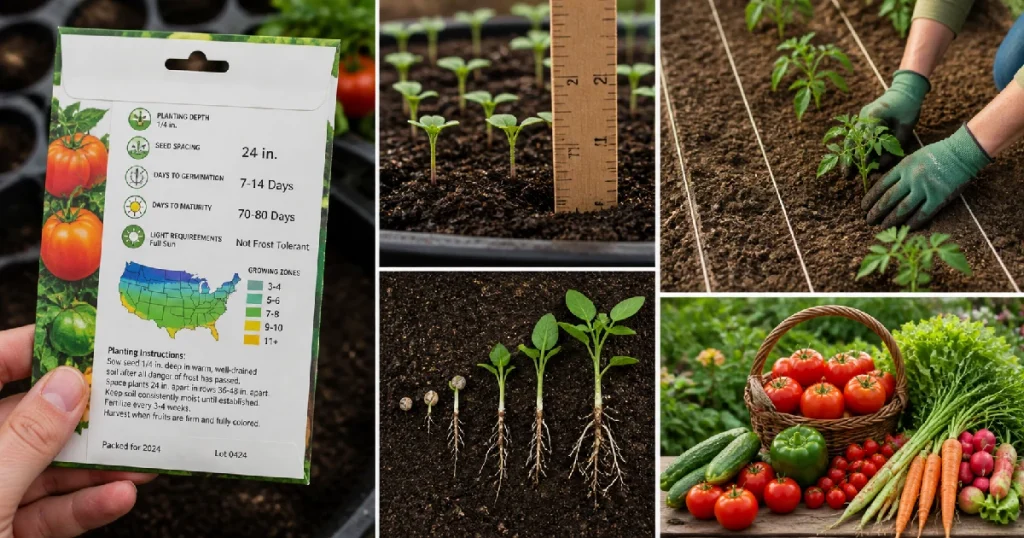
You can see what the packet actually says if you look closely.
Days to maturity are the most intriguing and misunderstood figure. Counting starts when the first true leaves appear when seeds are sown directly into the ground. Unlike the rounder cotyledon leaves that emerge first and resemble miniature versions of the plant’s adult foliage, these leaves emerge second. When seedlings are started indoors and then moved outdoors, the count begins on the day they are planted. It is very important to make this distinction. In the event of a misinterpretation, a harvest schedule may be thrown off by weeks, resulting in warm-season plants being frozen early or cool-season crops running into summer heat.
Germination time is dependent on ideal conditions, such as soil temperature and moisture level. As a result, the instructions begin to interact with local reality in ways that the packet cannot fully explain. In soil between 21 and 27 degrees Celsius, tomato seeds germinate the fastest; at lower temperatures, the process slows significantly but still occurs. In ideal greenhouse conditions, a packet might state seven to fourteen days. It could take three weeks for the same seeds to germinate in a spare bedroom that is a little chilly in March. Directions are correct. Quite simply, the circumstances are different. By following the soil temperature recommendations, starting seeds before the last frost date and using a heat mat when necessary, this gap can be significantly reduced.
As soon as the instructions reach their limits
Following seed packet instructions and knowing your own garden are incompatible. The spacing recommendations-based on the plant’s anticipated mature size-appear ostentatious when you view a tray of tiny seedlings that require no space at all. Planting closer feels more efficient. It rarely happens. In humid environments, crowded plants compete for light, water, and nutrients, reducing yield and causing disease outbreaks. It yields better results to give each plant the space specified in the packet and to trust that the seemingly empty space between them will eventually be filled consistently than to give in to the temptation to add one more.
It is the details of soil, microclimate, and local conditions that are lacking in the instructions. “When all danger of frost has passed” implies that you know when your most recent frost occurred, which varies depending on the year and location. South-facing slopes warm earlier, frost pockets at the bottom of gardens stay colder longer, and urban gardens behave differently from rural ones. Despite the growing zone map on the back, gardens within the same zone can vary considerably. It is a good idea to follow the packet to the letter as a starting point. Expert gardeners spend years learning about the specific patch of ground they are working on and building on it.
A tiny envelope’s back can’t be ignored without some consideration. We often overlook the advice to check the “packed for” date to make sure the seeds are from the current season and haven’t spent years in a warehouse losing viability. Before planting, knowing that old seeds germinate poorly or not at all saves a lot of time. The packet contains everything you need to get started. Reading it is quite different from whether you have read it.
As a Senior Editor at Mini Greenhouse Kits, Hannah Kinsley is a passionate supporter of small-space gardening and urban gardening. Hannah, who is currently majoring in Environmental Policy through the University of Michigan’s Environmental Studies program, infuses her writing with a solid academic foundation and a sincere enthusiasm for the environment. You can find her playing soccer or exploring the city’s green areas with friends when she’s not researching the newest trends in city gardening or creating content for minigreenhousekits.com.