

On a Tuesday morning, she showed up with a clipboard, muddy boots that she had clearly worn before, and a neutral expression. Prior to her visit, I spent the weekend cleaning up, including hosing off the patio stones, trimming back the overgrown rosemary, and pulling weeds near the fence. The garden looked quite presentable to me. Someone lived and cared for it, if not obsessively. After about four minutes of entering the gate, the expert garden designer I had hired tilted her head towards the corner of my Japanese maple, which had been slowly losing ground against the fence, and said, “That’s been struggling for a while, hasn’t it?” Actually, it wasn’t a question at all.
Next came one of the more subdued moments of humility in my adult life. That’s for sure, she wasn’t cruel. It wasn’t exactly a disaster in the garden. She was able to see things that I had just stopped seeing. When you spend enough time in a place, you lose sight of what’s really there. In your mind, you see the garden as you recall it or as you envision it. For a trained eye, that is not a problem. When it rained, water would pool imperceptibly beneath the surface of the property’s slight slope toward the back, slowly suffocating the roots of a plant I had been blaming myself for killing. Almost no one voluntarily walks the path from the back door to the seating area since it requires two awkward turns around an elevated bed. It was located directly in front of the kitchen window, which I gaze at every morning while the kettle boils, that she found the most cluttered and visually disorganized part of the yard.

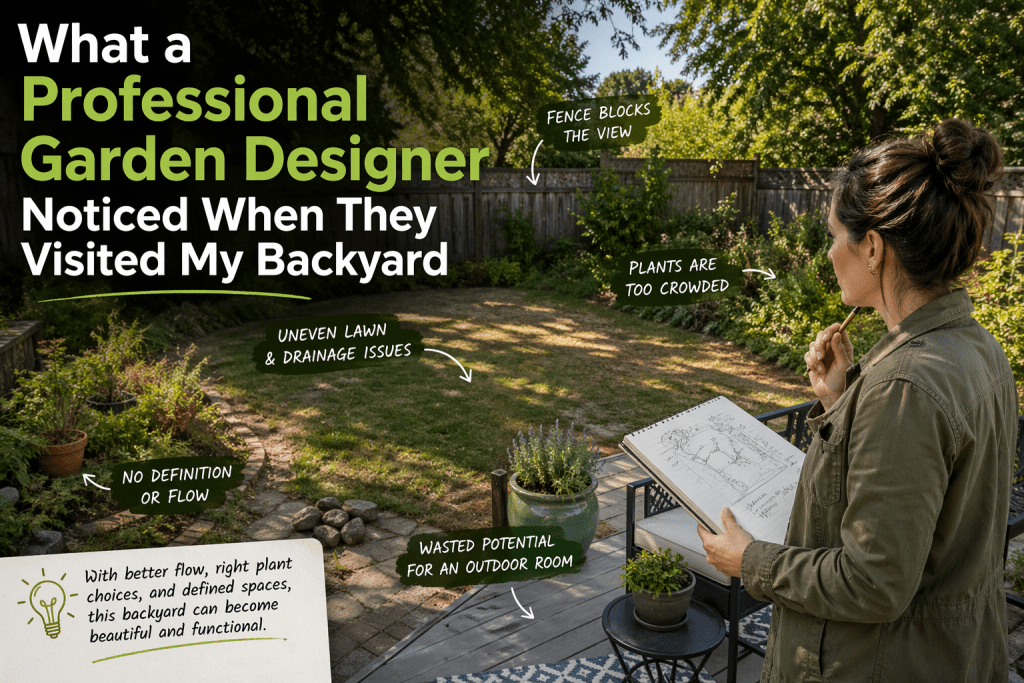
Plants are usually the first thing people expect a garden designer to discuss. The ones that are attractive, the ones that are incorrect, and the ones that are dying for unknown reasons. That wasn’t where she started. Grading, drainage, and the actual location of the sun’s rays at various times during the day were the first things she tackled. She had been in the garden for perhaps twenty minutes before mentioning a particular plant. She pointed to a hydrangea that I had always been somewhat proud of and said, “That hydrangea is in the wrong spot.” If it survives ten years, half the path will have been consumed. Four years ago, I planted it. It was a mystery to me. If you planted something small and watched it grow slowly, season by season, it’s almost impossible to see things correctly due to scale.
There was a lot of discussion about flow. Not in an abstract, magazine-style sense of interior design. Where do your feet instinctively want to go when you leave the back door? If the answer does not point to your dining table, seating area, or other desired location, the layout is against you. My garden was not overtly inviting. Among the items planted and seated within were a table, a few chairs, and an elevated bed, but there was no narrative, according to her. There was no way you could have known one area of the garden would lead you in a different direction. While resting a little on the fence, she commented, “People think of gardens as collections of things.”. “They should think of gardens as sequences.”.
From inside the house, she gazed at the view for a considerable time. I was most surprised by this aspect of the visit. She stared out the kitchen window for a minute and a half. After that, she walked to the living room’s door. From her bedroom, she peered upstairs. “You live with the garden even when you aren’t there,” she said. It’s usually a window-framed background presence visible through glass. Day-to-day quality of life may be more affected by the interior view than by the actual sitting experience. It never occurred to me to think about it that way. My garden had been built-or rather, accumulated-without any consideration for how it would appear from within. There was a void where a focal point should have been. There was visual noise where depth should have been.
She noticed the “separate yard syndrome.” Warm colors, vintage materials, and a certain vibe define my home’s style and color scheme. From the outside, the garden appeared to be part of a completely different building. Materials of different types. Colors of varying hues. There is no connection between the exterior and interior. Without being harsh, she stated this clearly. It had been years since the garden and house coexisted without actually coming into contact. In her experience, this is one of the most frequent things she observes and likely the easiest to ignore due to the fact that most people design rooms from the inside out, treating the garden as a separate project years later.
Some of the plants in my garden were truly beautiful. For many years, I had a hardy fuchsia. Late-summer drift of decorative grass. These were handled with caution by her. She didn’t tell me to rip them out. However, she failed to inform me that they were in the right place. Delivering this portion of a consultation must be the most challenging, she replied. “A plant you love in the wrong position is still a plant in the wrong position.” It’s like telling someone that something they’ve cared for has been lost. Her honesty was tempered by caution. She suggested that we move instead of removing. As a whole, she discussed what each plant was doing for the garden.
| Field | Landscape & Garden Design |
| Core Expertise | Site evaluation, plant placement, hardscaping, spatial flow |
| Industry Body | Association of Professional Landscape Designers (APLD) |
| Typical Services | Design-only consultations, full project supervision, garden coaching |
| Average Project Cost | $1,500 – $15,000+ depending on scope and region |
| Reference Website | https://www.apld.org |
| Notable Principle | Right plant, right place — function before aesthetics |
| Common Client Problem | Disconnected yard spaces with poor flow and mismatched plantings |
By the time she departed, a few hours after she arrived, I had a longer and more structured list of observations than I had anticipated. Flow of water. Get moving. Ratio. A personal opinion. A sense of coherence between the outside and the inside. Whether I picked lovely flowers had nothing to do with it. The issue was whether the garden served as an extension of the life happening in the house or if it merely sat there in the back, misinterpreted and underutilized. The average garden in most neighborhoods might fall somewhere in the middle of that range. In any neighborhood, it’s hard not to wonder how many backyards are subtly failing their owners without either party being aware.
I didn’t receive a completed plan from her. An alternative viewpoint was presented. Checking the view from the kitchen window before planting anything is something you can’t unlearn. You notice that people are able to avoid obstacles because of your path every time you go outside. The garden looked exactly the same as it had on Monday when I awoke on Wednesday morning. I couldn’t see it that way, however. Instead of making repairs, a professional may be able to change your perspective on the area. Next, I was responsible for the work. For the first time, I recognized what I was seeing.
As a Senior Editor at Mini Greenhouse Kits, Hannah Kinsley is a passionate supporter of small-space gardening and urban gardening. Hannah, who is currently majoring in Environmental Policy through the University of Michigan’s Environmental Studies program, infuses her writing with a solid academic foundation and a sincere enthusiasm for the environment. You can find her playing soccer or exploring the city’s green areas with friends when she’s not researching the newest trends in city gardening or creating content for minigreenhousekits.com.