

At the beginning of the experiment, there were 108 lettuces. Hayley Jones, an entomologist with the Royal Horticultural Society, planted them in raised beds and patio pots for six weeks and observed the results. Around the bases of some lettuces, she applied crushed eggshells, pine bark, copper tape, sharp horticultural grit, and wool pellets, the five most popular home remedies for slugs. Others were left completely unguarded by her. After harvesting the plants after six weeks and removing each leaf individually, she measured the damage to the square centimeter.
Most gardeners were disappointed with the results. In terms of damage, lettuces surrounded by barriers and those left to fend for themselves did not differ significantly. Eggshells had failed. Both lacked grit. According to some gardeners, wool pellets provide no discernible protection in controlled environments. Even though it told gardeners their remedies weren’t working, Jones carefully pointed out that it was at least helpful evidence.

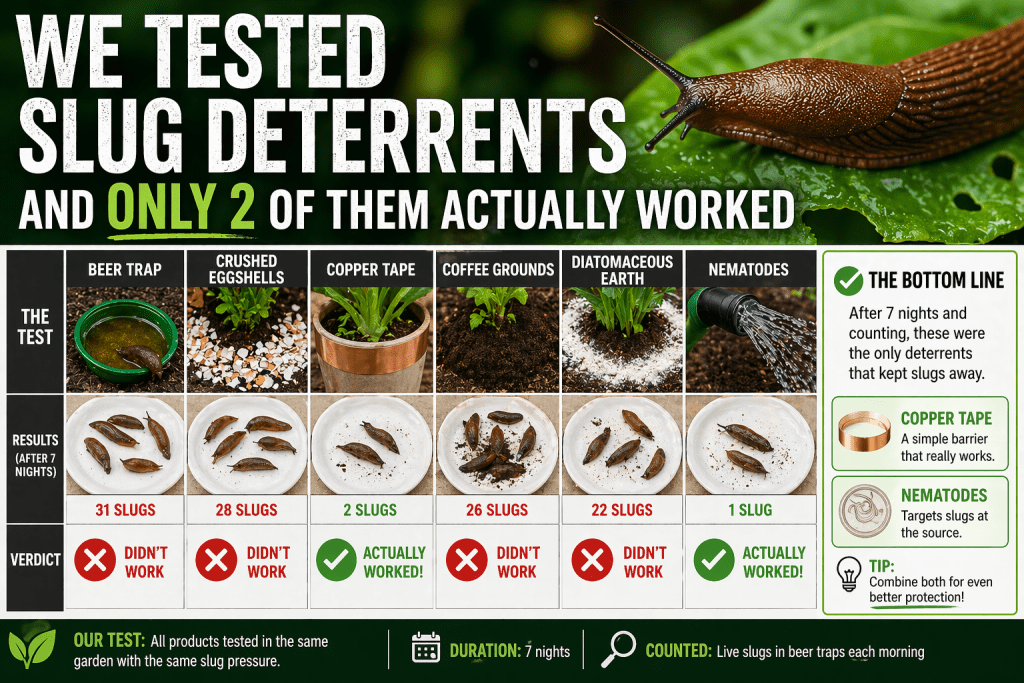
Several smaller tests have been concluding for years that the slug problem is more complex than folk remedies suggest, and the complication is mostly anatomical. Mucus protects slugs from irritating or uncomfortable surfaces. When covered in slime, a soft-bodied creature can easily overcome obstacles such as coarse bark, crushed shells, and sharp grit. A bare hand would feel the sharpness, but a slug does not. The object simply moves on. In understanding this mechanism, which accounts for the majority of deterrent failures, the belief in eggshells becomes less folklore and more like a persistent misperception of what slugs are actually like.
There is a particular and annoying aspect to diatomaceous earth. Due to its tiny sharp edges, the fine powder is effective in truly dry conditions, dehydrating the slug. Most garden settings do not remain dry, which is the problem. After just one watering, one night of rain, and one thick layer of dew, DE clumps, loses its abrasive quality, and offers no more protection than regular dust. It is in climates where slugs are most active that wet conditions and slug pressure tend to coexist, so the one situation where DE works is also the one that renders it useless. As a result, it may have been one of the more expensive non-solutions on the market for organic pest control.
The two approaches that consistently stand up to scrutiny operate on completely different principles. Copper tape, when placed in an unbroken ring around a pot or raised bed, causes a slight electrostatic reaction when it comes into contact with slug mucus. As a result, slugs are more likely to turn around than to continue over this reaction. Vertical application is crucial. Copper bands seem to have the greatest deterrent effect when placed around pots, forcing slugs to climb up against the barrier instead of approaching horizontally. Slugs can easily move around copper if a stem or branch extends from the protected area to the soil outside. The critical failure mode is this. In order for the barrier to function, it must be complete.
There is nothing sophisticated about beer traps, but they are consistently deadly. The shallow container (a jar lid works well) filled with beer, buried level with the soil, creates an irresistible lure for slugs. As they get close, they drown and fall into the water. A trap manages a population rather than offers a total defense around a single plant, and it must be emptied and refilled regularly. The number of slugs clearly decreases over time, however. An eggshell-covered trap full of slugs on a rainy morning is almost grimly satisfying because it shows that the issue is being addressed.
Quick Reference: Slug Deterrents — What Works and What Doesn’t
| Method | Verdict | Notes |
| Copper Tape / Barriers | ✅ Works — with conditions | Must form a complete, unbroken ring; most effective on pots (vertical surface); leaves must not bridge over it |
| Beer Traps | ✅ Works — population management | Shallow containers at ground level; reduces overall population rather than defending one plant; requires regular emptying |
| Parasitic Nematodes (Phasmarhabditis hermaphrodita) | ✅ Highly effective | Biological control applied to moist soil; kills soil-dwelling juveniles; requires soil temp above 5°C (40°F) |
| Hand-Picking (Night/Dawn) | ✅ Effective | Most direct method; best done after rain or at night with a torch |
| Crushed Eggshells | ❌ Does not work | Slugs produce thick mucus that insulates them from sharp surfaces |
| Coffee Grounds | ❌ Does not work | Failed in controlled trials |
| Diatomaceous Earth (DE) | ❌ Unreliable | Works when completely dry; loses all efficacy after rain or watering |
| Sharp Horticultural Grit | ❌ Does not work | Same mucus insulation problem as eggshells |
| Wool Pellets | ❌ Inconsistent | Some anecdotal support; no significant protection in formal trials |
| Pine Bark Mulch | ❌ Does not work | Tested by RHS; no measurable difference in plant damage |
| Slug Pellets (including organic) | ⚠️ Not recommended | Shown to have negative effects on wildlife; RHS advises against |
| RHS Study Design | 108 lettuces, 9 patio pots + 9 raised beds, monitored 6 weeks | Led by entomologist Hayley Jones |
| Reference | RHS – How to Stop Slugs and Snails: What Works? |
If gardeners are willing to go further, parasitic nematodes, which are microscopic organisms sold as soil drenches under names such as Nemaslug, will kill slugs at the underground stage, where the majority already resides. Because juvenile slugs rarely appear in large numbers, surface barriers often fail to prevent slug damage. By following slugs into their soil habitat, nematodes reach areas that barriers cannot. Because they require moist soil and temperatures above five degrees Celsius, they have a limited seasonal window, but within that window, they consistently produce results that eggshells have never achieved.
Those who have been spreading coffee grounds around their hostas for ten years with a sincere belief in the technique are hard not to sympathize with. In the context of slug control, the information ecosystem is ancient, spreads from neighbor to neighbor, and generally resistant to data that contradicts it. RHS results, however, consistently point in the same direction. Two effective methods exist. The others are time-consuming and expensive rituals that yield nothing but satisfaction.
As a Senior Editor at Mini Greenhouse Kits, Hannah Kinsley is a passionate supporter of small-space gardening and urban gardening. Hannah, who is currently majoring in Environmental Policy through the University of Michigan’s Environmental Studies program, infuses her writing with a solid academic foundation and a sincere enthusiasm for the environment. You can find her playing soccer or exploring the city’s green areas with friends when she’s not researching the newest trends in city gardening or creating content for minigreenhousekits.com.