
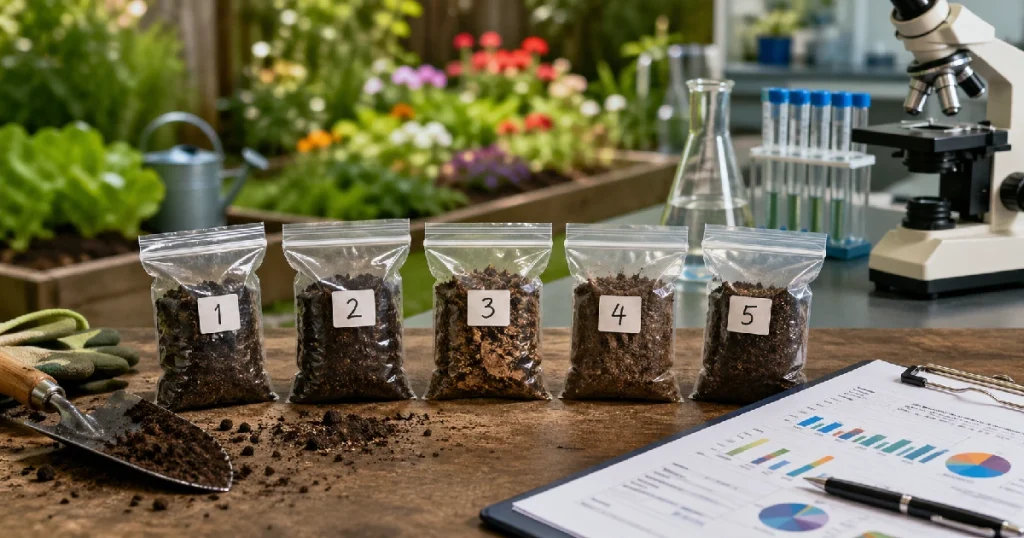
Each sample was labeled with a number and a brief description of the garden from which it came. These included a kitchen garden that would not produce well no matter what was planted in it, a raised vegetable bed in a suburban backyard, and a front border that had been composted for three years. From the outside, they all looked the same. It was dark, a bit wet, and had a subtle earthy scent. Unaided eyes could not distinguish the differences.
Most home gardeners never test their soil. It’s not exactly laziness; rather, it’s that there isn’t a clear connection between what is underground and what is visible above. Plants that appear unhealthy are either replaced or given more water or fertilizer. Rarely is the soil itself examined. A garden’s soil chemistry controls practically everything, including nutrient availability, pH-locked nutrients, and contaminants no one thought to look for. Getting a blood test after years of treating symptoms without a diagnosis is similar to sending five garden soils to a lab and waiting for the results. The numbers have a way of redefining everything when they return.
The pH results alone were instructive. Regardless of the amount of phosphorus, calcium, and magnesium in the soil, a garden with a pH that is too high or too low will not be able to absorb them. Fertilization cannot affect soil pH in the same way that soil pH affects nutrient availability. An excess of alkalinity was found in one of the five samples, which is probably the result of repeatedly applying wood ash. The gardener had been using wood ash as a general amendment every autumn in accordance with internet advice because it quickly raises pH. The plants in that bed had been slow-growing and pale for two years. According to the lab’s report, the reason was given in exact numerical terms.
Lead screening results from one sample needed to be handled with caution. Most people are unaware of the prevalence of lead contamination in urban and older suburban garden soils, which is a legacy of leaded paint, leaded gasoline, and industrial activity that lasted for the majority of the twentieth century. UMass Extension lab, one of the nation’s most reputable university testing facilities, regularly tests for lead as part of its routine analysis. Elevated levels don’t always mean a garden can’t be used, but they do alter the discussion about what can be grown there safely and in the future. Raised beds should be filled with clean imported soil. A home test kit would not be able to detect this kind of information, which is genuinely helpful and sobering.
Organic matter numbers revealed quieter stories. In a well-composted garden that has received regular amendments for years, excellent organic matter content indicated good soil structure, healthy water retention, and a healthy microbial population. In another garden, the one with the most enduring productivity problems, organic matter was present at a significant level. Despite applying synthetic fertilizers every year to increase yields, the gardener had never developed the underlying biology that sustains healthy plants year after year. Since the solution-consistent organic matter addition over time-is completely doable, but requires understanding why it’s necessary, many gardeners in similar circumstances could greatly benefit from knowing this number.
The nutrient profiles of all five samples were significantly different. It was found that phosphorus levels were so high that increasing them, as many generic garden fertilizers would do, could actually inhibit plant growth by preventing iron and zinc absorption. Another test revealed a potassium deficiency affecting fruit quality rather than growth, making a diagnosis without testing nearly impossible. The main problem with educated guesses about soil nutrition is that excess and deficiency can have similar symptoms, and adding more of the incorrect substance makes the problem worse.
| Category | Details |
| Topic | Laboratory Soil Testing for Home Gardens |
| Key Institution | UMass Extension Soil Testing Lab, University of Massachusetts Amherst |
| Test Cost | Approximately $20 for standard analysis; $50–75 with full organic recommendations |
| Processing Time | Typically 1–2 weeks from sample submission |
| What Tests Measure | pH, phosphorus, potassium, organic matter, magnesium, lead, soluble salts |
| Sample Method | 10–15 vertical slices, 6–7 inches deep, mixed into one 2-cup composite |
| Recommended Frequency | Every 3–5 years, or when plant health problems appear |
| Common Findings | pH imbalance, nutrient deficiency or excess, heavy metal contamination |
| Reference | Iowa State University – Soil Testing Resources for Home Gardeners |
Due to the simplicity of the soil test process, it seems hard to explain the low uptake among home gardeners. Take ten to fifteen vertical soil slices from different garden locations, combine them in a clean bucket, and send two cups of the combined, dried soil to a laboratory. Processing takes one to two weeks. The cost of a basic analysis at a university extension lab, such as UMass, the University of Minnesota, or the University of Wisconsin, is about twenty dollars. Private labs are more expensive, usually between fifty and seventy-five dollars, but they often provide more comprehensive organic-specific advice for gardeners without synthetic inputs.
Considering the five results side by side, it is difficult to ignore how different the interventions are for each garden, and how impossible it would have been to determine those specific interventions by observation alone. Two of the five gardeners had been using the incorrect amendments for years; the mistake wasn’t due to carelessness, but rather to logical assumptions that were incorrect. The test cannot tell you everything about your garden. In contrast, it provides information about what the ground beneath your plants is actually doing with accuracy that can’t be matched by years of experience.
Olivia Murphy is a Senior Editor at Mini Greenhouse Kits and a fervent supporter of small-space and urban gardening. Alyssa, who is currently majoring in both literature and biology at Michigan State University, infuses her writing about city gardening and small-space growing with a unique blend of scientific curiosity and storytelling instinct. Her love of literature influences how she tells the stories behind the plants, and her background in biology gives her content a grounded, research-informed edge. When she’s not working on her next gardening piece, you can find her curled up with a good magazine or watching a movie that she’s been meaning to watch for weeks. She writes with passion at minigreenhousekits.com.