

It is common for people to associate “wildlife garden” with something elaborate, such as a pond with a pump, raised beds with native wildflowers, or a hedgehog house ordered from a catalog. Clearly, attracting wildlife requires significant financial and planning investment. Therefore, it’s noteworthy how often people who do this work challenge that idea. Typically, wildlife gardeners give embarrassingly straightforward responses when asked what single modification had the greatest impact.
The first and most frequent topic mentioned is water. The water can be in any accessible form, not just a built-in pond with aquatic plants and a liner. Pebbles are placed in a shallow dish. Hidden in a patio corner is a recycled bucket. Water is the one resource that all living things require, and it is frequently genuinely scarce in increasingly paved, heat-absorbing suburban and urban areas. Birds become aware of standing water within days. Frogs can appear out of nowhere in a matter of weeks. Bees use the shallow edges. This is the kind of outcome that deserves to be known more because it is so inexpensive.

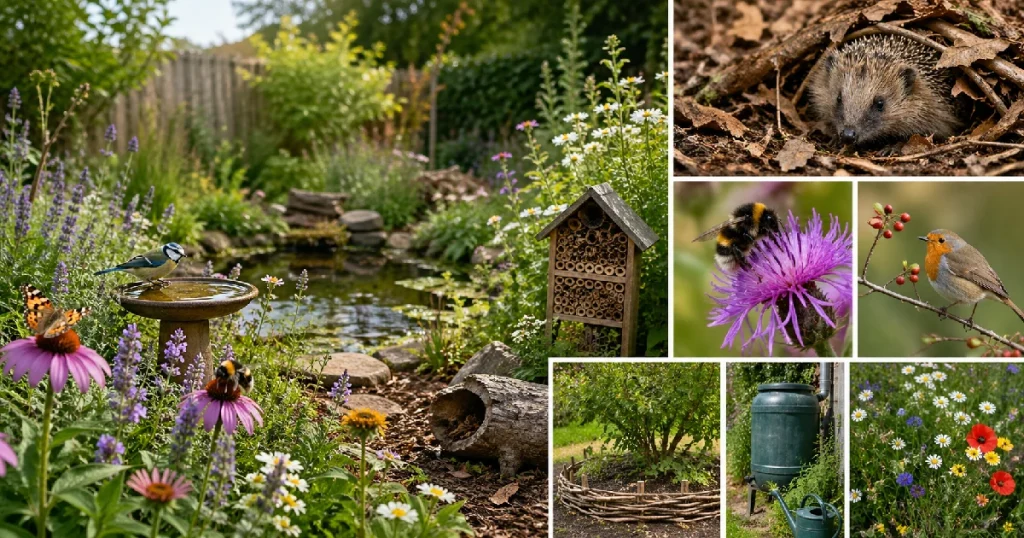
The second response, which is given nearly as frequently, is more difficult to convince a particular type of gardener. Don’t keep things tidy. Particularly, cease clearing every nook and cranny, stop trimming dead flower stems in November, and stop clearing wet logs from the shed’s side. It turns out that a large part of what wildlife requires in a garden goes directly against traditional gardening instincts-tidiness, order, and clear borders. Dead stems retain seeds throughout the winter. Birds and hedgehogs rely on log piles for overwintering insects during the lean months, such as beetles, slow worms, and ants. Almost philosophical in nature, realizing that doing less is, in quantifiable terms, doing more.
The lawn question tends to divide people more. When grass is allowed to grow for an extended period of time, or even when a strip or patch is left unmowed throughout the summer, insect activity changes instantly and visibly. The longer the grass, the more cover small mammals have, the more food grasshoppers have, and the more places for butterflies to lay their eggs. While this change takes less time than the alternative, it may seem counterintuitive to those raised to associate a well-kept garden with a short, level lawn. It can sometimes be difficult even for ardent wildlife gardeners to completely let go of the cultural attachment to clipped grass.
Pesticides are probably the most disturbing results. According to research funded by the UK-based conservation charity SongBird Survival, house sparrow populations were nearly 40% lower in gardens with frequent use of pesticides. It is not a marginal effect. One conservationist called blue tits “hidden threats” in exactly the places where we believe they are safest, the hedgerows, where they have long been considered a garden bird constant. One-third of gardeners in the UK frequently use pesticides without considering their long-term effects on insect populations. Many well-intentioned garden upkeep practices may harm the wildlife they seem to coexist with.
When properly considered, the hedgehog highway seems insignificant. A small gap at the base of a garden fence allows hedgehogs to move between several gardens in a neighborhood, which is hardly a modification. Their foraging territory is greatly increased and their chances of finding a mate are greatly increased. In regions with sealed boundaries, hedgehogs are largely confined to isolated patches that are too small for them to survive. The answer lies in a hole the size of an apple. The fact that something so insignificant can serve as conservation infrastructure is hard to ignore.
| Category | Details |
| Topic | Wildlife Gardening: High-Impact, Low-Effort Changes |
| Key Organization | SongBird Survival (UK-based scientific research charity) |
| Founded | 2000 |
| Focus | Researching threats to songbirds and promoting bird-friendly gardening |
| Key Finding | House sparrow numbers nearly 40% lower in gardens using certain pesticides |
| Top Wildlife-Friendly Changes | Adding water, leaving areas messy, reducing mowing, cutting pesticide use |
| Audience | Home gardeners, urban wildlife enthusiasts, conservation-minded growers |
| Location | United Kingdom (findings applicable globally) |
| Reference | The Royal Horticultural Society – Wildlife Gardening |
Climbers are also surprisingly frequently grown up walls and fences. Ivy, honeysuckle, and Virginia creeper cover shadowed walls and bare fence panels, creating layered habitats for overwintering insects, nesting birds, and foraging bees. Vertical surfaces are rarely used by wildlife in gardens. Covering them at a comparatively low cost drastically alters the ecology of the area.
All of these responses have one thing in common: subtractive changes are typically the most significant. Stop mowing so often. Stop removing dead growth. Stop spraying. Don’t try to fill in all the gaps. A majority of people approach their gardens with a desire to add-to purchase, install, or enhance. In spite of this, wildlife gardeners continue to argue that restraint is a more potent gesture based on observation rather than theory. Generally, the garden knows what to do. It simply needs a bit more space to do so.
As a Senior Editor at Mini Greenhouse Kits, Hannah Kinsley is a passionate supporter of small-space gardening and urban gardening. Hannah, who is currently majoring in Environmental Policy through the University of Michigan’s Environmental Studies program, infuses her writing with a solid academic foundation and a sincere enthusiasm for the environment. You can find her playing soccer or exploring the city’s green areas with friends when she’s not researching the newest trends in city gardening or creating content for minigreenhousekits.com.