

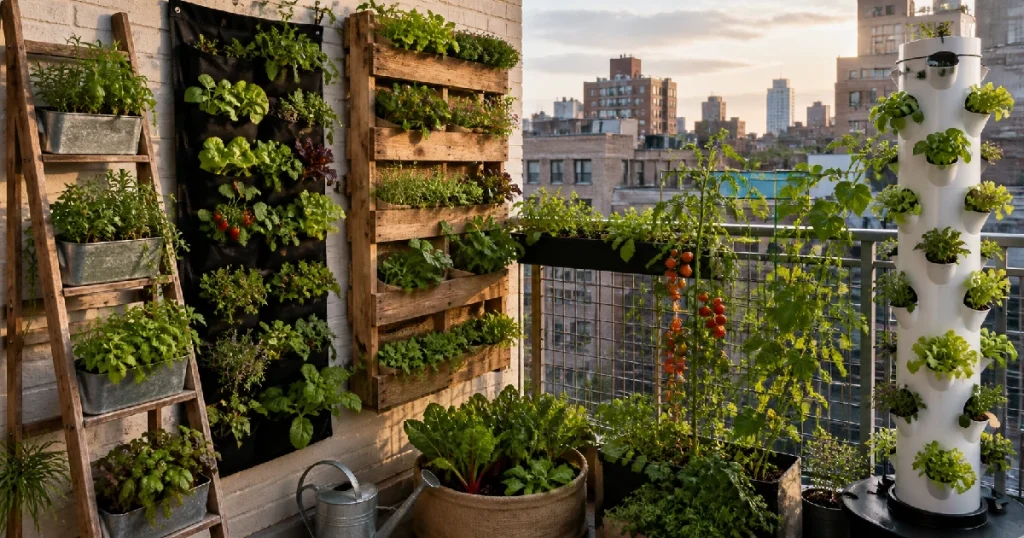
Gaze up at the balconies in any crowded urban neighborhood on a warm afternoon. Five or ten years ago, there were no green walls. An old wooden ladder leaning against a brick wall with herbs crammed every rung, tomatoes climbing a trellis bolted to a railing, and fabric pockets hanging from a fence filled with lettuce are examples of intentional, productive plantings rather than ornamental ivy left to its own devices. City gardening used to seem like an exception, despite the fact that it has always existed. Now it seems to be a silent, spreading habit.
The change makes sense from a practical standpoint. Increasing urban population density, apartment living, and the desire for a closer connection with food are all contributing to the reduction of outdoor space. Many city dwellers lack access to ground-level gardens with their tidy rows and open beds, and even those who do have a small concrete terrace cannot expand its square footage. Vertical gardening addresses this issue by utilizing height, a dimension that is abundant in most urban areas. A blank wall that did not produce anything for a household before can consistently produce herbs, greens, beans, cucumbers, and strawberries with the right setup.
Techniques range from the comfortingly improvised to the truly high-tech. Urban gardeners prefer hydroponic towers, which circulate nutrient-rich water through a soilless column of plants to maximize yields three to ten times higher than traditional growing methods. Systems such as the Lettuce Grow Farmstand can hold twenty to thirty plants in a space of four square feet. A south-facing balcony corner running one of these towers can actually supplement a household’s salad greens for months at a time, although these setups do require an initial investment.

Reasons for the continued growth of the DIY method
Hydroponic technology is not for everyone, and the most exciting innovation is occurring in less expensive alternatives. The fabric shoe organizers with clear pockets intended for closet storage have found a second purpose as instant vertical herb gardens when hung on balcony railings or fence panels. Each pocket comfortably accommodates a small plant, and the installation is nearly free. An old gutter positioned horizontally along a wall creates what gardeners call a cascading salad bar. Throughout the growing season, shallow-rooted lettuce or arugula can be harvested and cut repeatedly.
A wooden pallet with fabric lining across the slats and leaning against a wall can be used to grow strawberries and herbs without any structural work. Planters are placed on each rung of an old ladder and climbing plants are trained up the sides to create a tiered display. Unlike more carefully planned gardening trends, this type of gardening is inventive and resourceful. Especially for renters, it works because nothing is permanently fixed and everything can be disassembled and moved on moving day.
The reasons why growing conditions are often better than expected
Unexpected health benefits of vertical growing are underappreciated. Fungal conditions and soil-borne diseases that affect sprawling plants in contact with damp soil are much less likely to affect crops grown on trellises or in wall-mounted systems. As a result of training plants upward rather than allowing them to spread horizontally, air circulation is greatly improved. For crops like tomatoes and cucumbers that are susceptible to disease, this is especially important. The higher position also facilitates pest inspection as aphid colonies and whiteflies are easier to find at eye level rather than crawling along the ground.
A serious consideration should be given to the problem of watering. Vertical setups tend to dry out more quickly than ground beds since the growing medium is exposed to air on several surfaces. With drip irrigation, even a simple timer-controlled system that runs thin tubing along a wall-mounted planter, moisture can be maintained consistently over the course of a season, which hand-watering rarely does. For maximum light, south-facing walls are ideal. However, many leafy greens can tolerate less direct sunlight, which makes north and east-facing walls more productive.
The fact that all this is taking place on rooftops and balconies suggests that vertical gardening has progressed beyond the point where it needs to be justified. The system works. Yields are actual. You can try these techniques if you have a few meters of wall space and a little patience. Instead of growing vertically, urban gardeners are increasingly wondering which strategy works best for their walls.
As a Senior Editor at Mini Greenhouse Kits, Hannah Kinsley is a passionate supporter of small-space gardening and urban gardening. Hannah, who is currently majoring in Environmental Policy through the University of Michigan’s Environmental Studies program, infuses her writing with a solid academic foundation and a sincere enthusiasm for the environment. You can find her playing soccer or exploring the city’s green areas with friends when she’s not researching the newest trends in city gardening or creating content for minigreenhousekits.com.