
A certain type of gardening disappointment sneaks up on you. Rather than the dramatic frost that destroys everything overnight, a greenhouse full of tomato plants that produce little is an example of a slow, invisible failure. In August, the trusses are bare. According to the grower, the weather, the compost, and the variety are to blame. Maybe they never consider the true culprit, which is a sealed greenhouse on a bright June morning that silently reaches 40°C before noon, destroying pollen before any fruit is set.
This happens every summer in backyards across the country. Overheating kills more greenhouse plants than cold, contrary to what most people believe when they purchase a building that is supposed to keep things warm. Reasonable reasoning seems to be the case here. The greenhouse traps heat. Heat is beneficial to plants. Heat increases growth. This logic ignores the physics of what occurs inside a tiny glass or polycarbonate box on a calm, sunny day. As short-wave solar radiation passes through the panels and warms the interior surfaces, it re-radiates as long-wave infrared, which is then blocked by the glazing. The interior temperature rises 20 to 30 degrees above the outside temperature within a few hours. A pleasant spring morning of 18 degrees Celsius can turn into a 45-degree oven by midday if nothing is open.
The problem is exacerbated by smaller structures. The six-by-four greenhouse heats up more quickly than a large greenhouse because it has a higher ratio of glazed surface to interior air volume, fewer vents to release heat, and less thermal mass to absorb it. Most of these buildings are delivered by the manufacturer with just one roof vent. It covers about half of the ventilation that the Royal Horticultural Society considers to be the functional minimum, usually about a quarter of a square meter. A greenhouse’s total vent area should make up 20% of its floor area, according to the RHS. Only a few hobby greenhouse ships come close to that number. There is usually a significant discrepancy between what is packaged and what plants actually require.
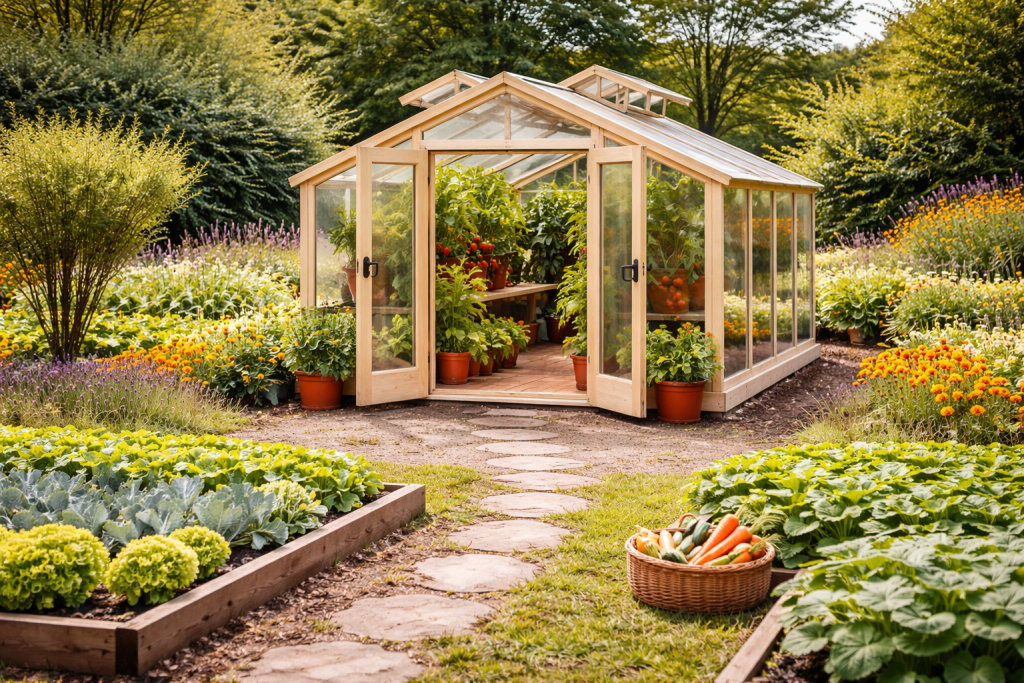
In order to understand why ventilation is important, it is necessary to take three factors into account at once. The first factor is heat. The second factor is humidity. Plants continuously release moisture through their leaves, which causes condensation on glass, damp patches on foliage, and the damp, still air required by botrytis and powdery mildew. Water vapor runs all day in a sealed space with nowhere to go. Grey mold does not require an invitation. An unventilated greenhouse consistently provides still air and humidity above 70%. The third issue is carbon dioxide. The photosynthesis of plants in a sealed space can be slowed down even when there is enough light and water. There is an apparent reason why growth stalls.
From a structural perspective, the solution is simple: air must enter low and exit high. As hot air ascends, it cools. Roofing vents placed at or near the ridge allow cooler air to escape by convection by drawing it in through lower openings, such as a doorway, a louvre vent on the sidewall, or any gap at the base. This stack effect can be achieved without fans, electricity, or intervention as long as the openings are large and present. By adding a louvre vent low on the windward wall along with a roof vent, small greenhouses get much closer to the 20 percent goal. A relatively low-cost intervention that yields disproportionately large results. You can’t ignore the difference when the thermometer stops consistently reaching 35 degrees.
For unattended greenhouses, an automatic vent opener is the most useful improvement. The device is bolted to the roof vent frame and has a mineral wax tube that expands when the temperature rises, opening the vent. The tube contracts when the temperature cools, allowing a spring to close the vent. There is not a single wire. There is no power. There is not a single battery. There is nothing simpler, or more reliable, than this mechanism that has been in use for decades. With an entry-level price of about £46, entry-level models open at about 16 degrees Celsius and reach full extension by 25 degrees. It takes 15 to 20 minutes for the wax to move significantly, so on a hot spring morning, the greenhouse may overheat before the vents are fully opened. On most days, and especially when the grower is away, they work well enough to prevent the catastrophic heat events that destroy crops.
Seasonal ventilation has more than one fixed setting. Because spring is an awkward season, growers must open vents in the morning and close them again in the afternoon. Midday is warm enough to overheat, and night is cold enough to threaten frost. In the summer, leave the door open on warm nights above 15 degrees, open everything, and use a watering can to moisten the floor every couple of hours. The final step—wetting the floor rather than the plants—cools the air by three to five degrees through evaporation, is free, and serves as one of the most effective non-chemical controls for red spider mites, which thrive in the hot, dry conditions caused by inadequate ventilation. On dry days, winter still needs a little ventilation at noon to avoid gray mold that is created when cold and humidity combine.
People who have lost crops that took months to grow seem to blame the greenhouse. It’s not enough. The position is incorrect. It has been a terrible summer. There is still no way to determine how many of those losses can be attributed to something as simple as an undersized vent opening or a roof panel that remained closed during a string of hot days. A max-min thermometer, available at most garden centers, would clearly explain the situation: check the maximum reading every day. The ventilation isn’t working if it consistently rises above thirty degrees. Pollen from tomatoes over 35 years old is already dying. The plants will not show it for weeks. The harvest, however, will be worth it.