
There is a certain kind of garden disappointment in August when the spring flush has long gone, the early summer perennials have gone to seed, and what is left looks worn out and sparse. With a slight change in plant selection, this common mistake can be avoided completely. Typically, it occurs in gardens designed primarily for spring. There is no difficulty in finding a solution. As opposed to plants that produce for a week before ceasing, it is crucial to select plants that can continue to grow.
Dahlias are the most striking example of what a long season looks like in practice. The dahlia plant flowers until the first hard frost in the fall, usually in late June or early July, depending on when the tubers were planted. Pollinators use single-flowered varieties as a dependent canteen starting in midsummer, dinner-plate varieties that halt guests in their tracks, and pompon varieties the size of golf balls. A practical fact that most gardeners fail to realize is that dahlias started indoors in April and sprouted in warmth establish noticeably faster than tubers planted directly into cold soil in May. A two-week head start on a warm windowsill results in flowers appearing in late June instead of mid-July. Over the course of a season, that difference is significant.
In spite of its less glamorous appearance, the blanket flower, or gaillardia, has an amazing bloom period and is much more forgiving than a dinner-plate dahlia. When planted in full sun, varieties such as “Arizona Sun” and “Mesa Yellow” bloom from late spring until the first frost. As the summer progresses, their red, orange, and yellow flowers intensify rather than fade. When the plant is established, it is drought-resistant, requires very little fertilizer, and produces new flowers as long as the old ones are removed. One of the most dependable summer gardening value propositions.
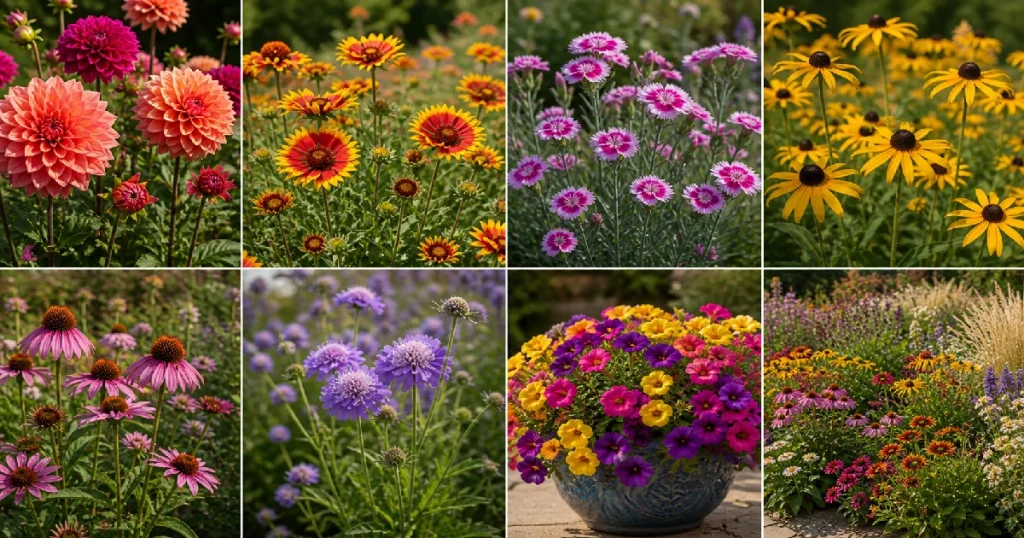
Dianthus, also known as pinks, is on the more subdued end of the long-blooming spectrum. In warm afternoon air, the tiny, fringed flowers emit a scent somewhere between clove and cinnamon. A scent like this permeates the air before the source is discovered. They bloom from May to October and prefer alkaline soil and good drainage. Borders and containers also work well with them. Most other summer flowers don’t retain water as well as Dianthus stems, so their cutting-garden potential is undervalued.
Throughout North America, black-eyed Susans have bloomed for centuries along roadsides and in meadows. Most climates produce golden-yellow flowers with dark brown centers on two to three-foot stems from June to September. Pollinators love them, they self-seed voluntarily, and they are more drought resistant than many similar plants. Gardeners sometimes ignore them because they seem so simple, as if something so reliable couldn’t also be worth cultivating.
In July and September, echinacea, or coneflowers, bloom later. Although the first flowers are the most striking, as the season progresses and the petals fall, the remaining seed heads become architecturally fascinating and serve as food for goldfinches and other seed-eating birds until autumn. While deadheading prolongs the flowering period, some spent heads should be left intact for wildlife reasons at the end of the season. Ecological utility and neatness are fairly balanced here.
| Category | Details |
| Subject | Flowers That Bloom Continuously From June Through October |
| Flower Types Covered | Mix of perennials, tender perennials, and long-season annuals |
| Top 8 Flowers | Dahlias, Blanket Flower (Gaillardia), Dianthus, Purple D’Oro Daylily, Black-Eyed Susan (Rudbeckia), Coneflower (Echinacea), Scabious (Scabiosa), Calibrachoa |
| Bloom Duration | June–October (some varieties from May; some until first hard frost) |
| Sun Requirement | Minimum 6–8 hours of full sun daily for most varieties |
| Key Maintenance | Regular deadheading to encourage continuous flowering |
| Best for Pollinators | Coneflower, Scabious, Salvia, Blanket Flower, Catmint |
| Best for Containers | Calibrachoa, Dianthus, Dahlias, Blanket Flower |
| Drought Tolerant Options | Blanket Flower, Coreopsis, Black-Eyed Susan, Catmint |
| USDA Hardiness Range | Most suited to zones 4–9; Knock Out Roses extend to zone 11 |
Throughout the afternoon, bees hover around scabious’ pale lavender and blue pincushion flowers in a manner that suggests genuine preference rather than convenience. Because it blooms at a scale and height that complements taller plants without competing with them, it is especially useful in the garden. From early summer to autumn, it blooms. Due to the long, thin stems that bend slightly in the wind, a full bed of mixed scabious and grasses resembles a miniature meadow in late August.
Calibrachoa completes the eight by being an expert in containers. Plants are covered with tiny trumpet-shaped flowers from the moment they are planted until the first frost. There is no need to deadhead it, it can withstand chilly and hot autumn days without complaining, and it comes in a wide range of colors to complement nearly any setting. In one pot, calibrachoa can perform the task of three plants-exactly what a long season requires.
As a Senior Editor at Mini Greenhouse Kits, Hannah Kinsley is a passionate supporter of small-space gardening and urban gardening. Hannah, who is currently majoring in Environmental Policy through the University of Michigan’s Environmental Studies program, infuses her writing with a solid academic foundation and a sincere enthusiasm for the environment. You can find her playing soccer or exploring the city’s green areas with friends when she’s not researching the newest trends in city gardening or creating content for minigreenhousekits.com.