
Stand on any rooftop in a major city on a clear morning and look across the skyline. You can see thousands of square feet of underutilized, flat, sun-exposed space per building, multiplied by thousands of buildings. Mostly, it absorbs heat, collects rainwater, and gradually deteriorates due to weather. There is a compelling case for changing that. Food supply chains in these cities are lengthy, expensive, vulnerable, and environmentally damaging. The solution is, quite literally, to sit on top of the issue.
Over the past decade, there have been significant changes in the scale at which urban rooftop farming is being pursued as well as the seriousness with which food entrepreneurs, city planners, and regular citizens are taking it on. Brooklyn Grange in New York runs one of the largest rooftop soil farms in the world with more than an acre of growing space spread across building tops in Queens and Brooklyn. The farm produces tens of thousands of pounds of vegetables a year and supplies restaurants, farmers markets, and community-supported agriculture programs. Singapore, a city-state that imports more than 90% of its food and views supply chain vulnerability as a legitimate national security concern, has transformed rooftop and vertical farms into a purposeful policy priority supported by government funding and urban planning frameworks. Residential buildings in Mumbai, Chennai, and Bengaluru are dotted with terrace gardens. In addition to rising vegetable prices and memories of supply chain disruptions during COVID-19, these gardens are often organized by resident welfare associations. There is a difference in topography. The underlying logic is the same everywhere.
Rather than understanding the food miles argument abstractly, it is better to understand it in a concrete way. A vegetable usually has traveled several hundred to several thousand kilometers by the time it is sold in a large city after being grown in a rural agricultural area. Transport, packaging, handling, storage, and the energy expenses associated with each of these processes are all included in that trip. The gap between harvest and consumption is also growing, cellular structure is disintegrating, and nutritional content is decreasing over time. According to Harvard T.H. Chan School of Public Health research, fresher produce has a higher nutrient density. Nutritionally and nutritionally speaking, a tomato picked from a rooftop in the morning and served at a restaurant four stories below that evening differs from one that has been in a truck for three days. It is not insignificant for the people who consume it, and it is not insignificant for the environment when you consider the total carbon cost of doing away with that truck trip multiplied by the amount of food consumed in a city.
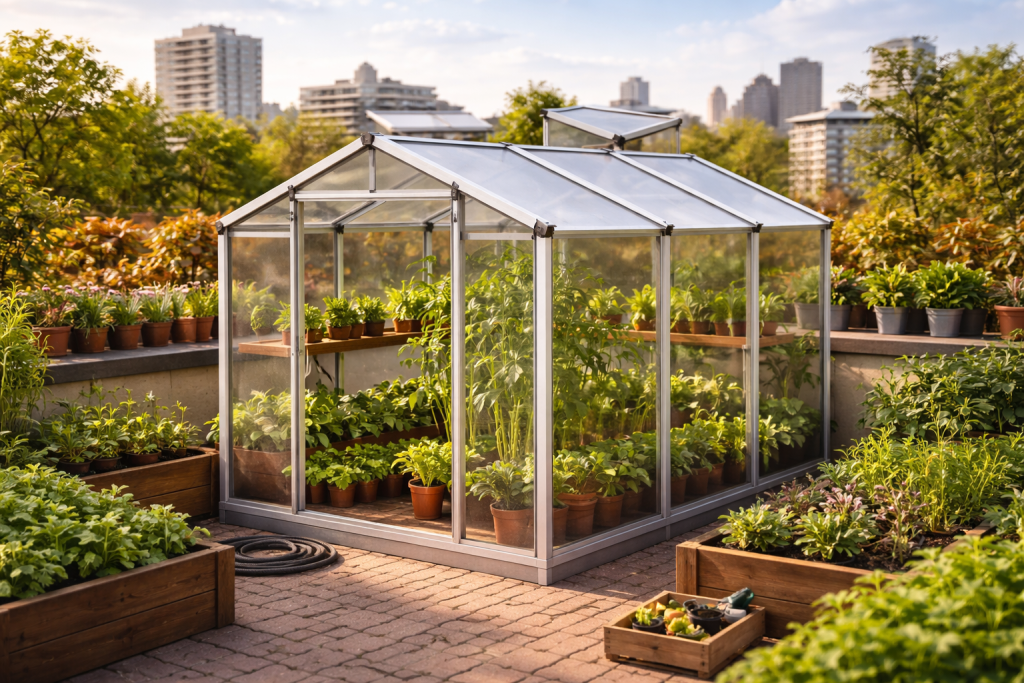
As rooftop growing has evolved over the past decade, the options now span a wide range of scales, budgets, and skill levels. Most affordable are soil-based raised beds, which are familiar to anyone with gardening experience, reasonably priced, and able to produce significant quantities of herbs and vegetables on average apartment terraces. A lightweight hydroponic system that circulates nutrient-enriched water through growing channels or reservoirs can produce higher yields per square foot while using up to 90% less water than traditional soil growing because soil is eliminated and plant spacing can be closer. Plant roots are suspended in the air and nutrients are distributed via a fine mist in aeroponic systems, which are even more efficient in terms of growth rate and resource efficiency. Vertical tower systems, which stack plant positions upward, allow twenty or thirty plants to be grown on three or four square feet of roof space. Technology is not overly complex. Most of it can be assembled with common parts or is available as a kit for home assembly.
In addition to producing food, rooftop farming has environmental benefits that city officials are becoming more aware of. In cities around the world, urban heat islands are a serious and growing problem. Concrete, asphalt, and glass concentrations produce quantifiable temperature rises when compared with their surroundings. Rooftop farms absorb sunlight rather than reflecting it, evaporate water through plant surfaces to actively cool the surrounding air, and reduce the amount of heat that buildings absorb and re-radiate at night. Studies tracking cities with significant green roof coverage, including research compiled by the C40 Cities network, suggest widespread adoption could reduce peak summer temperatures by several degrees. During increasingly hot summers, this difference is important for energy consumption, health, and urban life.
The community aspect of rooftop farming is often overlooked when production volumes and environmental metrics are discussed. No amount of fresh produce delivery can match the benefits of a shared rooftop garden in an apartment building: it allows residents to spend time together while working toward a common goal. As a result, organizations like Earth5R in India have been developing whole urban farming initiatives that not only teach locals how to grow food, but also how to manage a community-based food production system. We discussed how to connect rooftop gardens to composting initiatives, how to collect rainwater, and how to view a building as a closed-loop system on a small scale. The social benefits of this kind of project are real, even though they are harder to measure than yield per square foot.
The obstacles are also real, so ignoring them would be dishonest. Structural load limits determine what can be grown and how. Proper waterproofing is difficult and expensive. Building codes in many cities have not kept up with rooftop agriculture, so anyone wishing to grow more than a few pots faces regulatory uncertainty. Pest control in an elevated, semi-enclosed setting requires a different approach than in ground-level gardening. The evidence from rooftop growing operations on all continents suggests that none of these issues are insurmountable, but they are real expenses that anyone considering rooftop gardening must take into account.
With urban rooftop farming growing city by city, the question is no longer whether it is feasible, but rather how quickly infrastructure, regulations, and cultural familiarity can catch up with physical capacity. Rooftops already exist. The sun already illuminates them. On a large scale, the growing techniques have been validated. Building owners, city planners, and regular citizens can still choose to use that wasted space as a productive resource. That decision has already been made by some cities. Anyone who hasn’t started yet is just further behind in a process that doesn’t seem to be ending anytime soon.