
On a sunny February morning, a tiny greenhouse at the end of a suburban garden appears to have it all under control. The seedlings on the upper shelf receive low winter light, and condensation on the polycarbonate panels is just beginning to evaporate. From a distance, it appears to be a balanced system. When you step inside, you notice a calmness, a hint of moisture, and an uneven warmth. There is a cold band across the floor and a hot pocket close to the roof, so the thermometer on the wall does not give a complete picture.
Hobby greenhouse growers eventually reach this stage. As intended, the structure captures and retains solar energy. There is, however, a surprising effect of the internal climate-the actual daily range of temperatures, humidity levels, and air quality-on plants. A solution almost always involves the same three pieces of equipment, each of which performs better when combined than when used individually.
Most frequently, the thermostat is overlooked or undervalued as the brain of the system. When nobody is around, a maximum-minimum thermometer that records the highest and lowest temperatures over a 24-hour period is all that’s needed to understand what’s really going on inside. Frequently, growers are surprised by the number that greets them in the morning, which shows the overnight low. There are signs that tomatoes and peppers are being forced to endure temperature fluctuations they were not designed for, such as slow growth and blossom drop. In addition to automating the reaction, a good thermostat will also turn on the fan when the temperature rises too high and the heater when it falls below a threshold. In a system that cannot tolerate inattention, the human element is eliminated.
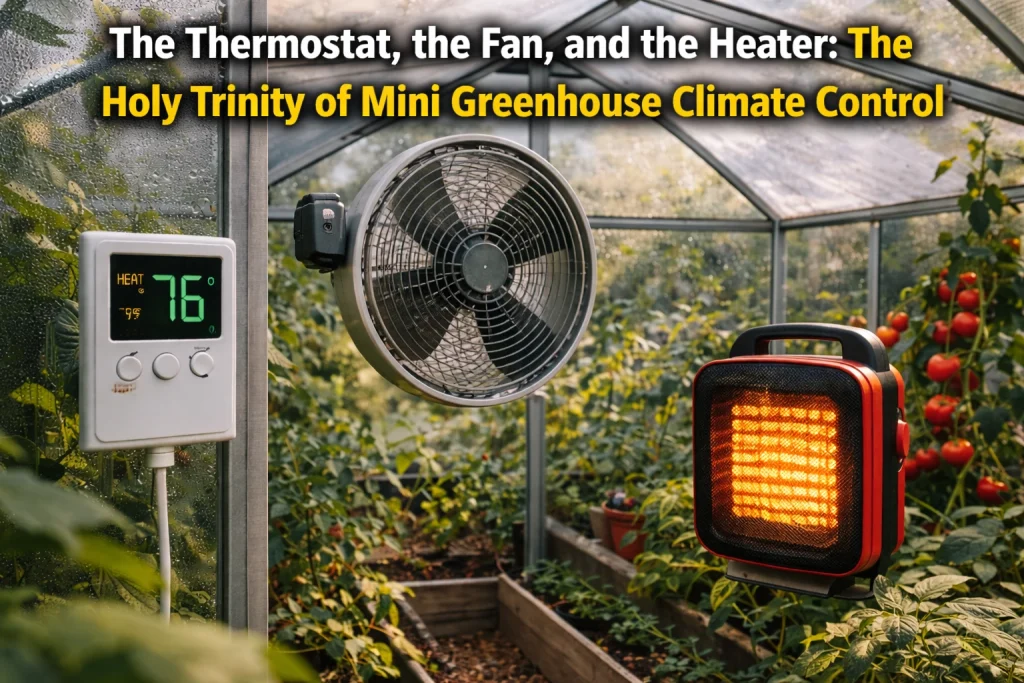
As a fan performs multiple tasks at once, it is more difficult to describe its function. The most obvious function is to move hot air out of the greenhouse and bring in cooler air. When internal temperatures approach danger, a thermostat-connected exhaust fan can turn on, drawing the air down before plants are stressed. Although less discussed, secondary functions are just as important. A well-placed circulation fan denies Botrytis the conditions it needs to thrive by creating still, humid air. As a result of air movement, stagnant pockets where fungal pathogens establish themselves are disturbed. Furthermore, air movement evenly distributes carbon dioxide throughout the growing area, preventing local depletion that occurs when still air surrounds actively photosynthesizing plants. Many crops may have been subtly underperforming due to inadequate air circulation, mistaking the symptoms-weak stems, slow growth, and unexplained disease pressure-for more complex problems.
When the nights are cold during the shoulder seasons and winter, the heater closes the loop. It is here that a greenhouse that allows for true year-round growing differs from one that simply extends the growing season. Due to their responsiveness, efficiency, and ability to maintain a comfortable floor temperature for most cool-season crops, electric fan heaters with thermostats are the most popular choice in smaller buildings.
The goal is not tropical warmth. Nighttime temperatures between 7°C and 10°C are sufficient to prevent frost damage and maintain biological processes for most crops hobby growers wish to cultivate year-round. The heater, which is controlled by a thermostat, only operates as long as it is necessary to maintain the floor. It’s a construction issue rather than an equipment issue when the outdoor space is heated through openings in a poorly sealed structure.
By coordinating these three parts, the thermostat becomes a functional system instead of three separate components. The two-stage thermostat, which is commonly found in more serious hobby setups, can control both heating and cooling. By turning on the heater when temperatures drop and the fan when they rise, it maintains a band rather than a fixed point. Commercial greenhouse operations have controlled the climate in this way for decades. In spite of the scale difference, the reasoning is the same, and the tools needed to replicate it at the hobby level have become affordable and readily available.
When comparing a well-equipped mini greenhouse with one without this kind of control, it’s difficult to ignore the fact that the plants look different. More uniformly developed, less stressed at the extremes. A thermostat, fan, and heater aren’t complex technological devices; rather, they eliminate the factors that cause plants to be silently defeated over weeks in unlucky ways.