

In a rural part of Britain, a group of people gather on a Monday morning with tea mugs at a therapy garden. Despite coming from different parts of the city, having different life circumstances, and having different diagnoses, they are brought together by a common program and the garden itself. By midday, the horticultural therapist conducting the sessions has noticed something interesting: regardless of where they started in the morning, the group consistently drifts toward the same corner of the garden. No one coordinates it. There is no explanation for it. Eventually, they end up there. It’s the kind of subtle, enduring detail that makes you wonder if the design of outdoor spaces may be far more important than most people realize.
In recent years, the therapeutic garden movement has quietly grown, integrating elements of landscape architecture, healthcare design, and environmental psychology that had previously rarely been combined. Evidence supporting it and the degree to which hospital administrators, architects, and urban planners are taking it seriously have changed recently. Horticulturists and occupational therapists are no longer the only ones who care about it. Large hospitals design their inpatient courtyards based on these ideas. Researchers are now urging cities to treat green space as soft infrastructure-a structural necessity that absorbs pollution and noise just as a retaining wall absorbs soil, rather than as a decorative feature.
All of this is supported by a substantial body of science by now. In a recent meta-analysis, gardening activity had a measurable effect size of 0.55 on well-being measures, which would be exciting if associated with a new medication. Researchers used fMRI scans to observe changes in brain activity following horticultural tasks, with emotional processing regions showing altered connectivity patterns. Compared to reading in a quiet room after experiencing acute stress, gardening was more effective at reducing cortisol levels. Approximately 90% of garden users in healthcare settings reported feeling happier after spending time outdoors, according to Pacific Horticulture research. There is no softness to these results. Their findings suggest that people’s bodies undergo quantifiable changes when they interact with plants and well-designed natural areas.

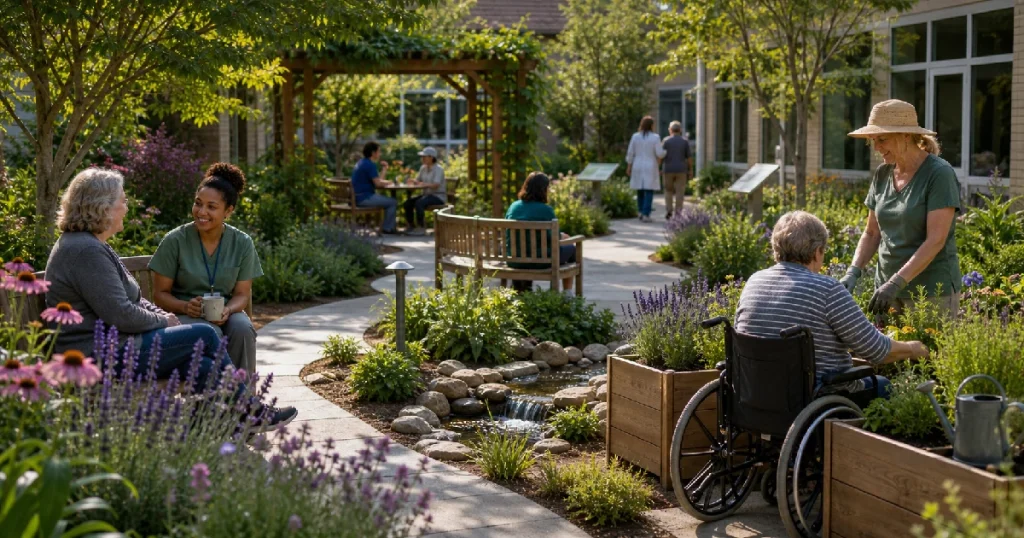
Evidence-based design transforms therapeutic outdoor environments
The therapeutic garden movement is distinguished from broader outdoor enthusiasm by the intentionality of its design thinking. There’s more to these gardens than just the fact that they’re near a hospital. The path’s width, the bench’s location, the direction a seat faces, and the scent of lavender planted within wheelchair users’ reach have all been considered in relation to the people who will use this space. People naturally feel safer and more at ease when they have an open, serene view in front of them and something solid behind them. Jay Appleton’s Prospect-Refuge Theory was developed in the 1970s. A beautifully designed garden appears to be an evolutionary legacy from the African savannah, as evidenced by how people gravitate toward it. Bench placement is not an easy task.
Circular paths are frequently used in therapeutic gardens, especially in dementia care settings, and their purpose is more pragmatic than decorative. A path that leads back to the beginning eliminates the silent worry of not knowing how to get back. With raised beds that come in different heights, people with different mobility limitations can garden standing up or in a wheelchair. Each day, they can choose the configuration that suits them best. Scientists call this a parasympathetic nervous system response, which is a quantifiable shift towards calm caused by even small solar-powered water features. Design decisions like these are deliberate. Each of them is engaged in a different activity.
Time spent with these materials makes it difficult to ignore how much of what makes these gardens successful has been intuitively understood for centuries. Water and sensory plants were used in eighteenth-century Islamic healing gardens in ways that surprisingly resemble modern evidence-based guidelines. Healing outdoor spaces are a long-standing instinct. In Singaporean workplace courtyards or Toronto hospital gardens, it’s more recent to be able to explain exactly why they work.
There are a number of reasons why cities are beginning to value therapeutic green spaces
Its urban planning component is perhaps the most intriguing and contentious aspect of the movement. The question of what outdoor space really is for has become urgent in new ways as cities become denser and the negative effects of urban living on mental health become increasingly difficult to ignore, with anxiety and depression rates continuing to rise and loneliness emerging as a legitimate public health concern. Urban planners are increasingly advocating that green spaces should serve therapeutic purposes rather than just aesthetic or recreational ones. As part of the movement, landscape architects are asked to consider how a space works for people who are distressed, recovering from surgery, managing dementia, or who haven’t spoken to anyone in days.
| Movement type | Evidence-based landscape and horticultural therapy design |
| Core purpose | Improve physical, mental, and emotional health through intentional outdoor spaces |
| Primary settings | Hospitals, nursing homes, rehabilitation centres, urban public spaces, workplaces |
| Key research finding | 90% of garden users reported positive mood change after time spent outdoors (Pacific Horticulture) |
| Meta-analysis result | Gardening shows 0.55 effect size improvement in well-being measures |
| Design principles | Sensory-led planting, universal accessibility, circular paths, water features, prospect-refuge theory |
| Recommended plant-to-hardscape ratio | 70% planting / 30% hardscape (or less hardscape where possible) |
| Historical roots | Islamic healing gardens (8th century) designed around water and sensory planting |
Community gardens provide an example of this in action. Besides feeling happier, participants report feeling less lonely and having social capital that extends beyond the garden. Sharing produce with a neighbor, working alongside someone on a shared bed, or showing up regularly somewhere all matter in ways that are hard to measure but easy to see. Gardener once said that giving heirloom tomatoes to a neighbor made her entire day. This is not the result of a study. It’s just a fact.
In the future, it will be challenging for the therapeutic garden movement to maintain its evidence-based rigor. A phrase like this runs the risk of being diluted and applied to any green space with some lavender and a bench without considering the underlying design principles. In general, horticultural therapists avoid this, emphasizing the difference between a garden that is simply pleasant and one that is designed to meet specific needs. As the movement expands, it may become more difficult to maintain that distinction. Although the evidence is consistent for the time being, the people who regularly gather in that garden—drawn for whatever reason to the area that has been so thoughtfully designed for them—seem to be making the case without words, at least for the time being.
As a Senior Editor at Mini Greenhouse Kits, Hannah Kinsley is a passionate supporter of small-space gardening and urban gardening. Hannah, who is currently majoring in Environmental Policy through the University of Michigan’s Environmental Studies program, infuses her writing with a solid academic foundation and a sincere enthusiasm for the environment. You can find her playing soccer or exploring the city’s green areas with friends when she’s not researching the newest trends in city gardening or creating content for minigreenhousekits.com.