

As soon as you enter Justin Laird’s greenhouse on the coast of Northern California, you notice not any technology or equipment, but rather the smell. The air fills with clusters of tiny white flowers that smell almost exactly like jasmine when coffee plants are kept in a warm, humid environment. The main surprise of growing coffee in a greenhouse is actually that gap between the living plant and the morning beverage. The flowers have nothing to do with the bitter, roasted drink most people associate with “coffee.” The experience is strange, patient, and botanical.
As a color scientist, Laird’s approach to coffee cultivation reflects his background. As he was on a business trip in Asia, discussions kept returning to the equatorial band, where most of the world’s coffee is grown today. Rising global temperatures could reduce the number of viable coffee-growing regions by up to 50%, according to researchers monitoring the crop. Seeing this statistic, he began to wonder if the growing environment could be created rather than discovered. After returning home, he found an 18-by-24-foot Ceres greenhouse on a coastal property four hours from his home, bought a roasting machine used by commercial operations, and purchased his first seeds from Hawaii. This coastal fog and consistent temperatures, which ranged from 40 to 60 degrees Fahrenheit, were more like those of a highland tropical climate than anything San Jose could offer.
Despite popular belief, the plant is actually more tolerant than most people think. Coffea arabica, the most common variety, is often described as picky and climate-sensitive, which is mostly true in temperate countries. In a greenhouse that provides consistent warmth and some frost protection, it settles in surprisingly easily. Since it grows under the canopy of taller trees in its native Ethiopian highlands, it adapts well to the lower light levels of a northern greenhouse. British horticulturist Bob Flowerdew wrote for Hartley Botanic that it is one of the best conservatory plants because of its glossy, dark green leaves and jasmine-like flowers. It’s not incorrect what he says. The majority of people who grow coffee in greenhouses will likely enjoy the plant for much longer as an ornamental than as a beverage.

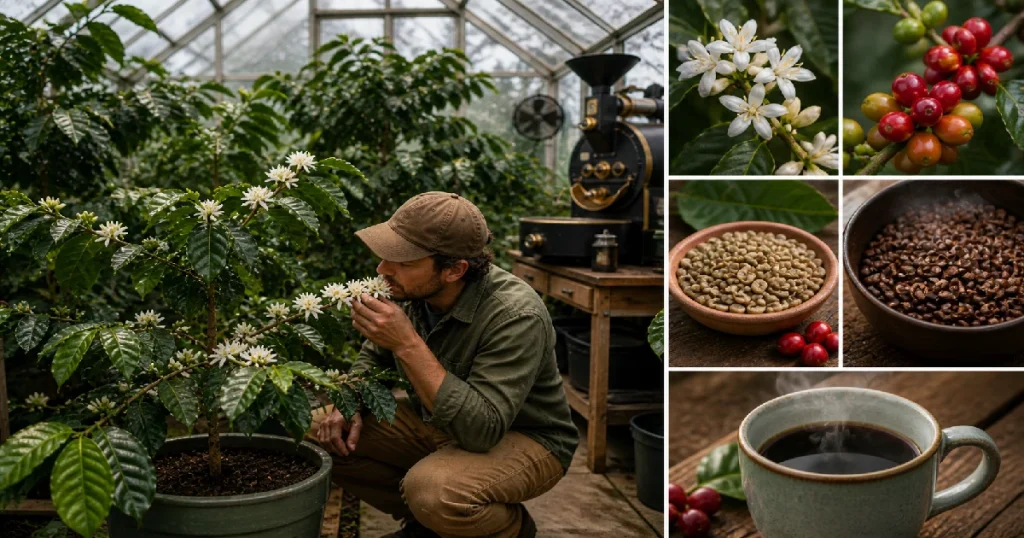
There is the first real surprise. Slowly, coffee moves. It’s really, really slow. From seed to fruit, the plant takes three to four years. The red cherries, which contain two beans each, take time to ripen. Because they arrive in small waves over several weeks, commercial operations cannot handle the patience and small-batch labor required to process them. Roast the beans after removing the skin, fermenting the remaining fruit for a short time, and drying them. Once you get a cup of coffee, you’ve put years of effort into making enough to fill a small jar. Drinkable substances can be created. It is unlikely to be competed with by a well-sourced bag from a specialty roaster. The framing, however, obscures the true nature of what individuals like Laird are doing.
The concept of efficiency isn’t appealing to some growers who are methodical, curious, and interested in the entire process. It’s about understanding. Laird collaborated with a soil lab in California to replicate the exact conditions that his plants preferred. Using a controller installed in the greenhouse, he monitors temperature, humidity, and ventilation remotely. He is testing whether soil chemistry, temperature range, humidity, and altitude-equivalent stress, all factors that contribute to a good cup of coffee, can be controlled rather than inherited. Academic greenhouse labs are currently investigating how controlled environments could help coffee growers adapt to the unpredictability of traditional growing regions. The agricultural scientist and hobby grower are currently collaborating on related issues.
Despite all of this, there is a larger tension at work. Almost all coffee is grown in the Global South, mostly by smallholder farmers who have limited access to the technology Laird is using in his backyard. The Ugandan coffee company Wild’s founder, Endre Vestvik, expressed a genuine concern that production may shift toward affluent consumer markets, leaving origin farmers further behind as indoor and greenhouse growing methods become more feasible. Vestvik believes this is a second colonization of the commodity. A Californian hobbyist cultivating twelve plants for their own use doesn’t make the issue go away. The same technology scales differently depending on who controls it.
The greenhouse coffee plant is still beautiful despite this. The waxy leaves capture and retain light. While the flowers only last a few days, they fill the room in a way that is out of proportion to their size. On top of that, as they ripen slowly on branches that took years to produce, the cherries have an indescribable quality that falls somewhere between patience and proof. If the grower is prepared to consider the long term, that may be sufficient. Coffee is essentially incidental if it is served.
As a Senior Editor at Mini Greenhouse Kits, Hannah Kinsley is a passionate supporter of small-space gardening and urban gardening. Hannah, who is currently majoring in Environmental Policy through the University of Michigan’s Environmental Studies program, infuses her writing with a solid academic foundation and a sincere enthusiasm for the environment. You can find her playing soccer or exploring the city’s green areas with friends when she’s not researching the newest trends in city gardening or creating content for minigreenhousekits.com.