

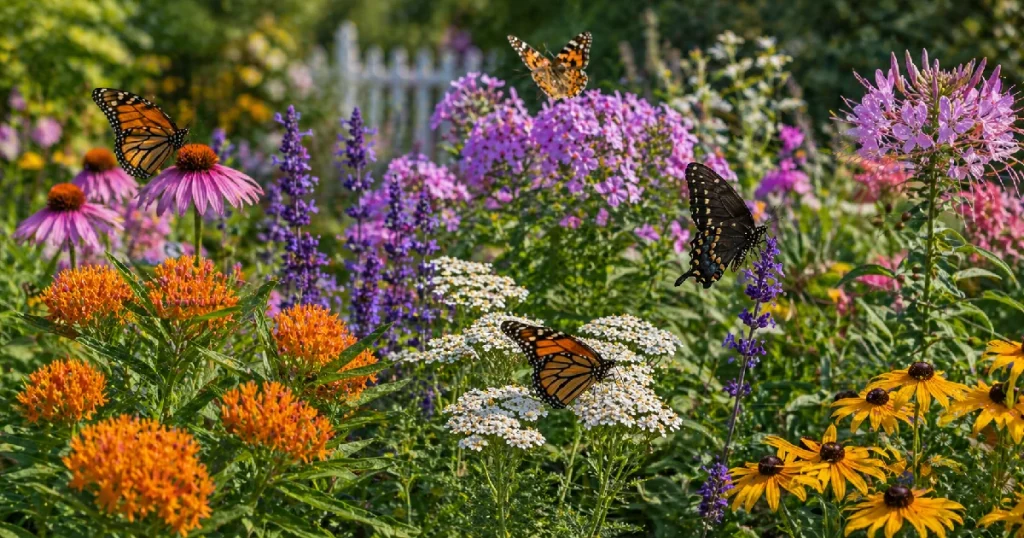
When the dew has burned off and the air has just begun to warm in midsummer, a well-planted garden comes to life at a specific time all at once. Bees are working the salvias. A painted lady opens and closes her wings on a flower with a flat top. A monarch butterfly makes slow, tilting arcs between milkweed stems. It seems effortless. No, it isn’t. That type of garden requires careful consideration of which plants perform the work, when, and for whom.
Lavender is probably the most popular solution for attracting butterflies. While this is an incomplete response, lavender does attract some species and produce nectar during its relatively short bloom period. When using lavender as a centerpiece, timing is crucial. During the early summer, it blooms most intensely; after that, it is almost finished, leaving nothing for the second half of the season, when butterfly activity tends to peak. A lavender garden appears promising in June, but becomes quiet by August. For the majority of butterfly species, the situation is completely reversed.

Growers frequently promote Pentas, and for good reason. The plant produces clusters of tiny, star-shaped flowers in red, pink, white, and soft lavender from late spring until frost. Without interruption, this nectar source covers the entire active butterfly season. In the South, where the heat would deplete other plants, it seems to thrive even more. Michigan State University’s butterfly garden program lists it as one of the best plants for attracting butterflies. Rather than being the best for a specific area or species, it is the best overall. An unqualified endorsement from a research institution is worth paying attention to.
There has been an increase in complexity in the recommendation for Buddleia, the butterfly bush. On a warm August afternoon, you’ll often see six or seven species feeding simultaneously, their wings overlapping, and the entire shrub practically vibrating with movement as you pass a mature buddleia. There is concern that it is invasive in many areas, especially the Pacific Northwest and parts of the eastern United States, where it spreads rapidly into disturbed areas and displaces native plants. The sterile cultivars of buddleia solve the seed-spreading problem, so if buddleia appeals to you, look for them.
It is well deserved that Verbena bonariensis receives more attention than it usually does. Lilac-purple flowers bloom from midsummer through October on airy, branching stems, reaching heights of five feet. Despite its height, it can be used behind a border without obstructing anything, and it seeds freely without causing problems. The flat-topped flower clusters make landing and feeding easy for butterflies. In addition to butterflies, hoverflies and some types of bees also find it attractive.
Milkweed isn’t just a nectar plant, so it belongs to a different category. Female monarch butterflies lay their eggs only on this plant, and caterpillars can only eat it as a food source. If there is no milkweed nearby, monarchs move on without stopping. Over the past few decades, monarch populations have drastically declined, a decline that conservation organizations have been monitoring with growing concern. Therefore, planting milkweed has become more important than just designing a garden. Unlike most plant choices, it is an obvious ecological intervention.
The Joe-Pye plant looks amazing but sounds unglamorous. It blooms in late summer with wide, flat-topped flower clusters in deep, dusty mauve. Six or seven feet is the maximum height it can reach. Local butterfly populations have a long evolutionary history with this butterfly since it is native to eastern North America. A variety of species work the flowers simultaneously, including painted ladies, skippers, fritillaries, and swallowtails. Because they cover similar late-season territory with less height and more color variety, Zinnias are ideal for smaller spaces or border edges.
The late season is complete by stonecrop, or sedum in its various upright forms. American painted ladies and silver-spotted skippers are attracted to its flat, nectar-rich flower heads. In September and October, when butterflies are still active but food sources are diminishing, it blooms. It is also virtually drought-proof once established, which is important for gardens that suffer from summer heat and drought.
| Category | Details |
| Topic | Summer Butterfly-Attracting Plants for Garden Planting |
| Key Research Source | Michigan State University – 4-H Children’s Gardens Butterfly Plant Program |
| Focus Species | Monarch, Painted Lady, Swallowtail, Silver-Spotted Skipper, Buckeye |
| Top Performing Plants | Pentas, Buddleia, Verbena bonariensis, Milkweed, Joe-Pye Weed, Zinnias, Sedum |
| Essential Conditions | Full sun, sheltered location, mass planting preferred |
| Host Plants Required | Milkweed (Monarchs), Stinging Nettle, Dill, Fennel (caterpillars) |
| Bloom Season Coverage | Early summer through late autumn depending on plant selection |
| Best For | Home gardeners, pollinator garden designers, conservation-minded growers |
| Reference | Michigan State University – Butterfly Plants |
From approximately May through October, no single plant can provide all the food butterflies need. Most successful gardens have something that blooms at the beginning of the season, something that endures through the middle, and something that continues to produce nectar as the temperature drops in the fall. Lavender may be included in that sequence. The solution cannot be complete.
As a Senior Editor at Mini Greenhouse Kits, Hannah Kinsley is a passionate supporter of small-space gardening and urban gardening. Hannah, who is currently majoring in Environmental Policy through the University of Michigan’s Environmental Studies program, infuses her writing with a solid academic foundation and a sincere enthusiasm for the environment. You can find her playing soccer or exploring the city’s green areas with friends when she’s not researching the newest trends in city gardening or creating content for minigreenhousekits.com.