
It seems that there is a garden in nearly every neighborhood where things just seem to grow. There are flowers blooming when they should and continuing longer than they should, vegetables arriving in large quantities, and shrubs appearing full. It isn’t necessary that the gardener there is engaged in expensive or exotic work. One number that most gardeners never consider checking and even fewer know how to interpret frequently makes all the difference. Knowing the pH of the soil changes the logic of nearly everything else in the garden.
A pH scale ranging from 0 to 14 indicates how acidic or alkaline a growing environment is. The ideal pH zone for most vegetables, flowers, and ornamental plants is between 6.0 and 7.0; anything below seven is acidic, sometimes called “sour” in older gardening terminology; anything above seven is alkaline, or “sweet.” 6.5 is a common recommendation for general mixed gardens. During that half-point in the middle of the scale, nitrogen, phosphorus, and potassium become most accessible to roots. Nutrients do not disappear at different pH levels. Because they are chemically locked into forms that roots cannot utilize, plants starve in soil that, on paper, has everything they need.
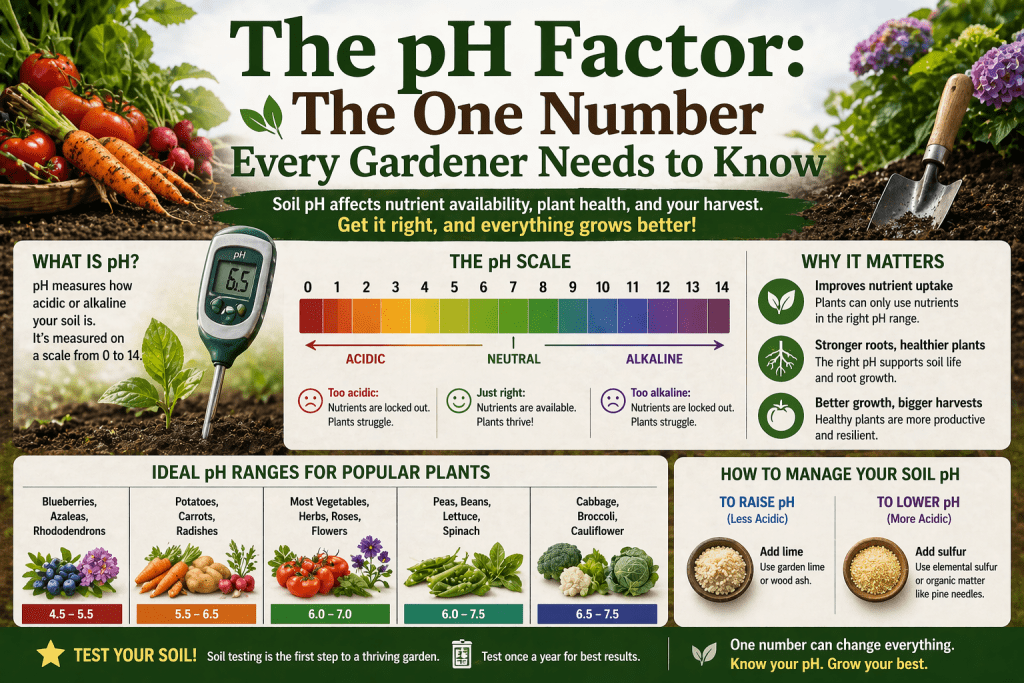
It is a challenge even for seasoned gardeners. Fertilizer applications that don’t work are often attributed to the product, the brand, the timing, or some nebulous incompatibility. Because the pH of the soil was incorrect, it’s possible that the nutrients were sitting there untouchable. If you add fertilizer to soil with a severely misaligned pH, it’s like putting money into an account you can’t access; the resources are there, but they’re not accessible.
It is important to understand acid-loving exceptions because they are most confusing to gardeners who are unaware of their existence. Blueberries require iron and other micronutrients that become highly soluble in soil with a pH of 4.5 to 5.5, which is actually acidic and would stress most plants. They will survive for a season or two in neutral garden soil at a pH of 6.5, appearing paler and yellow, never yielding much, and confusing the owner. Planting asparagus and clematis in beds that have been heavily amended with acidifying materials can harm them since they prefer slightly alkaline soil. Plants are aware of their desires. The hardest part is figuring out what the soil can offer.
Most gardeners lose steam during testing, which makes sense. Sounds technical or like something that requires specialized knowledge to understand. You can get a helpful reading in minutes with a simple home test kit from any garden center. It is faster and easier to use a digital pH meter year-round. For gardeners seeking precise, useful information, they can send a soil sample to a county cooperative extension office for analysis, including pH, nutrient levels, and organic matter percentages. In addition to saving years of underperforming beds, this final option usually costs between ten and thirty dollars. There’s no doubt that it’s one of the most underutilized tools for home gardening.
| Category | Details |
| What pH Measures | Acidity or alkalinity of soil on a scale of 0 to 14 |
| Neutral pH | 7.0 |
| Optimal Range for Most Vegetables | 6.0 – 7.0 |
| Single Best Target for General Gardens | 6.5 |
| Acid-Loving Plants (e.g. blueberries, azaleas) | pH 4.5 – 5.5 |
| Neutral to Alkaline Lovers (e.g. asparagus, clematis) | pH 6.0 – 7.5 |
| Nutrients Best Available At | pH 6.5 (nitrogen, phosphorus, potassium) |
| pH Below 4.7 | Bacterial activity drops sharply; organic matter stops breaking down |
| pH Below 5.0 Risk | Aluminum and manganese toxicity can damage roots |
| Raising pH (less acidic) | Add agricultural lime or wood ash |
| Lowering pH (more acidic) | Add sulfur, peat moss, or aluminum sulfate |
| Testing Options | Home kit, digital meter, or county Extension office lab analysis |
| Recommended Test Frequency | Every 2–3 years, or before major planting changes |
| Reference | RHS – Understanding Soil pH |
When you know where the pH is, adjusting it is deliberate and slow. The pH of acidic soil rises over several months when agricultural lime, or ground limestone, is added, sometimes taking a growing season. Similarly, wood ash functions, but more rapidly and in smaller quantities. To lower pH in alkaline soil, peat moss or sulfur are usually added well before planting. Without retesting, gardeners who aggressively add amendments risk overcorrecting, and neither procedure is instantaneous. Soil is not a device with dials that respond quickly. This is a slow system that takes time to react to inputs, so patience is required.
Gardening advice frequently ignores what the soil is actually doing in favor of planting and watering methods. The pH factor determines root health, microbial activity, nutrient availability, and ultimately whether a plant thrives or merely exists. It is not always possible to resolve an issue by knowing the number. The majority of other interventions, however, are guesses due to a lack of information.
As a Senior Editor at Mini Greenhouse Kits, Hannah Kinsley is a passionate supporter of small-space gardening and urban gardening. Hannah, who is currently majoring in Environmental Policy through the University of Michigan’s Environmental Studies program, infuses her writing with a solid academic foundation and a sincere enthusiasm for the environment. You can find her playing soccer or exploring the city’s green areas with friends when she’s not researching the newest trends in city gardening or creating content for minigreenhousekits.com.