
The majority of buyers consider what they want to grow in a small greenhouse before purchasing it. It’s probably tomatoes. Some chillies, some early salad crops, and some seedlings planted before the outdoor season begins. Nearly all of the reasoning is logical, proactive, and plant-centric. Neither the ecosystem created by a sealed, warm, humid structure for everything that feeds on those plants, nor the speed at which it can go from manageable to overwhelming once it gets going, play a significant role in that mental image.
A closed mini greenhouse is nearly perfect from the perspective of pests. The temperature remains high compared to the outside air. Humidity is high and constant. The food, which consists of young, delicate, actively growing plants, is easily accessible. Rain does not remove insects from leaves. Wind does not disturb populations. The number of outdoor pests is not controlled by natural predators such as ladybirds, parasitic wasps, ground beetles, or birds. Outside, an aphid colony is constantly under pressure. In a polycarbonate structure, it faces virtually nothing. Retrospectively, the reproductive mathematics are completely predictable.
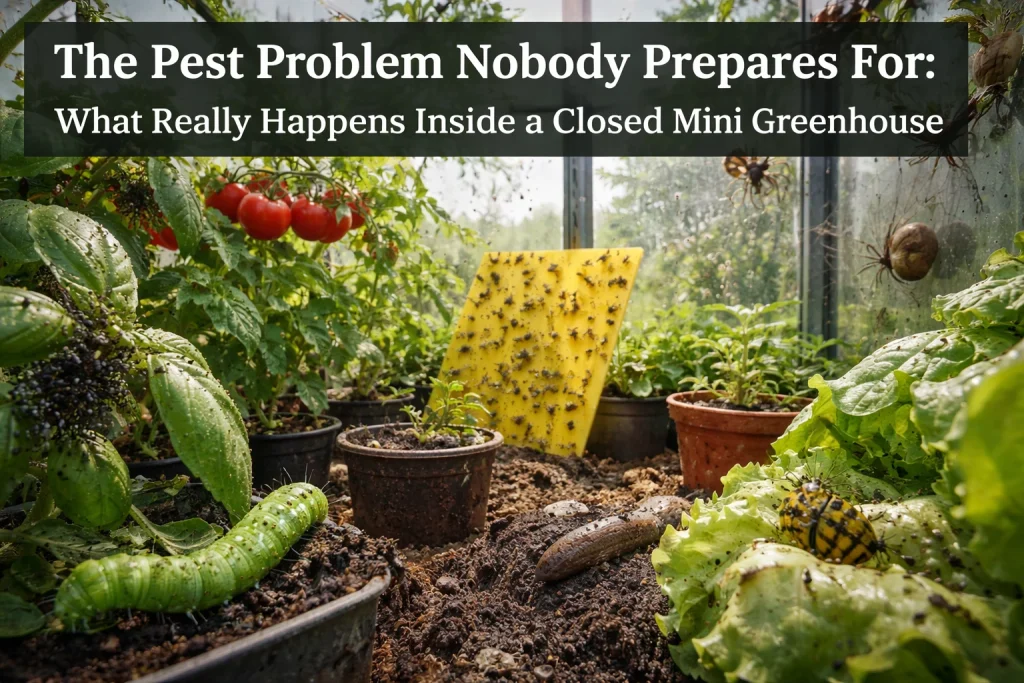
Understanding which pests establish themselves most easily in closed mini greenhouses is important because they behave differently and require different responses. Aphids and whiteflies are the most noticeable insects. A female whitefly can lay up to 400 eggs, and the life cycle takes three to four weeks in warm weather. Therefore, a small founding population can grow into a significant infestation before growers realize there is a problem. As a result of the sticky honeydew they leave on plant surfaces, photosynthesis is hindered by sooty black mold. Aphids reproduce even faster during the parthenogenetic stages of their cycle, giving birth to live young every seven days without a mate.
Spider mites are the most confusing insects. A half-millimeter in diameter, they are invisible to the naked eye until evidence builds up, such as pale flecking on leaves, bronze discoloration throughout the entire plant, and eventually fine webbing, which indicates a population that has been present for much longer than the grower thought. In buildings, they prefer the hot, dry corners that receive the most sunlight and the least amount of airflow. By the time the webbing becomes apparent, the infestation is already severe.
The larvae of fungus gnats feed on young root tissue and fine root hairs in wet compost, while the adults hover around pot surfaces and soil. As long as the compost remains moist, they develop as a result of overwatering. When humidity and condensation are persistent in a mini greenhouse, it is easy to unintentionally maintain that condition.
Especially vulnerable are seedling trays since they have no root system to fall back on when fungus gnat larvae start feeding.
Vine weevil is considered one of the most sneaky greenhouse pests because its damage is invisible and occurs underground. Adult beetles move slowly along the undersides of leaves and pot edges at night. Leaf margins are nicked with scalloped bites. Despite being annoying, this is not a major problem. Larvae are fat, white, C-shaped grubs that hatch from compost eggs and do most of the damage. By the time a plant collapses in the spring, seemingly without warning, its roots have already been eaten by them throughout the fall and winter. Container plants are especially vulnerable to larvae because they have nowhere to spread out.
Due to a lack of seasonal reset, closed greenhouse pests are particularly difficult to manage. The cold weather outside lowers or eradicates pest populations, giving growers a window of opportunity to successfully eradicate infestations. Inside a tiny greenhouse that keeps warm all winter, that window does not open. Despite three or four more generations of reproduction, a population of whiteflies that first appeared in October is still present in February. Pests that persist from season to season become increasingly difficult to manage because population sizes are already larger at the beginning of the growing season and because repeated exposure to the same management products fosters resistance.
Reading the testimonies of growers who have dealt with severe mini greenhouse infestations, it’s difficult to ignore how frequently the origin story involves one plant brought in without quarantine. A geranium overwintered on the patio. At a car boot sale, I found a fuchsia. From a garden center, this tomato plant looks fairly clean. In many cases, weeks of intensive treatment could have been contained with two weeks of isolation-a cold frame, a covered area outside, or someplace apart from the growing area. The quarantine habit is one of those things that seems fussy until one has experienced the alternative.