
The seedlings appear flawless on day four. Despite the compost’s surface, two tiny, upright, pale green leaves push through with the resolve that freshly sprouted seeds consistently demonstrate. Still attached to the propagator is the clear plastic lid, which produced the warm, misty atmosphere that initially encouraged the seeds to sprout. It feels wrong to take it off. The seedlings are very small. The air outside the dome is drier and colder. In the case of nearly every novice grower standing over that tray, it makes sense to leave the cover on a bit longer. In the interest of safety.
Usually, the first growing season ends with that choice, made with the best of intentions. Those same seedlings have long, thin stems by day six or seven, reaching upwards toward light that they cannot see through the fogged plastic. Compost’s surface develops a light white fuzz by day ten. Rather than mold from subpar seeds or roots, this is the first sign of fungal colonization spreading through a sealed environment with 100% humidity and no airflow. Several days later, the plant tips over and some stems become soft. Damping-off, a fungal disease that spreads rapidly and leaves no trace, is one of the most common causes of total seedling loss in home gardening. In addition, it is nearly impossible to avoid.
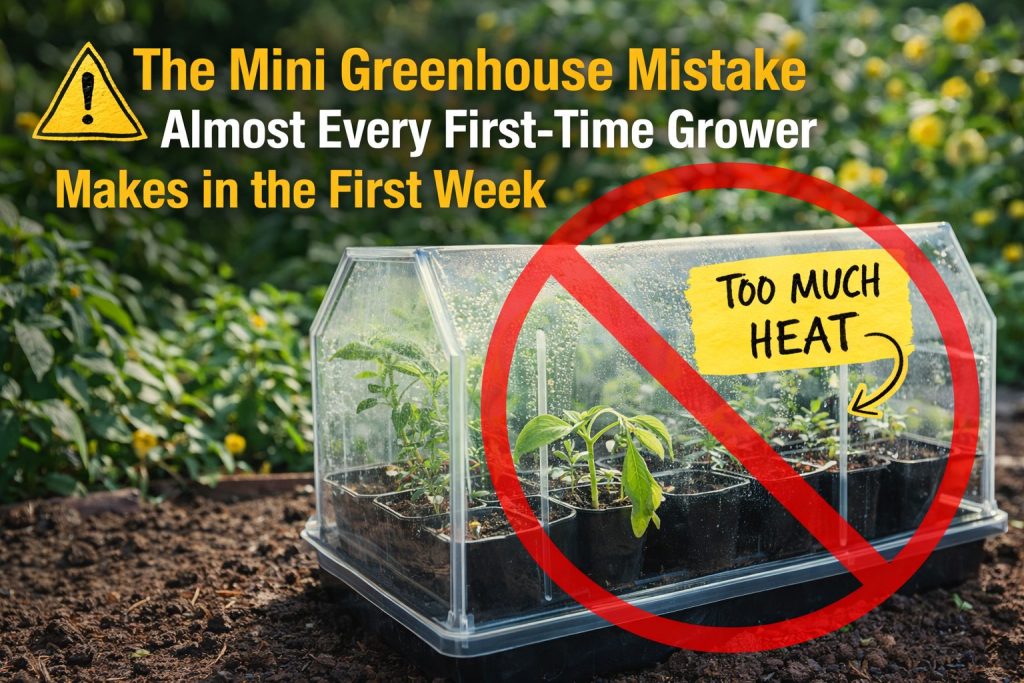
Until it doesn’t, the humidity dome makes sense. Moisture and warmth are necessary for seeds to sprout. A covered propagator creates the microclimate necessary for germination in crops that might otherwise struggle in the unpredictable temperatures of a house or cold greenhouse. It performs its intended function flawlessly. As soon as germination occurs, the problem arises. When a seedling emerges from its seed coat, it needs airflow, less humidity, and bright light. When the dome is left on, the warm, damp, still air that shielded the seed weakens or kills the plant it produced.
Growing new plants consistently follows this pattern, which seasoned growers find nearly predictable. It seems dangerous to remove the cover. A term used to describe tall, thin, and structurally weak plants that grow quickly in the wrong direction and search for light through hazy plastic is leggy. Humidity increases. Condensation covers the dome’s interior. The sealed environment prevents evaporation, so the compost surface never completely dries between waterings. The next issue is fungal infection, which typically starts as a faint discoloration at the soil line before softening and collapsing. When the first green appears above the compost, remove the cover immediately. It wasn’t a few days later, but right away. At that hour of the morning.
The two errors are so closely related that they often coexist. A sealed propagator, which keeps the compost nearly perpetually moist, reinforces the idea that seedlings are getting enough water and that any wilting indicates they need more water. Wilting seedlings in humid, sealed environments are more commonly caused by root oxygen starvation-compacted, wet compost that prevents roots from breathing-than by drought. Growers water compost when the surface feels lightly dry. Watering is often done on a schedule or whenever the plants appear uncertain, which can lead to a daily overwatering of a compost that is already wet. Overwatering and trapped humidity create the perfect environment for damping-off fungi to thrive.
Thirdly, light goes wrong during the first week, making everything worse. Most people put their mini greenhouses in bright spots, such as next to a window, in a conservatory, or against a south-facing wall, when setting them up for the first time. In comparison to indoor living standards, bright is genuinely inadequate for seedling development. Seedlings grow quickly and tall in the wrong direction without intense, direct light, devoting resources to stem length rather than root growth and leaf mass. Thus, plants appear tall but are physiologically and structurally underdeveloped. When a basic grow light is placed close to the trays, usually six to twelve inches above them, results are significantly altered. As a result, the growth remains compact and the stems are strong enough to sustain the plant during transplanting.
Before planting anything, place a max-min thermometer inside the empty greenhouse for two or three days before planting anything. It is not uncommon for unexpected results to occur. When the outside temperature is 18 degrees Celsius, a small plastic greenhouse on a south-facing patio can reach 50 degrees. In the absence of ventilation or shade, seeds will cook instead of sprouting, and the grower will wonder if the seeds were defective if nothing appears after two weeks. No, they weren’t. The setting made a difference. The first seed is inserted twenty minutes after the structure is constructed, and the first season is saved.
I can’t help but feel sorry for new growers going through this. A mini greenhouse’s retail experience does not adequately prepare consumers for how quickly the interior becomes hostile to plants. Growth is correlated with warmth, according to the packaging. There appears to be a shielding effect from the humidity dome. Place the plant in the sunniest part of the garden, water frequently, and keep the cover on. During the first week, they are all incorrect. Experienced growers know this because they have themselves made the same mistakes, usually only once. Seedlings cannot handle the learning curve. Information does.