

In late summer, you’ll see the same thing in most home greenhouses. In half of the building, cucumbers are piling up faster than anyone can consume them, while tomatoes are sprawling off their stakes, while the other half is empty and unoccupied. Then September comes, and suddenly there’s nothing. There is an implosion of the boom. It’s time for the bust. Six weeks after growing the vegetables in large quantities, the grower finds themselves back at the grocery store purchasing the same vegetables they were growing in large quantities.
Staggered succession planting is the basis of the mini greenhouse crop planning method. There is no complexity to the system. It’s almost disarmingly simple: you sow small batches every two to four weeks instead of filling every tray and container at once. Instead of a single, massive harvest followed by a long quiet period, you get a steady, manageable flow of produce throughout the year. Once a crop is harvested, it is replaced by another.
Many home growers initially oppose this strategy. The psychological appeal of filling space, planting everything available, and watching everything grow together is strong. When a greenhouse is fully stocked, it appears to be productive. At first, a partially staggered one doesn’t feel as satisfying. In addition, a full greenhouse also creates a problem: a glut, a gap, and the gradual inconvenience of having to wait for the next cycle.

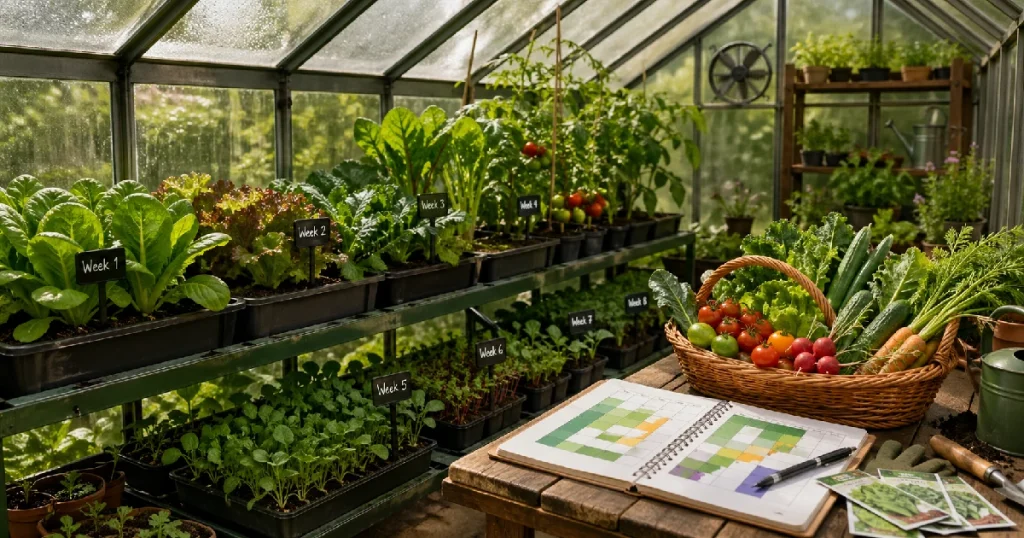
The “little and often” approach, as some seasoned growers refer to it, views the greenhouse more as a pipeline than a storage area. When lettuce, radishes, spinach, and arugula are sown every two to three weeks, harvested cleanly, and replaced promptly, this rhythm works best. Radishes, for example, take about 30 days to prepare. They take up very little space, grow in nearly any container deep enough to hold them, and vanish from shelves before the next batch arrives. Those who plant three or four radishes at a time in staggered sowings will never run out or feel overwhelmed.
Crop choice is almost as important as timing. A mini greenhouse is ideal for growing leafy greens, including kale, Swiss chard, spinach, and cut-and-come-again lettuce varieties, since they grow rapidly in small spaces, can withstand lower temperatures, and respond to cutting by resuming production rather than stopping. Herbs like mint, cilantro, and basil, which flourish in a greenhouse’s controlled heat, produce harvests that seem out of proportion to their size. When grown in big pots or hanging baskets, compact vine crops, such as Tiny Tim tomatoes, dwarf cucumbers, and peppers, significantly increase the range during the warmer months.
Vertical growing serves as both a planning tool and an efficiency trick here. In a single structure, shelves at different heights create distinct microclimates, with the top slightly warmer and the ground slightly cooler, so that different crops can be grown concurrently without competing. In the traditional greenhouse method, the floor is devoted to large containers containing mature crops, one shelf to seedlings just beginning, and another to plants in the middle of their growth cycle. Keeping the rotation visible helps growers stay on schedule. The pipeline is clearly visible at every stage.
Intercropping adds another layer. Radishes are sown around tomato plants that grow slowly in a space that would otherwise remain empty for weeks. As a result, the soil in that area is constantly occupied, and the radishes grow and emerge before the tomatoes. It is the same reasoning for lettuce grown beneath tomato foliage: the shade that would otherwise slow leafy greens actually helps them, and the lettuce keeps the root zone cool. By combining these factors, wasted space becomes genuinely rare in greenhouses, but timing is crucial.
Seasonal rotation keeps the system honest. During the spring and early summer, warm-season crops such as tomatoes, peppers, and cucumbers are grown from seed on the seedling shelf and then transplanted into larger containers. As summer plants grow weary, kale, winter lettuce, spinach, and mustard greens take their place. Colder, lower light levels actually benefit these plants. Furthermore, late summer is the ideal time to plant overwintering brassicas, such as cabbage and broccoli, which will survive the winter and provide food during the infamous early spring famine, when gardens are still weeks away from producing anything useful.
It’s genuinely satisfying knowing that no matter what crop is ready next, something will always be ready once the system is in operation. Instead of feeling like a seasonal endeavor, the tiny greenhouse feels more like a perpetual kitchen garden. It is a tiny, humming system that rewards attention and penalizes neglect. It might seem overwhelming at first to plan. The majority of worthwhile things do. It is difficult to refute the reasoning after a few weeks when shelves are consistently only partially full instead of occasionally overflowing.
As a Senior Editor at Mini Greenhouse Kits, Hannah Kinsley is a passionate supporter of small-space gardening and urban gardening. Hannah, who is currently majoring in Environmental Policy through the University of Michigan’s Environmental Studies program, infuses her writing with a solid academic foundation and a sincere enthusiasm for the environment. You can find her playing soccer or exploring the city’s green areas with friends when she’s not researching the newest trends in city gardening or creating content for minigreenhousekits.com.