
Damage is usually discovered first thing in the morning. The grower discovers something amiss when he opens the greenhouse door and reaches for the first plant to check the soil moisture level: healthy leaves are curled or yellowed, stems are stripped, and seedlings have disappeared. It is natural to blame watering or temperature. It also occurs infrequently. It’s almost always a closed greenhouse that creates the perfect conditions for insects that can kill plants quickly: it’s warm, protected, free of natural predators, and has concentrated food sources.
Most growers deal with aphids first due to their high reproduction rate. Black bean and green peach aphids, the two most prevalent species in UK greenhouses, are soft-bodied, 2–4 mm long, and unremarkable until they aren’t. New leaves, flower buds, and the tips of shoots where sap flows most freely are the youngest, most delicate growth. Yellowing leaves that are curling, sticky residue covering everything underneath the infestation, and occasionally a black sooty mold growing on that residue are often the first signs of an infestation rather than the insects themselves. In a heated greenhouse in the spring, a small aphid population can grow into a major infestation in just two weeks.
Even though whiteflies are easier to identify, they are frequently overlooked until the problem is discovered. There is a cloud of tiny white insects that appear from infected plants, resembling tissue paper that is briefly animated before returning to their normal state. Adults are not the primary threat. During several stages of development, their translucent, scale-like larvae attach to the undersides of leaves and feed steadily. In an outdoor garden, winter kills them back. Early intervention is more crucial than most growers realize when they notice adults emerging from a plant when the cycle continues uninterrupted in a heated greenhouse.
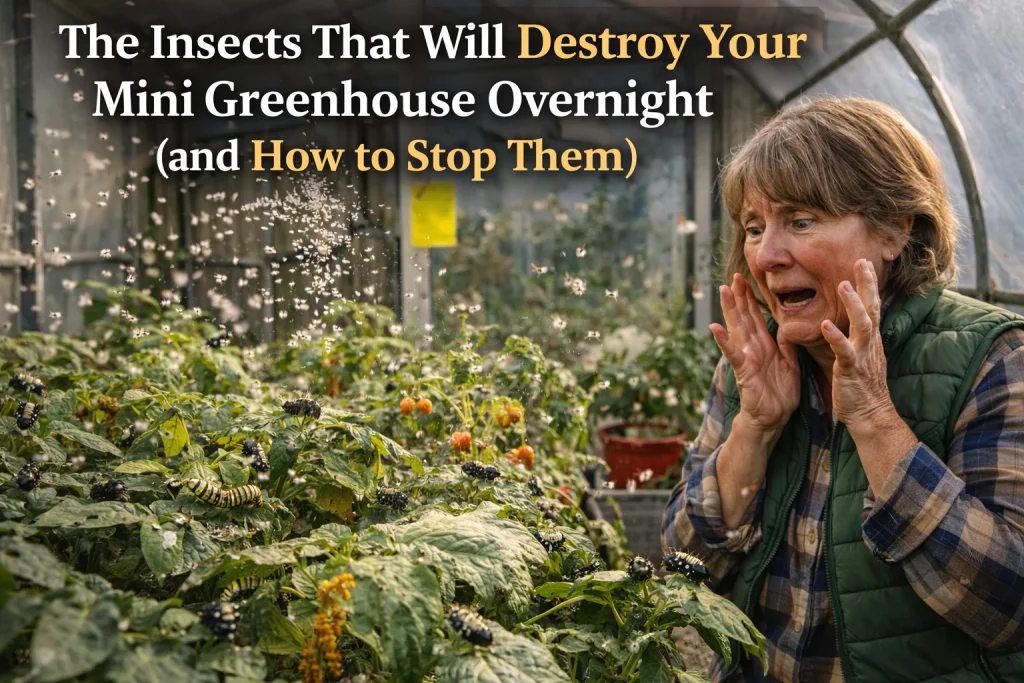
Red spider mites do most of their damage before they are visible to the unaided eye, which makes them a completely different problem. Because they are only 0.5 millimeters long, direct identification requires magnification, but their work can be read without it. Leaves with white or yellow flecks where sap has been drained. The foliage becomes bronzed as the infestation worsens. Eventually, silken webbing covers leaves and stems in severe cases, indicating a population that has existed and grown for a much longer period of time than most growers expect. In spite of this paradox, spider mites are a specific summer issue that gets better with higher humidity because they thrive in hot, dry conditions, which are ideal for many summer greenhouse crops.
Sap-sucking insects work on a different schedule than caterpillars. In contrast to caterpillars, aphids weaken plants over days or weeks, not instantly. It is possible for caterpillars of several moth species that use heated greenhouses as breeding grounds all year round, cabbage moth larvae, and cutworms to strip foliage or cut seedlings clean in a single night. Damage is evident in clean-edged holes, severed stems, and entire plants that have vanished under the soil’s surface. Since they feed primarily at night and conceal during the day, it is necessary to look under staging, inside folded leaves, and in the soil around plant bases.
It deserves special attention since the vine weevil operates on two levels at once and can cause damage for months before it is detected. Adult beetles are dark grey in color, about 9 mm in size, and have distinctive notch edges on their leaf margins from feeding. The larvae are fat, white, C-shaped grubs in the compost that destroy root systems methodically and completely. Despite looking healthy on Monday, a plant in a container may collapse without any recoverable root structure by Thursday. Container plants are particularly vulnerable to larvae because they have no place to spread.
Increasingly, greenhouse growers use biological control instead of chemical sprays, in part because it doesn’t need to be reapplied. Ladybirds – one of which eats about 5,000 aphids in its lifetime – often establish themselves in greenhouses and stay there for life. Whitefly larvae are parasitized by Encarsia wasps, which are so small that they are almost invisible, preventing them from reproducing. Physeiulus mites, which travel faster than red spider mites, eat about twenty of them per day. Dragonfli and Defenders are two UK suppliers of these insects, which are most effective when introduced early, before populations grow to the point where control becomes remedial rather than preventative.
Most greenhouse pest issues have one thing in common: new plants brought in without quarantine, which carry covert infestations that spread before anyone notices. Introductions that turn into infestations can often be avoided by isolating each new arrival for two weeks, either in a cold frame or in a protected outdoor area. Patience is needed at the point of purchase, when it is least appealing. We save weeks of treatment later. Despite the fact that the habit takes time to develop, the math is simple.