
It’s almost comical how gardening trends change. Experts now consider the same hollyhock that was removed from front borders a generation ago as “a must-have for adding vertical drama.” The price remains the same. It continues to grow in the same way. The only thing that has changed is what we choose to call beautiful.
It’s not surprising that grandmother-style flowers are making a comeback. Historically, fragrance was absent from contemporary gardens due to convenience, hybrid vigor, and the constant pressure to keep things neat and pollen-free. There was a sense that gardeners had come to terms with the fact that a garden could be immaculate without having any scent. That seems to be changing rapidly.
Sweet peas are perhaps the best example of what’s going on. Because of their papery petals and seductive aroma, these climbing annuals were common in Victorian cutting gardens. They seemed almost out of date for a while, like a butter dish on the kitchen table or lace curtains. In these days, seed suppliers can hardly keep them in stock. The change is due to the growing popularity of sensory gardening, the idea that a garden should be experienced rather than simply photographed. It also seems like a subdued protest against purchasing shrink-wrapped supermarket bouquets.
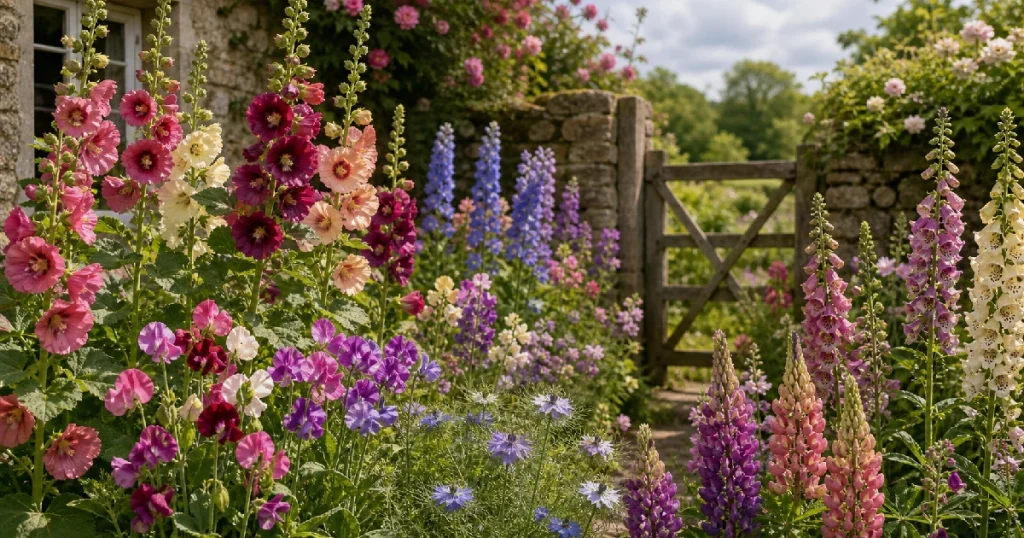
Hollyhocks have also returned, and their recovery is arguably the most spectacular. A hot summer would see these biennial towers of pink, crimson, and cream mark the entrance to farmhouse gates across England. Amber Tunney of Cherry Lane Garden Centers describes the change as “gardeners leaning into romantic, heritage planting styles.” That’s a sophisticated way of describing it. Alternatively, gardeners grew weary of the rigid geometry of modern planting, such as the blocks of decorative grasses and the excessively regulated color schemes, and began to crave something more organic. A hollyhock leaning against an old wall can do that easily.
During the Chelsea Flower Show, where designers have used foxgloves in the same way they used alliums in previous decades, foxgloves have experienced a subtly dramatic comeback. It can either be a good thing or a problem that they self-seed freely, depending on how much improvisation you can handle. Their tubular flowers attract pollinators, especially bumblebees, who are attracted to them. Twenty years ago, consumer gardening literature rarely mentioned pollinators.
Delphiniums play an odd role in this revival. Technically, they are admired because of their tall, blue spires, but they require staking, pout in clay, and are vulnerable to slug damage. Due to their effort, they are no longer regularly used. King Charles reportedly liked them, and that kind of cultural signal travels through gardening circles in ways that might surprise people who don’t pay attention to them. It appears that royal endorsement played a part in this. It works regardless of whether it’s absurd or not.
Lupins are a little different. Despite their stigma, they were never completely forgotten—you could still find them in garden centers during hard times. The frequency is too high. It’s too local. Too much like something planted near a roundabout. Ecology has taken precedence over aesthetics. Lupins fix nitrogen in the soil, making them useful to gardeners who want to use fewer artificial fertilizers. The environmentally conscious grower has successfully restored the lupin’s reputation, and its architectural height and vibrant colors are now genuinely exciting.
In addition to personal plant preferences, it’s important to consider the broader implications. A disenchantment with the notion that a plant must be a hybrid to be worth cultivating, or that newer is always better, seems to be behind the resurgence of cottage flowers. A nonprofit organization that protects heirloom varieties, Seed Savers Exchange, is reporting an increase in interest in its catalog. There seems to be an increase in local seed swaps, where gardeners exchange seeds they have harvested from their own plots. The issue of inheritance rather than commerce is being discussed regarding peonies, which can live for decades beyond their original owners.
| Category | Details |
| Subject | Cottage Garden Flowers Revival |
| Also Known As | Grandma-style / Heirloom / Heritage Blooms |
| Origin Era | Victorian & colonial garden traditions (1800s–early 1900s) |
| Key Flowers | Hollyhocks, Foxgloves, Sweet Peas, Delphiniums, Lupins, Peonies, Irises, Columbine |
| Revival Year | 2025–2026 (documented resurgence across UK and US gardens) |
| Key Appeal | Pollinator support, low maintenance, nostalgia, natural fragrance |
| Notable Trend Source | Chelsea Flower Show 2024–2025; Royal endorsement (King Charles) |
| Where to Source | Seed Savers Exchange (Iowa), local seed swaps, neighbour pass-alongs |
Some of the flowers making more subdued comebacks are less well-known than hollyhocks and sweet peas. A Victorian annual with lacy foliage and blue flowers that look like they belong in a botanical illustration is Love-in-a-Mist. Known as “Four O’Clocks,” Mirabilis jalapa opens its trumpet-shaped flowers in the late afternoon and releases a fragrance that attracts evening moths. Garden centers don’t sell these plants in four-inch pots with glossy labels. The envelopes that someone’s aunt, who has been cultivating them since the 1970s, has pressed into your hands, the back of seed catalogues, and old gardening books contain them. Currently, they are appealing because of that quality – handmade, passed-along, unhyped.
Contemporary hybrids will not disappear as a result of all of this. Compact, long-blooming, disease-resistant varieties will continue to be produced by the enormous plant industry. However, cottage flowers could signify a true correction – a realization that some things were thrown away too soon, and that a plant that has survived in gardens for two centuries probably knows what it’s doing. There was no change in the hollyhock. We did.
As a Senior Editor at Mini Greenhouse Kits, Hannah Kinsley is a passionate supporter of small-space gardening and urban gardening. Hannah, who is currently majoring in Environmental Policy through the University of Michigan’s Environmental Studies program, infuses her writing with a solid academic foundation and a sincere enthusiasm for the environment. You can find her playing soccer or exploring the city’s green areas with friends when she’s not researching the newest trends in city gardening or creating content for minigreenhousekits.com.