

It causes a certain kind of regret to reach for the small glass jar of dried basil and shake some dusty flakes over a tomato sauce that deserves better. Thousands of kitchens experience this every evening, and it is nearly entirely preventable. Planting herbs indoors may seem like a weekend project for overly enthusiastic gardeners, but the reality is more subdued and useful than that. The flavor of a meal can actually be changed by a few pots, a south-facing windowsill, and a little persistence.
It’s important to be honest about the true effects of fresh herbs. In the nebulous sense of a cookbook blurb, they do more than “add flavor.”. When dried basil reaches the spice rack, it has lost its sweetness and subtle pepper note, whereas fresh basil, picked minutes before it reaches the pasta plate, still has these qualities. The freshness of mint clipped from a pot on the counter cannot be matched by a dried substitute. Rather than being subtle, it leaves visitors wondering in private what has changed.
Herbs that are easy to grow indoors are also the most forgiving. Mint is nearly impossible to kill. Water and light are all it needs to grow, and it can recover from neglect very quickly. However, it needs its own pot; if left with neighbors, it will gradually push them out. The best choice for kitchens that don’t receive optimal sunlight is chives, as they are similarly uncomplicated, grow steadily after each cut, and tolerate moderate light. Skill is not required for either herb. Most of the time, they just need to be remembered.
With basil, things get a bit more complicated, which is also where most novices struggle. Warmth and bright light are important to it. By a drafty window or in a cool corner, it pouts. However, if it is content, it grows rapidly enough to outpace frequent use, and pinching the upper leaves regularly keeps it bushy instead of blooming early. As soon as basil flowers, its leaves turn bitter. Once someone discovers it, it appears to be a clear secret that everyone else is aware of.

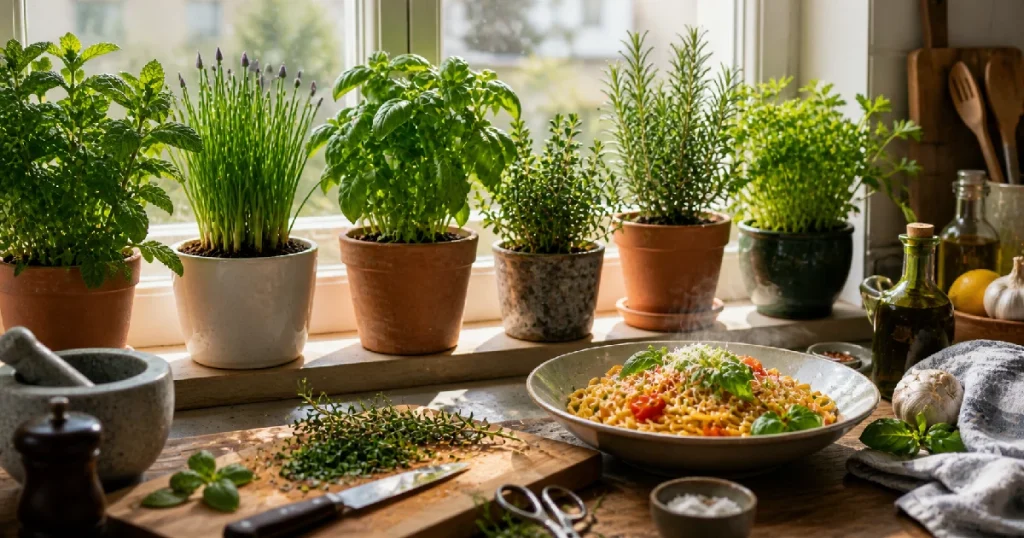
The Slow Herbs Are Well Worth the Wait: Growing Rosemary and Thyme Indoors
Herbs like thyme and rosemary work differently from those that grow faster. While they are less instantly satisfying, slower, and woodier, they are also more drought-tolerant and, in some respects, better suited to a busy person’s erratic attention span. Neglected rosemary grows well in particular. Moisture is not good for its roots. When left in damp soil, it gradually deteriorates before suddenly disappearing. It will, however, release a pine-resin aroma every time a branch is brushed if placed on a sunny windowsill in a pot with adequate drainage. There is a grounding effect even when it isn’t in use.
Small pots (four to six inches) of thyme work well in soups, stews, and roasted vegetables, giving them a rich, earthy flavor that dried thyme cannot quite match. Due to its slow growth, it does not require continuous harvesting from a nursery plant. If you frequently overbuy fresh herbs at the grocery store only to watch them wilt in the refrigerator drawer, keeping a pot of thyme close by is a much more sensible arrangement.
There is no doubt that parsley is the most underappreciated of these herbs. The plant grows quickly after cutting, tolerates partial shade better than most, and gives dishes that might otherwise feel heavy a “fresh green” quality. A spoonful of finely chopped parsley can elevate roasted carrots or lentil soup subtly. It is the type of ingredient that is noticeable by its absence but isn’t given credit for.
How to Establish an Indoor Kitchen Herb Garden: What’s Really Important
In most cases, it is better to start with nursery plants rather than seeds. Seeds need more time, attention, and patience before they can contribute to cooking. Basil plants can be repotted, given adequate light, and added to meals within days of buying them at the grocery store or garden center. There is a much smaller difference between effort and reward, and the initial investment is much lower. Many people who experiment with seeds give up and never try again because of this; they simply had to start the process from scratch.
Practical requirements are sufficient to be comforting for most herbs. It is nearly always a drainage problem that causes root rot, so you should use pots with drainage holes. Herbs prefer that the top inch of soil dry out between waterings, so check with a finger instead of following a schedule. While grow lights can compensate for a kitchen without windows, it is preferable to have a south or west-facing window. Even pinching a few leaves regularly promotes growth rather than stunts it. Guidelines like these are not difficult to follow.
| Category | Details |
| Topic | Indoor Herb Gardening for Home Cooks |
| Best Beginner Herbs | Basil, Mint, Chives, Parsley, Rosemary, Thyme, Lemongrass |
| Sunlight Requirement | Minimum 6 hours/day; south- or west-facing windowsill ideal |
| Watering Rule | Water when top inch of soil feels dry; never leave in soggy soil |
| Key Success Factor | Good drainage holes in pots; clay pots recommended for thyme and rosemary |
| Difficulty Level | Beginner-friendly; most herbs thrive on minimal attention |
Lemongrass is unique because of its personality. You can propagate it straight from a fresh grocery store stalk submerged in water. Curries, soups, and teas with its citrusy flavor cannot be duplicated by any other means. People perceive it as exotic and thus challenging, despite the fact that it is nearly the opposite of what they perceive. It is unclear why it isn’t more popular in home herb setups; it could be because they perceive it as exotic and therefore challenging.
It seems like cooking in a kitchen with a few functional herb pots on the windowsill is a little more thoughtful – not necessarily more difficult, but more deliberate. When the cook uses a living plant instead of a jar, their relationship with the food is altered. In the kitchen, little things tend to pile up. Herbs that are easy to grow indoors don’t require a lot of work. It is truly difficult to break a habit once it has been established.
As a Senior Editor at Mini Greenhouse Kits, Hannah Kinsley is a passionate supporter of small-space gardening and urban gardening. Hannah, who is currently majoring in Environmental Policy through the University of Michigan’s Environmental Studies program, infuses her writing with a solid academic foundation and a sincere enthusiasm for the environment. You can find her playing soccer or exploring the city’s green areas with friends when she’s not researching the newest trends in city gardening or creating content for minigreenhousekits.com.