

French marigolds, with their almost garish orange flowers set against dark green foliage, are nestled among rows of tomatoes in a suburban Ohio backyard, close enough to touch. It’s not exactly an aesthetic choice. Having lost half of a tomato crop to whiteflies two summers earlier, the gardener placed them there. This season, there have been no whiteflies. It’s hard to tell if that’s the weather, the marigolds, or something else. The gardener, however, is not moving them.
The majority of people learn about companion planting through a bad season and a recommendation from someone who is passionate about it. It is not as old as gardening itself that the idea of gardening as a hobby first emerged. Among the most researched examples of plants working together are the Three Sisters – corn, beans, and squash. Before European settlers arrived in North America, indigenous cultures were engaging in sophisticated intercropping. Corn gives beans something to climb on. Beans draw nitrogen from the atmosphere and deposit it in the soil. As squash spreads widely and low, it provides shade, retains moisture, and inhibits weed growth. There is something that every plant is capable of that no other plant is capable of. This is a sophisticated system that works.
Science is now catching up with observation, which has changed recently. According to USDA research, intercropping can significantly reduce pest outbreaks compared to single-crop rows. Pests that specialize in one crop become confused when they are surrounded by something completely different. Finding its preferred target is difficult for it. Either it moves on or it finds that there isn’t enough food to sustain a harmful population. For pest control, it is purposefully designed garden chaos.

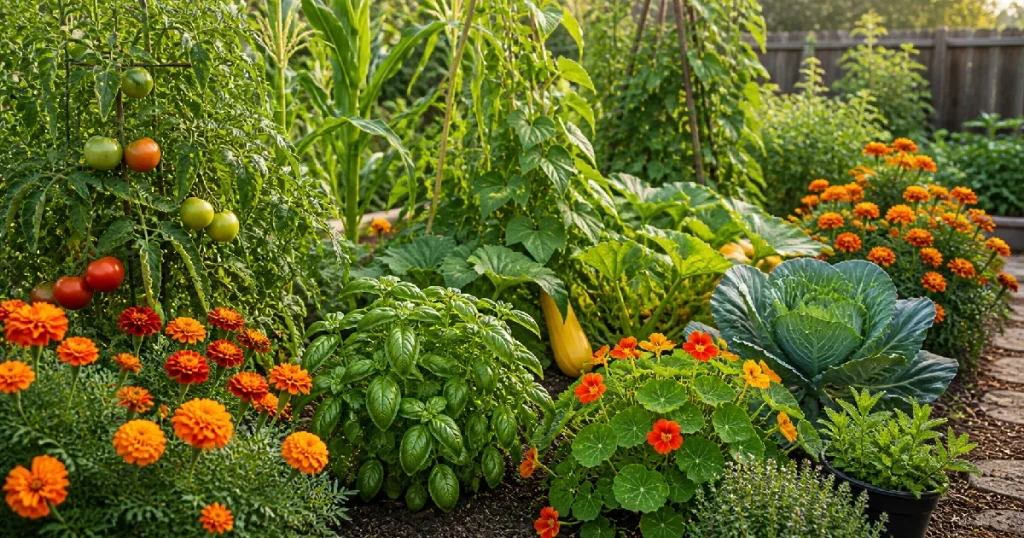
Marigolds are frequently discussed in relation to companion planting with good reason. French marigolds, especially Tagetes, release chemicals that poison soil-dwelling nematodes, which attack tomato roots and can destroy an entire bed before you notice anything wrong above ground. When planted thickly around tomatoes or peppers, they confuse and deter whiteflies, one of the most tenacious pests in a warm-weather garden. The same combinations recur in gardening literature from various nations and eras, as though plants had already discovered their alliances before gardeners began recording them.
Basil and tomatoes are another combination found everywhere that carries the weight of accumulated experience. The aromatic oils in basil that make it useful in the kitchen also keep flies, aphids, and spider mites away when it grows near its neighbors. Despite the persistent claim that basil enhances tomato flavor, there isn’t enough evidence to support that particular garden folklore. University extension programs now list pest deterrence as a valid gardening tactic rather than a gardening myth.
Nasturtiums use a different logic, and it’s important to recognize this. Instead of repelling pests, Nasturtiums attract them. Intentionally. Aphids find nasturtiums irresistible and much more appealing than nearby beans or cabbage, making them what gardeners refer to as trap crops, attracting them away from everything else. It requires a certain level of tolerance, which not everyone possesses, for the benefit of other plants. As soon as you observe a nasturtium completely covered in aphids while the nearby kale remains undisturbed, it is hard to dispute the idea.
| Category | Details |
| Topic | Companion Planting — Natural Pest Management in Vegetable Gardens |
| Method Origin | Traditional indigenous knowledge + modern ecological research |
| Key Principle | Biodiversity confuses pests and attracts beneficial predators |
| Top Pest-Repelling Plants | Marigolds, Basil, Nasturtium, Garlic, Rosemary, Sage |
| Top Beneficial Insect Attractors | Sweet Alyssum, Dill, Borage, Calendula, Tansy |
| Classic Example | Three Sisters — corn, beans, squash |
| Best For | Organic gardeners, food security growers, chemical-free households |
| Skill Level | Beginner to advanced |
| Key Caution | Mint must be container-grown — it spreads aggressively |
Brassicas, such as cabbage, broccoli, and kale, are often paired with strong-smelling herbs. There is an almost unwavering commitment by cabbage moths and flea beetles to confuse thyme, sage, rosemary, and mint with their prey. An Iowa State study showed quantifiable decreases in cabbage worm damage when thyme was planted nearby, which transforms a gardening tip into a gardening strategy. Mint, however, is an exception. Through underground runners, it can covertly colonize an entire bed in a season if left unchecked. By placing container-grown mint nearby, the benefit can be captured while the takeover can be prevented.
Companion planting’s appeal extends beyond pest control when observed across gardens and seasons. The garden is viewed more as a community of objects with complementary needs and purposes than as a production system from this perspective. Some relationships in that community are unclear, poorly documented, and based more on custom than on facts. Observation is just as important as following a chart here. Each garden has its own soil, pest pressures, and microclimate. Combinations that consistently work share one characteristic: they observe the actual behavior of the plants and adjust accordingly.
Olivia Murphy is a Senior Editor at Mini Greenhouse Kits and a fervent supporter of small-space and urban gardening. Alyssa, who is currently majoring in both literature and biology at Michigan State University, infuses her writing about city gardening and small-space growing with a unique blend of scientific curiosity and storytelling instinct. Her love of literature influences how she tells the stories behind the plants, and her background in biology gives her content a grounded, research-informed edge. When she’s not working on her next gardening piece, you can find her curled up with a good magazine or watching a movie that she’s been meaning to watch for weeks. She writes with passion at minigreenhousekits.com.