

Once you discover that your tomato plants are completely covered in aphids, a certain kind of panic sets in. Small and pale, clustered along each new shoot. It’s almost instinctual to reach for something, like a spray bottle. Most gardeners do that. It seems to work for one or two seasons. In response to the aphids returning more quickly and in larger numbers, the spray schedule subtly doubles. It is possible that they were unaware of what was happening on the other side of that equation.
Broad-spectrum insecticides eliminate aphids as well as everything else. Ladybug larvae make their way through a colony after crossing three leaves. Lacewing eggs were nestled in the underside of a stem. Infestation had already been found by the small, non-stinging parasitic wasp, and it was working on something truly amazing. All of it is gone. This results in a garden that appears tidy for a week or two before collapsing into the same problem, lacking the organic resistance it had developed over time.

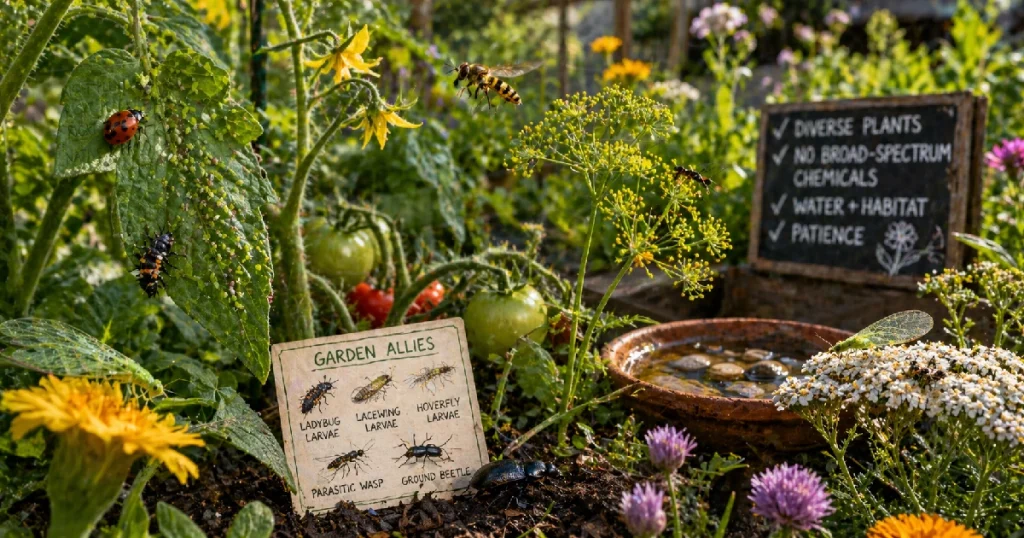
The Bugs You Keep Killing Are Actually Saving Your Vegetable Garden
In a garden without chemical treatment for a few seasons, it’s hard to ignore how much activity is already taking place. During the night, ground beetles consume cutworm eggs and slugs before they become a problem. Hoverflies are often mistaken for wasps because of their banded bodies. They hover close to flowering herbs during the afternoon, and their larvae are already eating aphid colonies on nearby brassica leaves. Spiders, which have a bad reputation almost everywhere in the garden, prey on flies, thrips, and caterpillars in the lower foliage. It is not uncommon for them to visit. In the right circumstances, they are residents.
One of the most surprising aspects is how simple the conditions are. In temperate gardens, plants like parsley, dill, chives, and calendula attract ladybugs, which are generally recognized as the main aphid predators. If dill blooms at the edge of a vegetable bed, it tells the local insect population that this is a place worth visiting – something a spray could never do. Fennel, cilantro, and Queen Anne’s Lac have flat-topped flower heads that are particularly good at attracting parasitic wasps. During their adult lives, these small, non-stinging wasps use caterpillar larvae as hosts for their eggs. Among the most effective pest control systems available to backyard growers, they are both unsettling and effective.
Lacewings deserve more attention than they currently receive. As dusk approaches, the adults move through the garden, their pale green wings almost decorative. There is a huge difference between the larvae. Sometimes called aphid lions, they move through colonies with a methodical intensity that is nearly impossible to witness. Lacewing larvae can eat hundreds of aphids during their development. Lacewing adults are attracted to gardens by marigolds, sweet alyssum, and yarrow, which provide nectar for their larvae.
In particular, novice gardeners tend to view gardens as problems to be resolved rather than systems to be managed. Pests are eradicated as soon as they appear. Vegetable gardens planted with flowering herbs, left mostly free of broad-spectrum chemicals, and allowed to retain some leaf litter around their edges develop something more similar to a living immune system. Pest populations don’t disappear completely because predator populations fluctuate with pest populations. Most home gardeners are unaware of how quickly this balance can develop when given the chance.
How Beneficial Insects for Vegetable Gardening Create a Self-Managing Garden
If intervention feels necessary, which it occasionally does, the choice of product is more important than most people realize. At dusk, when most beneficial insects have moved away from plant surfaces, insecticidal soap and neem oil are significantly less toxic to populations of beneficial insects than synthetic pyrethroids or organophosphates. Even these selective options should be used sparingly. It is not intended to reset a situation, but rather to nudge it in the right direction.
| Topic | Beneficial Insects for Vegetable Gardens |
| Field | Organic Horticulture / Integrated Pest Management |
| Key Insects | Ladybugs, Lacewings, Hoverflies, Parasitic Wasps, Ground Beetles, Spiders |
| Primary Function | Natural pest control, pollination, soil health |
| Main Pests Controlled | Aphids, whitefly, caterpillars, mealybugs, slugs, cutworms |
| Recommended Companion Plants | Dill, fennel, sweet alyssum, marigolds, yarrow, borage |
| What to Avoid | Broad-spectrum insecticides, excessive soil disturbance |
| Safe Alternatives if Needed | Insecticidal soap, neem oil, applied at dusk |
| Reference | The Old Farmer’s Almanac — Beneficial Insects |
Many species of insects will use a shallow dish filled with pebbles and kept topped up near flowering plants as a landing zone. Insects, however, rarely receive water from growers. It is also important to reduce unnecessary excavation and soil disturbance because parasitic wasps and ground beetles spend a large portion of their lives underground or in leaf litter, and frequent cultivation disturbs populations that have taken a whole season to establish.
Seeing a garden transition from a state of chemical dependency to one that mostly takes care of itself takes time. Halfway through a season, it can feel like a failure, and it doesn’t happen every time. As predator populations increase, aphids remain on plants for two weeks instead of being sprayed away. I don’t like it. The infestation simply vanishes one morning, and ladybug larvae are everywhere. That experience tends to permanently alter a person’s perspective on gardening more than any spray outcome.
Alyssa Bennet is a Senior Editor at Mini Greenhouse Kits and a passionate advocate for urban gardening and small-space growing. Currently pursuing her major in Arts at the University of California, Alyssa brings a distinctly creative eye to the world of city gardening – blending artistic sensibility with a genuine love for green living. She writes regularly at minigreenhousekits.com, and when she’s not crafting her next gardening piece, you’ll find her with a paintbrush in hand, watching sports, or exploring the city with friends.