
Each spring, it begins in the same way. While holding a seed packet and a phone, the weather outside is clearly saying one thing and the app is saying another. As per the packet, “sow March to May.” The temperature is just above freezing and the sky is gray. The app recommends next week after some thought. Those who have tried to assign the natural rhythms of gardening to software will recognize this minor annoyance. However, the apps continue to improve, and more people are using them. This field seems to be maturing quietly, category by category, right now, which deserves careful attention.
Garden planning apps have been around long enough to develop their own personalities. It’s capable, mature, a little cluttered on a small screen, and great at what it does. In terms of visual garden design, its drag-and-drop bed layout is still the best available for serious vegetable growers. Its crop rotation tracking across multiple seasons is absolutely indispensable for serious vegetable growers. The layout view includes companion planting compatibility, and the plant database includes hundreds of varieties with detailed growing instructions. There is no attempt at elegance here. For the most part, it tries to be helpful. Although the price, which ranges from $35 to $50 per year depending on how you subscribe, seems excessive for a tool that hasn’t changed significantly in years, the functionality makes it worthwhile for people who manage large vegetable gardens.
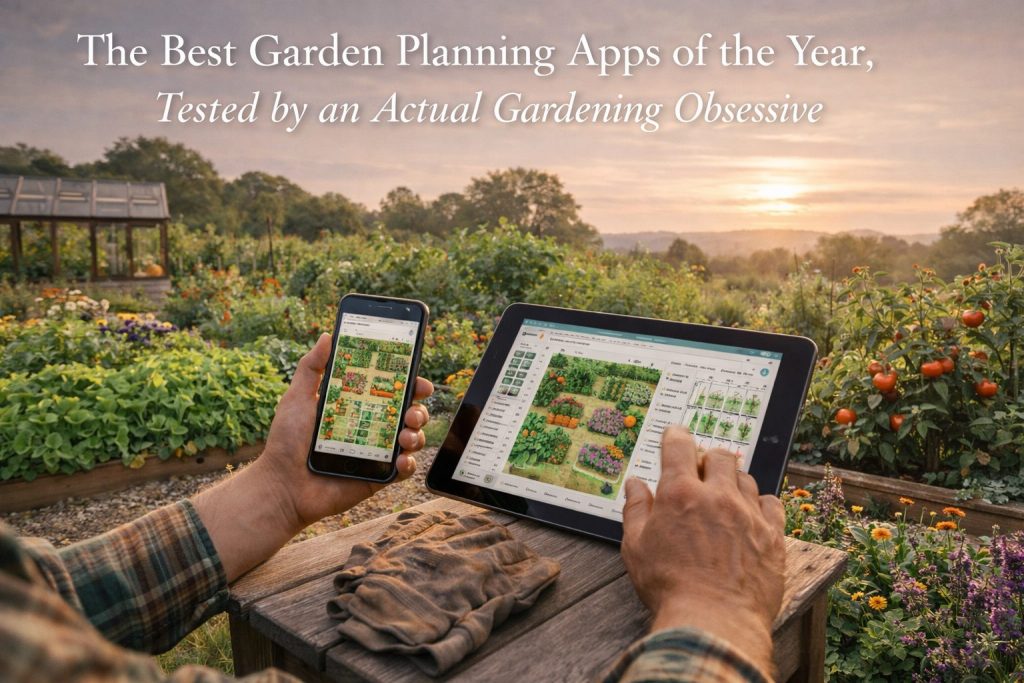
On the other end of the spectrum, Planter occupies a confident position. If you’re planting your first raised bed and don’t want a tutorial before figuring out where to plant your courgettes, there’s an app for you. It’s a straightforward color-coded system that shows green for good neighbors and red for bad ones, without the need for manual reading. Most garden planning tools were designed for desktop screens and scaled down reluctantly, so it feels like it was made for a smartphone, which may seem obvious but is not. It is evident from every tap that Planter was constructed in the opposite direction. In the free tier, you get one complete garden with all essential features. That’s more than most credit card-free apps offer.
Seedtime addresses a more limited issue than either of those, but it does so effectively. Seed-starting timing is a real source of anxiety for novice gardeners. Knowing whether you’re three weeks early, exactly on schedule, or already too late is a real source of stress. With Seedtime, you can customize planting schedules based on your location, watch video content to guide you through each stage, and also ask questions with an AI assistant called Sprout Bot. While the planting calendar itself is good, the guided lessons make it feel more like instruction than software. Perhaps this is what makes it so unique. Even though it’s still relatively new, it’s the most targeted tool available for those who are more concerned with seed starting than with spatial planning.
Unlike the others, Gardenize operates differently. It’s not a planner at all. This is a photo-based journal that documents your growth, location, and progress. As with a good garden journal, value accumulates gradually until you have three or four seasons of notes and photos arranged by plant and searchable within thirty seconds. The plant identification feature allows you to take a picture of an unknown object and receive a suggested name. There are more people than you might imagine who inherit a mysterious garden. At about twelve dollars a year, it’s possibly the most affordable option in the area given its scope.
In contrast, Leaftide was born out of a frustration that all the other apps on this list have discreetly overlooked: what to do with the plants that don’t move? There is an apple tree in the corner. Raspberry canes. The previous occupant planted the rosemary bush in the same spot. Garden applications lack a model for an evergreen plant. They treat the garden as a blank grid until the permanent plants outnumber the annuals. In addition to pruning logs, harvest records, variety-specific notes, and photo histories spanning years, Leaftide also tracks trees and perennials. Aside from zone-based frost dates, its scheduling engine incorporates day-length data and soil temperature signals to generate dates that change in real time as you make changes to your growing setup. Although it’s the most ambitious tool in the category, it still lacks the comprehensive plant database that GrowVeg has built over ten years.
There is no way to ignore the fact that none of these apps can do everything on their own. It may sound annoying, but the real advice is still to use two: one for tracking and one for layout. There is a big difference between what these tools did five years ago and what they do today. Unlike their predecessors, the top garden planning apps of 2026 are actually useful. Choosing an appropriate tool for each annoyance is the challenge.