
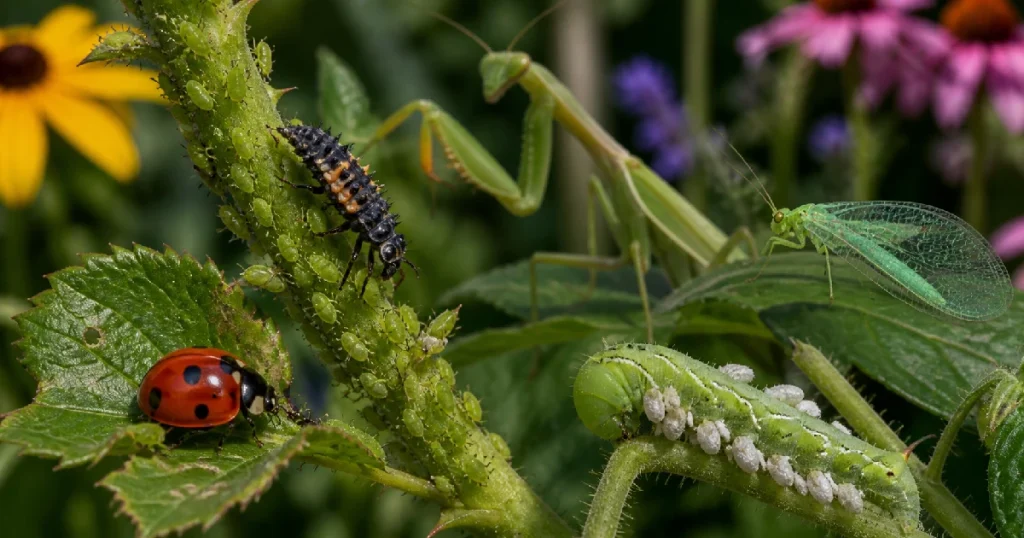
If you take a leisurely stroll through a vegetable garden in July and crouch down close to a rose stem covered in aphids, you will likely notice something that most people completely overlook. Unlike ladybugs, they are small, dark, spiky creatures with no resemblance to them. With what can only be described as quiet efficiency, they move among the aphids and pick them off one by one. Most gardeners consider these larvae pests when they first encounter them. There are some people who grab the spray without thinking. In millions of gardens every summer, well-meaning gardening endeavors quietly fail at that point.
Take a look at the numbers. About 97% of the insects in a typical garden are helpful or harmless. Three percent of the harm warrants intervention. In spite of the fact that the ratio should alter how anyone approaches an unfamiliar bug, the instinct is the opposite, especially for novice gardeners. It is considered a threat anything that is small, moving among the plants, or that can’t be recognized immediately as a bee or butterfly. The broad-spectrum insecticides available in garden centers do not distinguish between aphids and aphid-eaters. Since the pest population recovers more slowly than the predator population, they frequently leave the plants more vulnerable than before.
Differentiating these insects begins by observing what they do. Plants are consumed by insect pests. In spite of the obviousness of this statement, it is worth repeating since it is the most trustworthy field observation available at the moment. Plant matter is consumed by aphids, whiteflies, squash bugs, Japanese beetles, and other insects. In addition to feeding on sap, aphids congregate on fresh growth, causing the tips of stems to twist and curl. Until you see what remains, the methodical efficiency with which Japanese beetles skeletonize leaves is almost astonishing. It’s nearly impossible to spot tomato hornworms because they match the stem so closely, despite their size and ability to strip a plant’s foliage overnight. Damage occurs before the insect appears.
Different behaviors are displayed by beneficial insects. The larvae of ladybugs, green lacewings, ground beetles, hoverfly larvae, and parasitic wasps are examples of predatory species that move rapidly, hunt actively, and consume other insects rather than plant material. When an adult hoverfly hovers near a flower, it appears to be a tiny bee on the surface. When you observe the larvae on an aphid-infested stem, the purpose becomes clear. Parasitic wasps are arguably the most misunderstood among the group. Small, stingless, and easily missed, they lay their eggs inside or on caterpillars, such as tomato hornworms. It is obvious from wasp cocoons, which are white, cottony growths on the back of an infected hornworm, that the pest is already under control and that a well-intentioned spray at this stage would eliminate both the problem and the cure.
A social pattern is also worth studying. Congregation is common among pests. Aphids build dense, sluggish colonies on stems and leaves. Whiteflies ascend in clouds when disturbed. Because scale insects congregate in immobile patches, they can be mistaken for bark. When working alone or in small groups, beneficial predators cover ground quickly. A praying mantis perched atop a flowering plant is conducting an ambush. Cutworms and slugs are being hunted by a ground beetle at dusk. Information is conveyed by an insect’s stance and speed.
| Category | Details |
| Subject | Identifying Beneficial Insects vs. Garden Pests |
| Key Statistic | Only ~3% of insects are genuine destructive pests |
| Beneficial Categories | Pollinators, Predators, Parasitizers |
| Common Beneficial Insects | Ladybugs, Lacewings, Hoverflies, Ground Beetles, Parasitic Wasps, Praying Mantis, Spiders |
| Common Garden Pests | Aphids, Japanese Beetles, Tomato Hornworms, Squash Bugs, Whiteflies, Slugs |
| Pest Behaviour Pattern | Feed on plants, congregate in large slow-moving groups, cause visible damage |
| Beneficial Behaviour Pattern | Fast-moving, solitary, feed on other insects or nectar |
| Main Risk of Misidentification | Broad-spectrum pesticides kill beneficial predators, causing pest rebounds |
| Identification Method | Observe feeding behaviour, check for plant damage, note movement and grouping |
I find it frustrating to watch gardeners spray something they haven’t recognized, not because the impulse is illogical, but because the effects gradually accumulate over time. Recurrent broad-spectrum chemical treatments often lead to a particular type of pest problem: outbreaks that return more forcefully and rapidly each season since predators that would normally control them have been eliminated. Aphids return. The predators don’t. A vicious cycle has led many people to use chemicals more frequently when observation and moderation would have been better.
Identifying insects does not require an entomology degree. Slowing down and paying close attention to what a bug is doing rather than just its appearance are essential and creating a mental library of the most prevalent garden species is also necessary. Taking a picture of an unknown insect and comparing it with a university extension resource takes minutes. Observing a plant for a few days to see if it improves or deteriorates costs nothing. The garden is full of insects. There has never been a time like this. The objective is not to get rid of the insects, but to determine roughly which ones are beneficial and which ones are not, and to avoid taking action before this distinction has been made.
As a Senior Editor at Mini Greenhouse Kits, Hannah Kinsley is a passionate supporter of small-space gardening and urban gardening. Hannah, who is currently majoring in Environmental Policy through the University of Michigan’s Environmental Studies program, infuses her writing with a solid academic foundation and a sincere enthusiasm for the environment. You can find her playing soccer or exploring the city’s green areas with friends when she’s not researching the newest trends in city gardening or creating content for minigreenhousekits.com.