
As it sits on the garden center shelf, the bottle appears authoritative. It has a warning label. Active ingredients are listed in a small font that requires reading glasses. This product promises to eradicate seventeen different types of pests for fourteen dollars. When placed next to each other, a tablespoon of dish soap and a spray bottle of water do not appear to be competitors. However, that is the case for most common garden pest problems.
It is not only those who are skeptical of all products bearing barcodes who support homemade pesticides. Peace Corps publications on natural pest management for smallholder farmers in environments where commercial products are expensive or unavailable, agricultural extension services, and university entomology departments support this approach. Since they operate on fundamental principles that chemical engineering has not significantly improved on for soft-bodied insects—disrupting their physical structure, interfering with their life cycle, or making the plant unpleasant enough for them to move elsewhere—the basic recipes haven’t changed much.
As a first step, most gardeners use soap spray, which is very effective. One tablespoon of mild liquid soap, such as castile soap or plain dish soap without bleach or degreaser additives, can be dissolved in a quart of water to dissolve the waxy outer layer of soft-bodied insects like aphids, thrips, and spider mites. Commercial insecticidal soaps, such as those found in garden centers, work on the same principle. The active ingredient is fatty acid salts, which are essentially soaps. Direct comparison tests show no significant performance differences for immediate contact kill. In commercial products, consistency in formulation and, occasionally, the inclusion of substances that prolong residual activity contribute to their success. In order for a homemade soap spray to be effective, it must strike the insect directly. Once it dries, it’s finished. Reapplication every four to seven days is the price of simplicity.
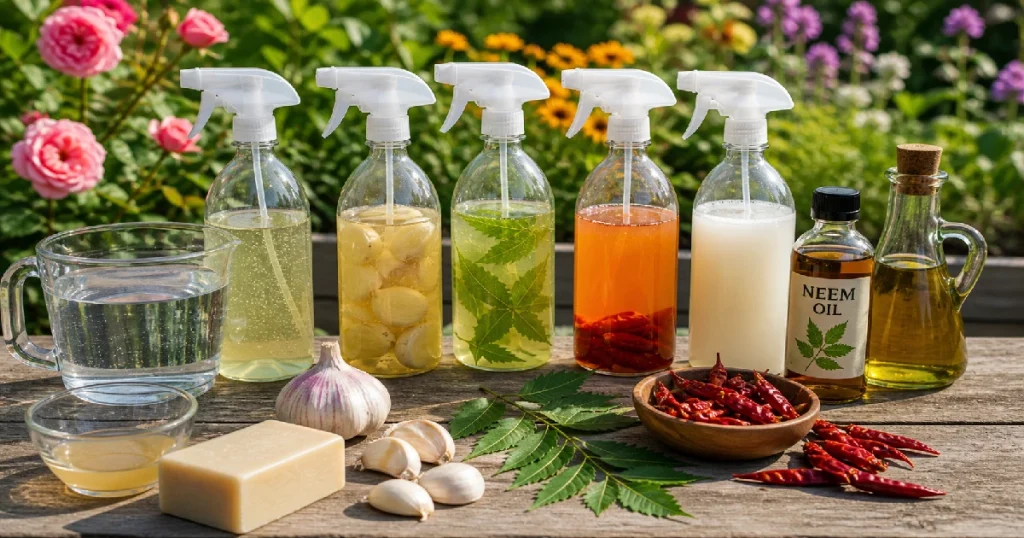
One of the most underappreciated components in the homemade toolbox is neem oil. Neem tree seeds contain azadirachtin, a substance that inhibits insect growth by preventing larvae from moulting, reducing feeding behavior, and impeding reproduction. Two teaspoons of neem oil mixed with a teaspoon of soap and a quart of water has been tested against over 400 insect species. As a secondary benefit, it has been shown to be effective against beetles, moths, and fungal problems. Organic commercial sprays containing neem extract generally perform comparably with homemade neem mixtures, with commercial products sometimes providing better emulsification and shelf stability. Due to the fact that it is made fresh and consumed immediately, the DIY version does not have the shelf-stability issue.
In this discussion, garlic spray holds a slightly different place since it is essentially a repellent rather than a contact killer. The sulfur-rich liquid that is produced after pureed garlic is steeped in water for an entire night, strained, and mixed with oil and soap attracts aphids, whiteflies, leafhoppers, and squash bugs. When used proactively or in the early stages of pest pressure, it can effectively divert insects away from treated plants, but soap sprays don’t eliminate infestations as quickly as it can. There is no denying that this is the same reasoning behind most commercially available botanical repellent products; the only difference is the packaging and the lack of a scent that will follow you inside if the wind changes.
| Category | Details |
| Subject | Homemade Garden Pest Sprays vs. Store-Bought Products |
| Most Effective DIY Spray | Insecticidal Soap Spray (dish soap + water) — matches commercial insecticidal soaps on contact |
| Best Organic Multi-Purpose | Neem Oil Spray — effective against 400+ insect species |
| Best Repellent | Garlic-Oil Spray — repels aphids, whiteflies, leafhoppers, squash bugs |
| Best for Mammals + Insects | Hot Pepper / Capsaicin Spray — deters rabbits, deer, mites, caterpillars |
| DIY Cost | Pennies per application using pantry staples |
| Commercial Cost | $10–$25+ per bottle for equivalent coverage |
| DIY Limitation | Contact-only; no residual protection; needs reapplication every 4–7 days |
| Commercial Advantage | Residual protection lasting 3–6 months for serious infestations |
| When to Use Commercial | Termites, carpenter ants, deep-seated cockroach problems — professional products necessary |
| Application Rule | Spray in the evening; cover undersides of leaves; patch test first |
A hot pepper spray is made from a tablespoon of dried chilli powder or half a cup of freshly chopped peppers simmered in water, strained, and mixed with soap. The ability of capsaicin to irritate insect sensory systems is unmatched by other commercial single-product sprays. As well as deterring rabbits and deer, the spray works on mites, caterpillars, and ants. During preparation, it is important to wear gloves and avoid eye contact. It may seem obvious, but a minor cut on your finger thirty seconds after straining the pepper mixture is often forgotten.
It is clear that most gardening advice softens more than it should when comparing DIY and commercial sprays. Homemade sprays are as effective as commercial sprays for quick, contact-based control of light infestations of soft-bodied insects. They are almost inexpensive, don’t leave behind any chemical residue that could damage beneficial insects that aren’t present at the time of application, and can be produced in amounts appropriate for the problem at hand rather than whatever the tiniest bottle on the market happens to contain. If an infestation is severe, the pest lives inside the plant or soil rather than on the surface, or residual protection is needed for several weeks, commercial products should be considered. Termites and carpenter ants, for example, should not be treated with garlic spray. On a Tuesday night, fifty aphids were observed on a rose stem.
Alyssa Bennet is a Senior Editor at Mini Greenhouse Kits and a passionate advocate for urban gardening and small-space growing. Currently pursuing her major in Arts at the University of California, Alyssa brings a distinctly creative eye to the world of city gardening – blending artistic sensibility with a genuine love for green living. She writes regularly at minigreenhousekits.com, and when she’s not crafting her next gardening piece, you’ll find her with a paintbrush in hand, watching sports, or exploring the city with friends.