
When you enter one of Gotham Greens’ thirteen locations across the US, you are immediately struck by a sense of controlled strangeness. In an invisible structure, rows of lettuce heads grow in water instead of soil beneath pink-tinged LED arrays. There is no mud, no insects, no seasons, and no weather. Plants are never quite as uniform as field crops. Everything is monitored by sensors, adjusted by algorithms, and harvested on a schedule that is rarely affected by the weather. This is either a very expensive method of growing salad, or it is the logical conclusion of modern agriculture, depending on your viewpoint.
According to research firms and their calculations, the global vertical farming market is currently worth between $7.5 and $8 billion. Estimates range from $18 billion to almost $40 billion in the 2030s. Rather than being the result of analytical ineptitude, the spread is a reflection of true definitional disagreements: some firms count greenhouse hardware, while others only count fully indoor multilayer operations, with varying reasons for including or excluding software layers. Despite these methodological variations, the direction remains the same. There is an expansion in the sector. We don’t know what it’s growing toward, and the projections don’t clarify.
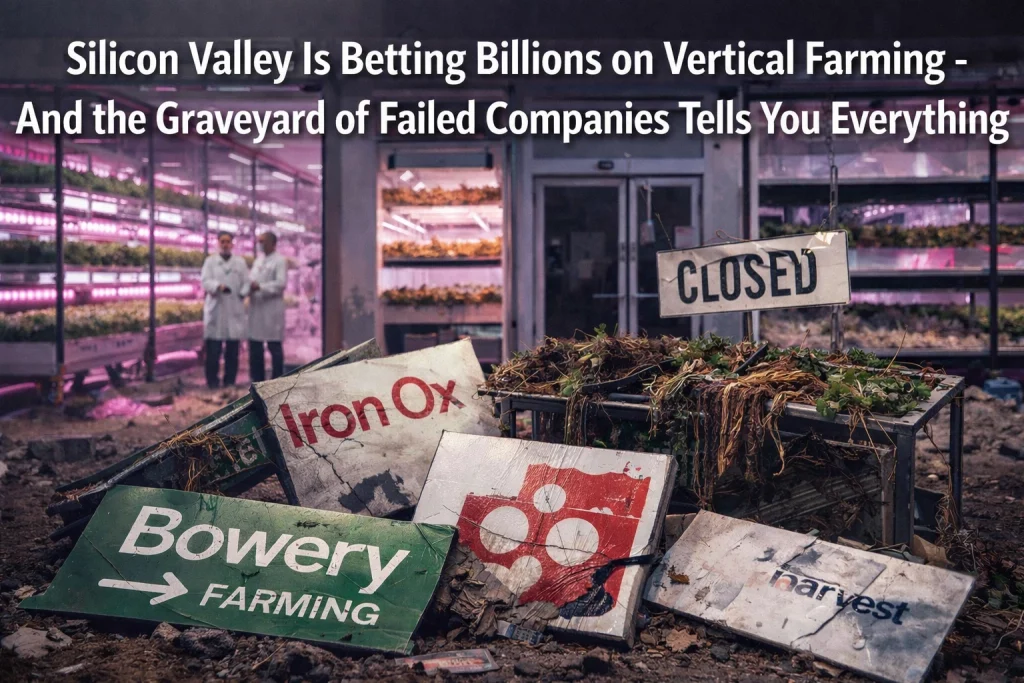
According to the market size figures, it is much harder to read the truth about recent vertical farming history. Between late 2024 and the end of 2025, the industry burned through its illusions remarkably quickly. After raising about $700 million and reaching a valuation of $2.3 billion, Bowery Farming ceased operations. Plenty Unlimited filed for Chapter 11 bankruptcy after raising nearly $1 billion. AeroFarms, AppHarvest, Kalera—the list of failed businesses is long enough, and the losses are substantial enough, to suggest the current growth of this industry is more debris than momentum. There were fourteen indoor farming bankruptcies in 2025 alone, with a total of more than $1.37 billion in funding. It appears that the survivors are carefully considering what went wrong with previous businesses as they discuss their operational rigor, discipline, and emphasis on securing off-take agreements before expanding.
The main cause of the failure was the energy issue. The economic case for many of the large-scale operations constructed during the venture capital boom was built on assumptions about lighting efficiency and energy costs that didn’t hold in practice, and electricity accounts for up to half of operating expenses in fully indoor vertical farms. The California utility pricing forced Plenty to mothball its Compton, California facility in late 2024. An unfavorable shift in the local energy market caused this, not poor execution or technology. The price per kilowatt-hour of electricity in a particular market may determine the geographic reach of vertical farming more than any advancements in crop science or automation over the next ten years.
Those businesses that made it through the correction are consistently growing what can be grown profitably indoors and selling it before developing the capacity to produce it. Leafy greens like lettuce, kale, herbs, and baby spinach still account for about half of the industry’s revenue. A controlled environment model is well suited to their 30- to 45-day crop cycles, stable retail demand, and premium positioning in grocery stores, which partially absorbs the energy costs that would make lower-margin crops uneconomical. In addition, Oishii’s 237,000-square-foot strawberry facility in New Jersey sells individual berries to Whole Foods for $2.50 each. To customers who have shown a willingness to pay for consistent quality, this facility offers premium fruit at premium prices. Plenty’s Richmond, Virginia business changed completely after filing for bankruptcy. While vertical farms cannot currently produce affordable calories at scale, they can produce costly produce that justifies the cost of production.
This brings us back to the original question. Is this a viable method of feeding a city? It is estimated that 70% of the world’s population will live in cities by 2060, when vertical farms will run on renewable energy. AI systems will be able to maximize yields at the individual plant level on these farms. The “30 by 30” initiative in Singapore, which aims to produce 30% of its food domestically by 2030, has already established the legislative framework for significant indoor farming in urban areas. Saudi Arabia’s 15-meter-high, 19-layer Riyadh vertical farm is proof that governments dealing with real food security issues are embracing the model in ways venture capital hasn’t.
The consumption of premium berries and leafy greens is not a diet. Indoor production is still well outside the economic range of foods that keep people fed, such as grains, root vegetables, and staple crops, and no reliable analyst predicts this will change any time soon. There is still uncertainty about whether vertical farming will close that gap by 2060 or if it will remain at the premium edge of the urban food supply, while conventional agriculture continues to take care of most nutritional needs. Vertical farming can serve upscale grocery chains, augment food supplies, and significantly improve food security in areas where the alternatives are worse in 2026. Is it possible to provide food for a city? No, not yet. There may never be a complete solution. The question turns out to be more intriguing than either the skeptics or the boosters anticipated.