

The sun was doing that thick slow melt over the fence line when I first smelled it. It is a scent that doesn’t just drift by you. It hangs in the air like a physical weight. I remember standing by the back porch with a handful of rusted garden shears and feeling like the atmosphere had suddenly become expensive. It was the smell of the first Oriental hybrid I’d ever managed to keep alive through a wet spring. Before that day I had always thought of the lily plant as something you buy in a grocery store wrapped in crinkly foil only to watch it turn into a yellowing stick on the kitchen counter. But seeing it in the dirt is a different story entirely. It is a presence. It has a gravity that other flowers simply lack.
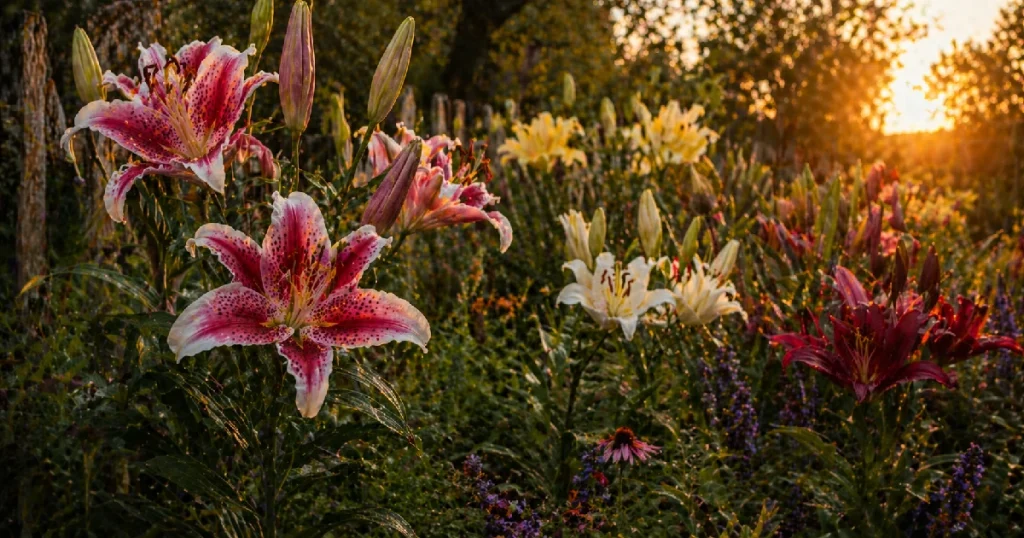
We tend to talk about gardens as if they are projects or checklists of chores. We measure success by how much we’ve tamed the weeds or how green the lawn stays. But every so often you encounter a plant that refuses to be part of the background noise. It demands that you stop what you are doing and just breathe. That lily flower was a deep saturated pink with speckles that looked like someone had flicked a paintbrush at it while it was still wet. I realized then that I wasn’t just growing a bit of seasonal color. I was tending to a ghost that would disappear in two weeks and leave me wanting more for the next fifty. It is a cruel trade when you think about it.
There is a strange tension in how these things grow. You spend months looking at a bare patch of earth wondering if the winter rot finally claimed everything. You poke around with a trowel and feel that sudden spike of adrenaline when you hit something firm. It is a quiet gamble. Gardening is mostly just waiting for things to happen and then being surprised when they actually do. We try to act like we are in control of the cycle but the truth is we are just spectators with watering cans.

Deciphering the mess of lily varieties and the lies of the catalog
I used to spend my January nights staring at those glossy catalogs where everything looks perfect and nothing ever has a bug on it. You see the endless lists of lily varieties and your brain starts to itch with the desire to own all of them. You want the towering giants that look like they belong in a jungle and you want the tiny ones that hug the ground. But the catalogs don’t tell you about the red lily beetles that look like tiny drops of blood and move twice as fast. They don’t tell you about the way a heavy rain can snap a stem if you didn’t bother with a stake.
I learned the hard way that not everything called a lily actually is one. You have the daylilies that are as tough as old boots and will grow in a ditch. Then you have the true lily species that are far more temperamental and require a certain kind of soil that feels like a well wrung sponge. I spent three years trying to get a Turk’s Cap to settle in before I realized that it hated me and my soil pH. It is a humbling thing to be rejected by a bulb. It makes you realize that your yard has its own opinions about what belongs there. You can’t just force a landscape to look like a painting if the chemistry isn’t right.
The true lily flower has a structure that is almost architectural. It feels like it was designed by someone who studied geometry but then got drunk on perfume. The way the petals curve back or the way the anthers heavy with orange pollen will ruin your favorite shirt if you get too close. It is an aggressive kind of beauty. It doesn’t ask for permission to take up space. I’ve started to prefer the ones that have a bit of a wild streak to them. The ones that don’t look like they were bred for a florist’s refrigerator. There is a grit to them when they are growing in the actual mud and competing with the grass.
What I learned about buried treasures and the secret life of lily bulbs
The first time I dug up a clump to move them I felt like I was committing a crime. You see these lily bulbs and they look so alien with their overlapping scales and their weird pale color. They don’t look like they have the capacity to produce something so elegant. They look like something you’d find in the bottom of a cave. But that is where all the energy is stored. It is a battery of potential. I stood there with dirt under my fingernails and realized that the part we see above ground is just a brief performance. The real work is happening in the dark where the worms are.
I’ve had friends ask me about the different types of lily plants and which ones are the easiest for someone who kills everything they touch. I usually tell them to start with the Asiatics because they are the most forgiving. They don’t have that heavy scent that gives some people a headache but they have colors that will make your eyes watering. They are the workhorses of the early summer. But if you want the drama you have to go for the Trumpets or the Orientals. Those are the ones that make you feel like you are living in a poem. They are the ones that keep you up at night when a storm is brewing because you’re worried the wind will take them.
There is a specific rhythm to planting them. You can’t just throw them in a hole and hope for the best. They need that drainage or they will just turn into mush by February. I’ve lost more than I care to admit because I was too lazy to add a bit of grit to the bottom of the trench. It is a lesson in patience and preparation. You are essentially planting a promise to yourself that you will still be there in six months to see the result. In a world that moves as fast as ours that feels like a radical act.
I find myself walking out to the garden at midnight sometimes just to see them in the moonlight. They look different when the sun is gone. They look colder and more remote. The white ones especially seem to glow with their own internal light. It makes you think about all the people who have planted these same lily species over the centuries. You are part of a long line of humans who have been seduced by a bunch of petals and some scent. It is a very old and very human kind of madness.
Sometimes the deer get them before they even have a chance to open. You wake up and find a row of decapitated stems and it feels like a personal insult. You want to yell at the woods but you know the deer were just looking for a snack and your expensive hybrids were the best thing on the menu. It makes you cynical. It makes you want to build a fence ten feet high or just give up and plant nothing but prickly things. But then a stray bulb you forgot about in a corner of the yard blooms anyway and all that anger just evaporates.
I don’t think I’ll ever stop trying to figure them out. There are too many variables and too many ways for things to go sideways. The weather is getting weirder and the seasons are shifting and I’m just trying to keep up. But as long as there is a bit of dirt and a few hours of sun I’ll keep putting those scaly things into the ground. It gives the year a sense of structure. It gives me something to look forward to when the sky is gray and the ground is frozen solid.
The scent is fading now as the night gets colder. The flowers are starting to curl at the edges and I know that in a few days I’ll have to cut the stalks down and wait for another year of silence. It is a quiet end to a loud performance. There is no grand finale or big speech. Just a slow return to the soil. I’ll probably go back inside and look at some more catalogs because that is what we do. We plan and we hope and we buy more bulbs even though we know we shouldn’t. It is the only way to stay sane in a world that feels like it’s falling apart.
Maybe next year I’ll try those tall yellow ones that the neighbor has. Or maybe I’ll just let the garden go wild and see what comes back on its own. There is a beauty in the neglect too. But for now I’m just going to sit here in the dark and let the smell of that one last bloom hang around for as long as it wants. It isn’t a perfect garden and it isn’t a perfect life but the lilies don’t seem to mind. They just keep doing their thing regardless of whether I’m watching or not. And that is probably exactly how it should be.
As a Senior Editor at Mini Greenhouse Kits, Hannah Kinsley is a passionate supporter of small-space gardening and urban gardening. Hannah, who is currently majoring in Environmental Policy through the University of Michigan’s Environmental Studies program, infuses her writing with a solid academic foundation and a sincere enthusiasm for the environment. You can find her playing soccer or exploring the city’s green areas with friends when she’s not researching the newest trends in city gardening or creating content for minigreenhousekits.com.