
The greenhouse appeared to be in good condition from the outside. In this neat lean-to building against a south-facing wall, seedlings are arranged in neat plastic trays on the shelves, and polycarbonate panels catch morning light. Everything seemed to be going smoothly by all reasonable standards. It made sense when someone opened the door one July afternoon and felt a wall of heat roll out, the kind that hits you before your brain can register it. Browning leaf edges made sense. For the entire month, the tomatoes refused to bear fruit.
The idea of including a thermometer had never occurred to anyone. I made that mistake at the beginning.
There is a sense in which small greenhouses are victims of their own efficiency. In the summer, they do a far better job than they should at trapping solar energy and creating a warm, enclosed space. A small, sealed greenhouse can reach 50°C by midday on a clear July day. At 45°C, leaf tissue irreversibly scorches. At 35°C and above, tomatoes stop setting fruit completely. It is neither a worst-case scenario nor an edge case.
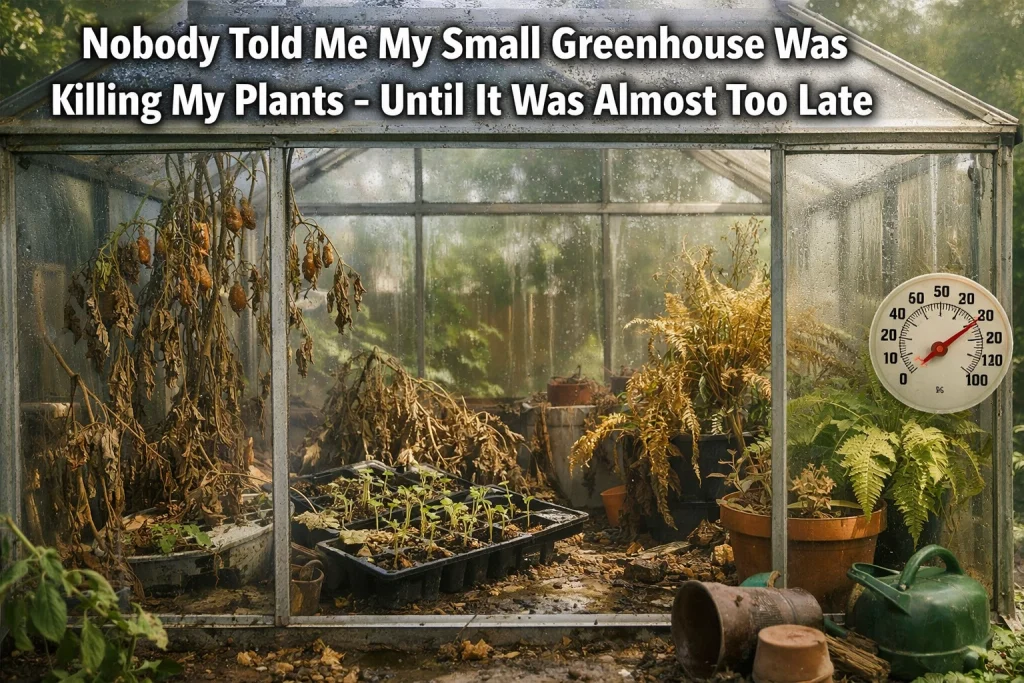
On a typical warm day with no vents opened, these are the typical operating conditions of a small greenhouse. It is impossible for the structure to distinguish between “pleasantly warm for seedlings” and “lethal.”
New greenhouse owners usually give up on ventilation. Let the air in, open the windows, and the temperature drops. The air volume of a small greenhouse is so small that even a passing cloud’s partial shade can raise temperatures within minutes when combined with a closed door. On Tuesday mornings, when plants cook for the first time while their owners are at work, automatic vent openers that operate without electricity seem like a luxury. After that, they seem invaluable. It is possible that in the history of hobby greenhouse growing, forgetting to open vents has killed more plants than any disease or pest.
Humidity makes everything worse. Fungal pathogens thrive in warm, humid, stagnant air. A closed greenhouse is practically ideal for botrytis, powdery mildew, and other diseases in August. During transpiration, plants release moisture into the atmosphere, which further increases humidity levels, slows down their own ability to cool through transpiration, and creates an environment conducive to the growth of pathogens that would struggle elsewhere. By keeping the air flowing, breaking up stagnant areas, and removing temperature differences between cooler floors and hot upper shelves, a small, nearly inexpensive circulation fan can make a big difference.
As a result of the enclosed warmth of a greenhouse, pests breed more quickly and deserve more attention than most hobbyists give them. It is inconvenient when a single whitefly manages to enter an open door in a garden. A warm, protected greenhouse can grow its population to 200 in three weeks. The logic of aphids is similar. Spider mites thrive in warm, dry microclimates, particularly when humidity decreases after vigorous ventilation. Routine leaf underside inspection is the only effective early warning system, but it takes so much time that many people don’t bother.
The hardening off issue also affects growers at the other end of the process. In a greenhouse, seedlings are not ready for the outside world in a particular and important way. If plants are moved immediately from sheltered warmth to a garden bed exposed to wind, temperature swings, and direct sunlight, transplant shock is severe enough to kill most of them. The solution is to gradually expose seedlings to outdoor conditions over a period of one to two weeks, beginning with a few hours and increasing over time. When planting out seems most urgent, patience is the key.
While the greenhouse industry promotes the idea of protection and control, the manual labor of active management-the checking, adjusting, and watching-is barely touched upon. For a small greenhouse, it’s not a set-and-forget system. There is a microclimate that punishes inattention more quickly and changes more rapidly than an outdoor garden. It may be the only thing separating growers who maintain plants from those who replace them every season while wondering what went wrong if they knew that from the start.