This is a common experience for first-time gardeners. You just planted something. It’s a beautiful day, the sun is shining, and the soil is being patted down. Around two weeks later, one of three things happens: either nothing appears at all, the seedlings appear pale and confused, or something has eaten them. The deflationary moment is so common, however, that it could almost be considered a rite of passage, despite its near-complete preventability.
Before you start gardening, you should know that not every plant will be happy in your garden. Most beginner gardening advice ignores this. Plants are not all appropriate for every part of the planet where you live. Native vegetable gardening completely alters the calculus. When you cultivate plants that are already accustomed to your local climate, soil chemistry, and rainfall patterns, you are not fighting the environment. It’s something you’re dealing with. It’s a very different experience.
There have been native vegetables growing in backyards, along creek beds, and at the edges of forests for thousands of years. Miner’s lettuce grows well in the cool, humid climate of the Pacific Northwest. Woodland sorrel thrives in shaded areas, where most store-bought greens wouldn’t. Traditional gardening manuals would classify Hooker’s onion and Pacific waterleaf as “difficult.” These are not rare or hard-to-find plants. Disregard is simply shown to them. A majority of people pass them every day without knowing they are edible.
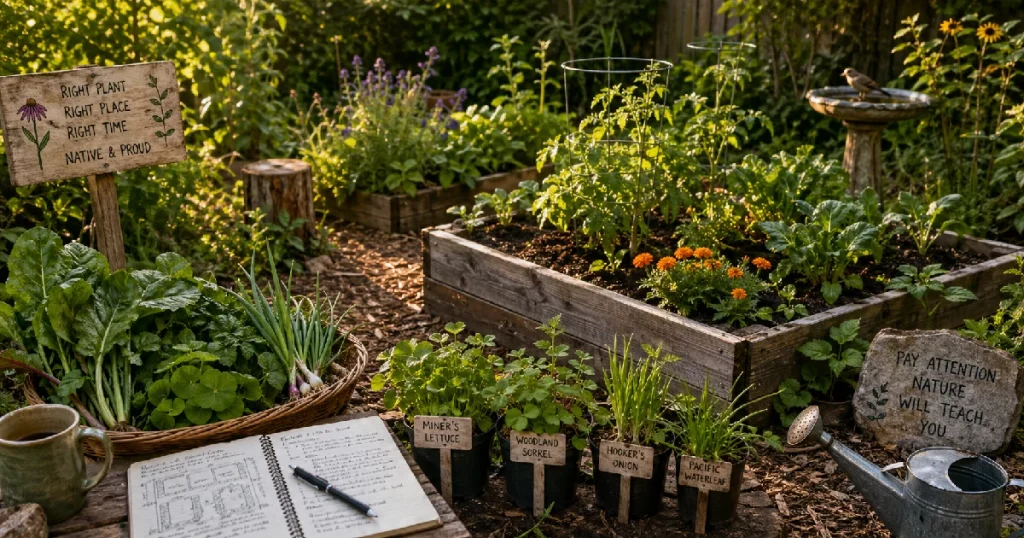
Growing native vegetables doesn’t require a lot of space or a background in horticulture. However, it requires an awareness of where you really live. Choose a location that receives six to eight hours of direct sunlight each day. The following is a true minimum, not a suggestion. In spite of a shaded spot appearing promising in the morning, vegetables and the majority of native edibles will not thrive without consistent light. Walk around your yard at different times of the day to observe where the sun really lands. It’s possible that a fence or a big tree partially blocks the area you thought was sunny for longer than you would expect.
Most novices undervalue the soil and later regret ignoring it. Despite the fact that native plants require a growing environment, they are more tolerant than their cultivated cousins. Before planting, work some compost into the soil. Investing in a raised bed, even a simple 4×4-foot box, is one of the best investments a novice gardener can make. It gives you complete control over what your plants grow in. There is no way to guess whether the current soil is nutrient-depleted or clay-heavy. The environment is built from the ground up and filled with functional elements. Raised beds also improve drainage, warm up faster in the spring, and make weeding easier.
Starting small is not a concession. This is a tactic. The temptation to plant twelve different things and see what sticks is strong, especially after perusing seed catalogs or scrolling through gardening accounts. Chaos and disappointment always result from that strategy. Keeping a 4×8-foot bed in good condition will yield more food and happiness than a large, neglected plot that disappears by July. Choose three to five crops. Take the time to learn them thoroughly. You shouldn’t expand before you’re ready.
For those who want to include native edibles with more well-known vegetables, treating them as companions rather than substitutes is a helpful approach. Next to your tomatoes, radishes, and green beans, plant woodland sorrel or Miner’s lettuce. The indigenous plants will take over very quickly, cause very little trouble, and add a unique flavor to your dish. There’s a feeling that regional cooking was always meant to look like this before global supply chains made it easier to buy Chilean strawberries in February than to observe what’s growing wild near your property.
Native plants contribute to the larger ecosystem in a way that farmed vegetables do not. Several insects have co-evolved with native plants, including butterflies, moths, and specialized pollinators. In the absence of those plants, those insects disappear. As a result, the birds that depend on those insects also disappear. Planting native vegetables contributes to ecological restoration quietly. In a garden that is bustling with activity in a way that a typical vegetable plot seldom is, something real is taking place.
Watering continues to be a common area where novices make mistakes in both directions. Overwatering kills more vegetable plants than drought. Success depends on soil that remains consistently moist, not soggy or completely dry. In comparison to plots at ground level, raised beds require more frequent maintenance because they dry out faster. Mulch will reduce evaporation, inhibit weed growth, and regulate soil temperature while reducing evaporation. This is one of those interventions that consistently yields positive results at almost no cost.
Pest control is primarily a matter of observation for novices who grow without chemicals. Take a stroll through your garden in the morning. Take a look beneath the leaves. Please note the changes from yesterday. Companion planting is an ancient method that is still effective today. It involves planting marigolds next to tomatoes or onions next to crops that are vulnerable to aphids. Typically, native plants attract beneficial insects that naturally control pest populations. The garden finds its own equilibrium with time and variety.
Native vegetable gardening is mostly about getting to know your specific patch of land during the first season. Where the light shifts in the afternoon, how fast the soil dries after rain are all things it likes and resists. Seed packets do not contain that information. Gardening, almost uniquely among pastimes, rewards quiet attention as well as tiny setbacks and modest victories. For most novices, it’s still unclear what they’ll grow or what mix of plants will thrive in their particular region. Uncertainty is a component of it, however. Observing the garden will teach you what it needs.
As a Senior Editor at Mini Greenhouse Kits, Hannah Kinsley is a passionate supporter of small-space gardening and urban gardening. Hannah, who is currently majoring in Environmental Policy through the University of Michigan’s Environmental Studies program, infuses her writing with a solid academic foundation and a sincere enthusiasm for the environment. You can find her playing soccer or exploring the city’s green areas with friends when she’s not researching the newest trends in city gardening or creating content for minigreenhousekits.com.