

I used to live in an apartment that exhaled dust. It was one of those modern builds with windows that barely cracked open. It also had walls that smelled of newly installed carpet and cheap paint long after I moved in. I would wake up with a throat that felt like it had been rubbed with sandpaper, squinting at the stagnant air in the sunlight. We spend so much of our lives inside these sealed boxes, surrounded by invisible off-gassing from our furniture and the chemicals we use to scrub our floors, that we forget we are biological creatures meant to breathe something more primal than recycled ventilation. That realization sent me on a sprawling, slightly obsessive mission to find the right indoor plants for air quality. At the time, I was mostly just looking for a way to stop sneezing.
There is a lot of noise online about what a few leaves can do to a room. Some people talk about it like it is a miracle cure, while others claim you would need a literal Amazonian rainforest in your bedroom to notice a difference. I tend to land somewhere in the messy middle. Bringing greenery into your home is not just about a laboratory result or a specific percentage of formaldehyde removed from the air. It is about a shift in the atmosphere. When you fill a corner with something that breathes, the air feels heavier in a pleasant way, more humid and less clinical.
I started with Peace Lily because a friend told me they were impossible to kill. That friend was wrong, by the way. I nearly did it in a month by overthinking the watering. But even as I struggled with its dramatic drooping, I noticed that the room felt less like a storage unit and more like a habitat. There is something deeply grounded about how plants that improve indoor air quality work behind the scenes. They are quiet workers. They don’t hum like an electric purifier. They just sit there, waxy and green, doing the ancient work of turning our waste into something we can actually use.

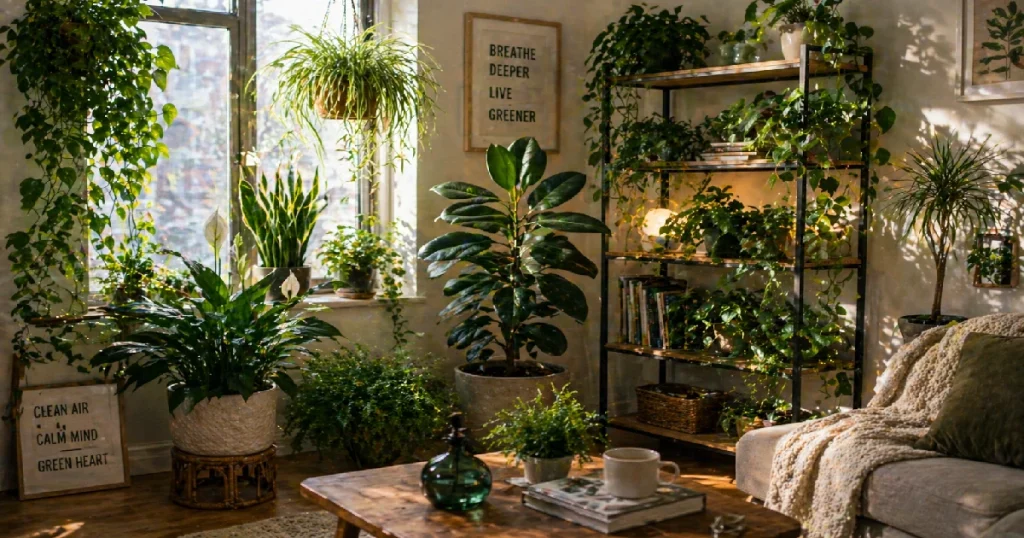
Why the most common houseplants that clean the air are actually the most effective
We often want to find the most exotic, difficult-to-pronounce species when we start a collection, but I have learned that the classics are classics for a reason. The Snake Plant is perhaps the most underrated roommate I have ever had. It doesn’t ask for much. It sits in the dark corners where other things tend to die and somehow still produces oxygen at night. Most air purifying indoor plants do their heavy lifting during the day, but the Snake Plant is a night owl I keep one right next to my bed because I like the idea of it working while I am unconscious. It scrubs the air of the day’s lingering toxins while the rest of the world is asleep.
I remember reading about the NASA study from the eighties, which everyone loves to cite like it is holy text. It listed Spider Plant and Dracula as top performers. While the science is interesting, the lived experience matters most to me. I have found that a Spider Plant in a hanging basket near a kitchen window does more for my mood and lungs than any sleek plastic gadget. They are messy, they throw out babies on long runners that tangle in your hair, and they are utterly charming in their chaos. These are the workhorses of the domestic world. They aren’t just decorative objects. They are filters with souls.
The Dracaena is another one that grew with me slowly. It looks like a miniature palm tree that lost its way. However, it is surprisingly effective at removing the stuff that comes off our cleaning supplies and lacquered tables. I have one in my home office that has seen me through three different jobs and a dozen different crises. It has grown tall and slightly crooked, leaning toward the light of a window it can never quite reach. However, it remains one of the most reliable indoor plants that filters toxins without demanding a complex humidity schedule or specialized fertilizer.
Integrating a living filter into a chaotic home life
The struggle with keeping air purifying indoor plants is usually not with the plants themselves but our own frantic lives. We forget to water them for a week, then drown them. I have been guilty of this more times than I care to admit. I once lost my Aloe Vera because I thought it wanted to be a swamp plant. It didn’t. It wanted desert neglect. Finding that balance between caring for and hovering over is the most challenging part of the whole process.
If you are looking for the most suitable indoor plants for air quality, you also have to consider the safety of other living things in your house. I have a cat who thinks every green leaf is her personal salad bar, which makes things complicated. Many of the most effective filters are actually toxic if ingested. I had to learn to move my English Ivy to the top of a bookshelf where no feline could reach. There is a certain irony in bringing a plant into your home to improve your health only to realize it could make your pet sick. It forces you to be more intentional about where things live. You see your home in layers, from the high, bright shelves to the shady, cool floor.
Pothos is probably the ultimate entry point for anyone with a black thumb. I call it the gateway plant. It grows so fast you can almost see the vines moving. I have draped them over doorframes and wound them around curtain rods. They are relentless. They are also incredibly efficient at pulling carbon monoxide and benzene out of stagnant pockets. When people ask me about plants that improve indoor air quality, I always point to Pothos because it gives you immediate feedback. It grows, thrives, and makes the room look like a jungle in a single season. It gives you the confidence to try something harder, like a Boston fern.
I love-hate ferns. They are magnificent when they are happy, soft and feathery and lush. They remind me of deep woods and hidden springs. But they are also incredibly finicky about air moisture. In the winter, when the heater blasts, a Boston fern can turn into a pile of brown needles in about forty-eight hours if you aren’t careful. Yet, they are some of the most effective indoor plants that filter out toxins like xylene and toluene. I keep mine in the bathroom now, where the steam from the shower keeps it from breaking down. It is constant negotiation.
What I find most interesting is how my relationship with these plants has changed my view of my own environment. I find myself opening my windows more often, even when it is cold, to give them a taste of the outside. I have become more aware of the smells in my house, noticing the sharp tang of an old piece of furniture or the heavy scent of a candle. My indoor garden has made me a better observer of my own life. It is no longer just about the most effective indoor plants for air quality in a clinical sense. It is about creating a space that feels breathable in every sense of the word.
As I sit here writing this, I can see the leaves of my Rubber Tree catching the afternoon light. It is a sturdy, stoic plant with deep green leaves that look carved out of leather. It doesn’t move much, but it is a fantastic air purifier standing guard in the corner of the room. Peace comes from being surrounded by these slow-moving companions. They remind me that growth takes time and that the air we breathe is a gift we often take for granted.
Whether you live in a sprawling house or a tiny studio with one window, there is room for something that grows. You don’t need a botany degree or a perfectly curated aesthetic. You just need a bit of dirt, a little light, and the willingness to let nature do what it has been doing for millions of years. The air will get clearer, your heart might get softer, and eventually, the silence of your home won’t feel so empty. It will feel like it breathes right along with you. It makes me wonder what other small, quiet things we overlook in our search for a better way to live indoors. There is always another corner to fill, another leaf to dust, and another deep breath to take.
As a Senior Editor at Mini Greenhouse Kits, Hannah Kinsley is a passionate supporter of small-space gardening and urban gardening. Hannah, who is currently majoring in Environmental Policy through the University of Michigan’s Environmental Studies program, infuses her writing with a solid academic foundation and a sincere enthusiasm for the environment. You can find her playing soccer or exploring the city’s green areas with friends when she’s not researching the newest trends in city gardening or creating content for minigreenhousekits.com.