

A rat problem is typically viewed as something dramatic – a creature scurrying across the patio, droppings in the kitchen, obvious evidence of invasion. In reality, things are much quieter. Rats can live in a garden for weeks, sometimes months, without the occupants of the house even realizing it. It is well known that animals are nocturnal, cautious, and remarkably adept at staying close to cover. When something obvious appears, the situation is already well established.
The garden offers them almost everything, when you think about it. You can find shelter under decking, inside dense shrubs, or beneath the floor of a garden shed. Bird feeders, compost heaps, vegetable patches, and fallen fruit left on the ground. Dripping taps, bird baths, or a poorly drained patio patch that collects rainwater. For rats to thrive, they require only one to two ounces of food per day and access to water every day. Well-tended gardens provide that without much effort on their part. There is a possibility that many gardeners run a rather comfortable operation without realizing it.
It is easy to miss their physical signs if you do not know what to look for. Starting with burrow entrances, which are about five to ten centimeters across, is a good idea. They are commonly found near fences, sheds, compost bin bases, or anywhere the soil is undisturbed and sheltered. Active holes have a smooth, almost polished edge, worn down by repeated use, usually with a small fan of loose earth pushed out in front. Check a burrow a day later by stuffing it loosely with soil or crumpled newspaper to see if it is occupied. Something is at home if it’s cleared.

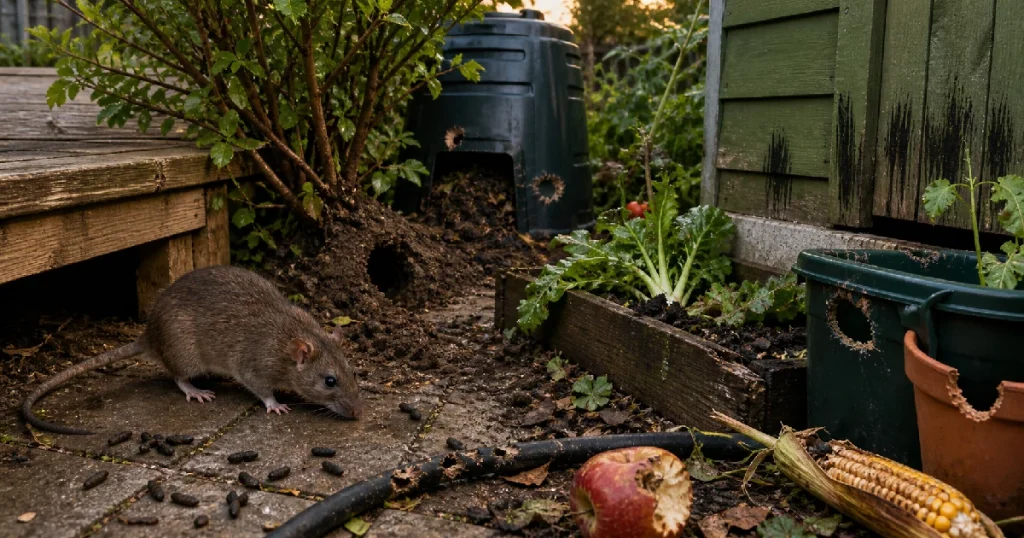
Runs are those thin, slightly worn tracks, roughly two to three inches wide, that cut through grass or mulch between nesting sites and food sources. Using their whiskers, rats navigate along walls and fence bases night after night. They also leave greasy smear marks as evidence. Oils in their fur transfer to surfaces when they come into contact with them repeatedly. Fences, shed walls, and low-hanging wooden structures are left with a dark, slightly slick residue. The kind of thing you might have walked past a dozen times without noticing.
Gardeners often overlook droppings, gnaw marks, and other signs of pests
The droppings of rats are one of the clearest signs, and they are more distinctive than people expect. The dark, shiny, tapered grains often resemble large rice grains and tend to cluster rather than be scattered randomly. When found behind stored items in a shed, under decking, or near a compost bin, they should be treated as a sign of active use, not a one-time occurrence.
It is worth paying attention to gnaw marks. Rats need to gnaw constantly to manage the growth of their teeth, which never stop growing. In terms of what they chew through, they are not particularly selective. Rat activity can be seen in holes in plastic compost bins, bite marks on wooden garden furniture, chewed irrigation tubing, and scored plastic rubbish lids. The incisors of vegetable crops leave parallel grooves, which are most obvious on root vegetables, fallen apples, and sweetcorn husks. It’s worth looking elsewhere for supporting signs if you find something half-eaten with that particular groove pattern.
| Common name | Brown rat / Norway rat / Common rat |
| Scientific name | Rattus norvegicus |
| Adult body length | 20–27 cm (plus 17–23 cm tail) |
| Weight | 200–500 g |
| Activity | Primarily nocturnal; daytime sightings suggest large colonies |
| Breeding rate | Up to 5 litters/year; 7–8 pups per litter |
| Health risks | Leptospirosis (Weil’s disease), Salmonella, Hantavirus |
| Attracted to | Bird feeders, compost, fruit, pet food, dense shelter, water |
| Burrow size | 6–9 cm wide entrance; smooth, worn edges indicate active use |
The meaning of a daytime sighting
The sight of a rat in a garden during daylight is unsettling. It contradicts what most people assume – that rats are nocturnal and therefore invisible. It is worth taking a daytime sighting seriously since it usually indicates population pressure: a colony that has grown large enough that competition for food and space is forcing individuals out during the daytime. Daytime activity is consistently noted by pest control professionals as an early warning of something more serious. By catching it at that stage, rather than waiting for further confirmation, the response becomes simpler.
If you suspect activity but haven’t seen direct proof, rake a small patch of bare soil smooth, or scatter flour near a suspected run, and check it the next day. Footprints, tail drag marks, or disturbed patches are immediate indicators. It’s easy, cheap, and has been used by pest controllers for years on properties where the evidence is ambiguous. Most of us don’t read the garden carefully enough, but it rarely lies.
Alyssa Bennet is a Senior Editor at Mini Greenhouse Kits and a passionate advocate for urban gardening and small-space growing. Currently pursuing her major in Arts at the University of California, Alyssa brings a distinctly creative eye to the world of city gardening – blending artistic sensibility with a genuine love for green living. She writes regularly at minigreenhousekits.com, and when she’s not crafting her next gardening piece, you’ll find her with a paintbrush in hand, watching sports, or exploring the city with friends.