

Having a well-kept lawn is a strange pride for Americans. The smell, the stripes, and the peaceful satisfaction of gazing out the back door at something controlled and uniform. Observing what lives in that grass, however, makes that pride feel hollow. Turf lawns are nearly perfect for keeping wildlife out. There are no flowers, no food, and no nesting places. The green carpet consumes water, chemicals, and time, and it serves little purpose other than to look good.
It might change. It can also change more quickly than most people expect.
In terms of land area, lawn covers approximately 40 million acres in the United States, making it the largest irrigated crop in the country, surpassing corn, soybeans, and wheat. There are approximately 80% of Americans who cultivate grass. Majority of people never made a conscious decision to do so. It’s just how yards look in this country, a legacy of postwar suburban aesthetics that no one questioned. Moreover, pollinators, the organisms that produce $30 billion of crops in the United States each year and one in three bites of food on your plate, are declining. Globally, approximately 40% of pollinator species are at risk of extinction. In 2017, the rusty-patched bumble bee was listed as an endangered species throughout the eastern and upper Midwest. Franklin’s bumble bees, last observed on the West Coast in 2006, may already be extinct.

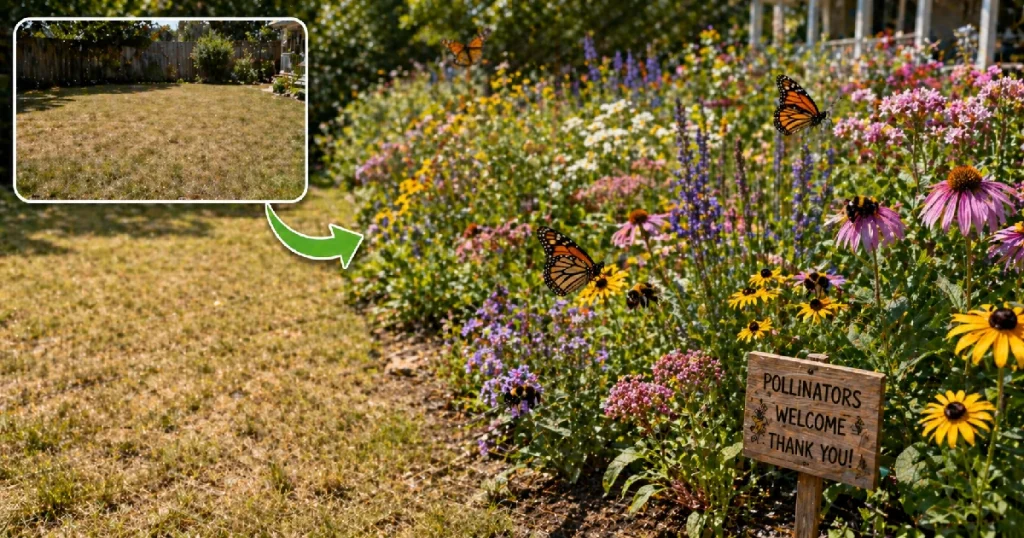
There is a clear connection between these two facts.
As the national coordinator for the Xerces Society for Invertebrate Conservation’s Bee City USA and Bee Campus USA programs, Laura Rost has watched people gradually realize that their backyards can do more for them. “Pollinators need consistent resources from early spring to late fall,” she says. A typical lawn is not only made of grass, but it is also a monoculture, a biological dead zone that does not provide any habitat for nesting ground beetles or foraging bees. For decades, most of us have been carefully maintaining that dead zone without realizing it.
Fortunately, reversing this doesn’t require spending a fortune on plants, hiring a landscape architect, or tearing everything apart at once. In the past eight years, Rost has been reducing the amount of grass on her third-of-an-acre suburban Portland, Oregon property. Since I’ve been here eight years, the lawn has shrunk every year. Using the street’s hedgerow as a pollinator corridor and a private space, she started with a thick row of native shrubs. During the growing season, that corridor blooms continuously.
If only as a mental gateway, the “No Mow May” movement is the most straightforward entry point. People are encouraged to leave their lawns untrimmed until May, when native bees emerge from hibernation hungry from winter hibernation, by a conservation group called Plantlife. In recent years, studies have shown that less frequently mowed lawns have a greater variety and abundance of bee species. In warmer climates, No Mow April could be equivalent. The bees won’t be saved by skipping mowing, since Rust is honest about the limitations. It’s a fun, small, introductory step,” she says. Most lawns lack native flowers; if you don’t mow a monoculture, it will only grow taller. People’s perceptions of their yard are altered by the gesture, however. As a result, they begin to perceive it differently.
A true transformation begins with a change in perception. As you begin to view your lawn as an ecosystem rather than just a surface, the following questions naturally arise. What time of year is it blooming? Where are the gaps? What can be placed in the area of the yard that does not require mowing?
In order to remove lawn, you don’t need to rent equipment or remove sod. A cardboard sheet mulching technique involves laying down multiple layers of cardboard, covering them with chopped leaves or mulch, and then waiting a few months. The grass is suffocated by it. In the spring, you plant directly into the decomposed layer. Aside from adding organic matter to the soil, it is slow, inexpensive, and genuinely effective. For impatient gardeners, removing sod with a flat spade is quicker but more taxing on the back. Either way, the goal is to make room for something better.
The importance of planting choices is often overlooked by novices. The co-evolution of native plants and native insects over millennia makes them essential to pollinator habitats. The European honeybee, a non-native species brought by colonists in the 17th century, can coexist with a wide variety of plants. Many of those relationships are surprisingly accurate, since native bees often require particular native plants. Sweat bees and small carpenter bees are attracted to ninebark in the spring, for instance. To push back the edges of her lawn, Rost planted lacy phacelia, which blooms lavender-blue and attracts a noticeable number of bumble bees.
Often overlooked, bloom succession is crucial to a successful pollinator habitat. A large number of flowers blooming in June is not enough. Pollinators need something from early spring to late fall. A yard with a spectacular but short summer show is far less valuable than one with three or four staggered flowering periods throughout the year. It’s also worthwhile to leave some wild elements around the edges, such as fallen leaves, dead stems, and a few logs. There are a large number of native bee species that nest on the ground, which requires undisturbed soil that is exposed to the elements. Others overwinter in hollow stems. The “tidy garden” aesthetic actively opposes them.
It’s hard to ignore how much of this is about breaking old habits rather than forming new ones. Mowing less frequently. Don’t throw everything away. It is important not to deadhead every flower in order to allow the birds to reach the seeds. There is a disproportionate return on each of these little surrenders.
There are, of course, actual challenges. Anxious neighbors, weed ordinances, and HOA rules can make a naturalistic yard seem more complex than it is. Rost’s advice is useful: keep an edge close to the sidewalk or street, label your native plants, and talk to your neighbors before they complain. A neighbor will perceive a front yard that appears purposefully designed-even if some areas are purposefully left unmowed-very differently than one that appears merely abandoned.
| Organization | The Xerces Society for Invertebrate Conservation (Bee City USA / Bee Campus USA) |
| Focus | Pollinator conservation, native plant advocacy, lawn conversion education |
| U.S. lawn coverage | ~40 million acres (largest irrigated crop in the country) |
| Native bee species (U.S.) | 3,600+ known species |
| Pollinators at global risk | 40% of all pollinator species face extinction threat |
| Crop dependence on pollinators | 1 in 3 bites of food; ~$30 billion in U.S. crops annually |
| Key movement | No Mow May (originated UK, 2019 — Plantlife); now global |
| Water used on U.S. lawns | ~20 trillion gallons/year (50–75% of residential water usage) |
| Bee Campus USA affiliates | 212 campuses; 236 Bee City affiliates (as of May 2025) |
| Reference / resource | xerces.org — The Xerces Society for Invertebrate Conservation |
The more profound issue, however, is one of proportion. What is the actual amount of lawn needed? For most American homeowners, the truthful answer is probably lower than what they currently have. Planting a hedgerow, sheet mulching a patch of lawn, or planting native perennials in place of grass can make a noticeable difference by fall. Bees appear when food is available. There is not much difference between a humming habitat and a dead monoculture from the back door.
Rost said a tree can have a meadow’s worth of flowers. There are so many mouths that can be fed by picking one nice tree.”
Most likely, that is the frame worth preserving. The lawn is not being denied in general. A landscape makeover is not necessary. As a result of generations of chemical fertilizers and riding mowers, a yard has lost its original purpose.
As a Senior Editor at Mini Greenhouse Kits, Hannah Kinsley is a passionate supporter of small-space gardening and urban gardening. Hannah, who is currently majoring in Environmental Policy through the University of Michigan’s Environmental Studies program, infuses her writing with a solid academic foundation and a sincere enthusiasm for the environment. You can find her playing soccer or exploring the city’s green areas with friends when she’s not researching the newest trends in city gardening or creating content for minigreenhousekits.com.