

There is a particular area at the edge of most gardens that never quite works, where the vegetables are thin and pale, and where something always seems out of place. Gardeners continue to excavate, modify, and cooperate with it. A smaller number crouch down to examine more closely what has already grown there without permission. These individuals receive much more helpful information than those who grab fertilizer bags.
There is no haphazard nature to weeds. Most gardeners are either unaware of this or have been informed but have forgotten it. In most cases, plants that appear on their own thrive because the conditions in that specific patch of soil are favorable for them. There is nothing annoying about a dandelion that just happens to land on a cracked clay path. Plants with deep roots evolved to live in compacted, calcium-deficient soils. The system is working. Although no one hired it for the position, the diagnosis remains accurate.
Compaction of soil is one of the most common issues in home gardens, especially in yards with heavy foot traffic or areas where heavy machinery passed during construction. Plantain, a low, broad-leaved weed that grows in worn-out lawn paths and heavily trafficked beds, is one of the most obvious indicators of this condition. A similar story can be told about bindweed, which persists in hard-packed, crusty soil with an almost intimate perseverance, and prostrate knotweed, which evolved specifically to survive being trodden on. As with dandelions, dandelions have a low calcium content as well. A dandelion’s taproot, which can reach up to eighteen inches into the ground, is both diagnosing and trying to fix the compaction layer. While pulling them out of a vegetable bed, you can’t help but feel grudging respect for them.

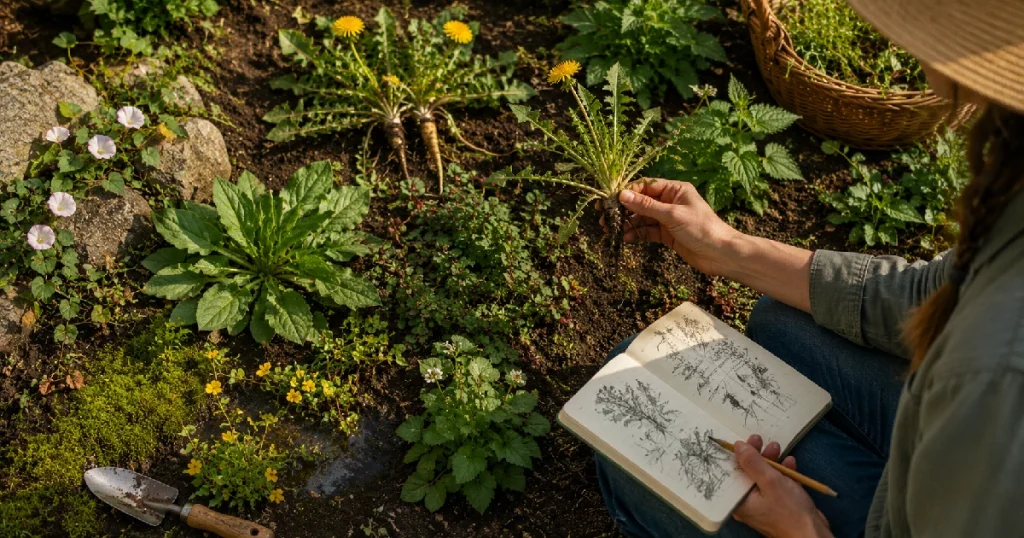
Different plants tell different stories about drainage. Dock and creeping buttercup thrive in conditions that would drown most cultivated crops. Therefore, gardens with clay-heavy soil, low-lying ground, or poor structures tend to fill with these plants. Moss is another sign to be taken seriously. It is easy to dismiss moss as a shade issue, which it partially is, but it also indicates an acidic, low-fertility soil. The problem is usually deeper than sunlight when grass struggles and moss thrives.
The good-news weeds, which belong to their own category, are important to understand. Stinging nettle, which is rich in phosphorus and nitrogen, is one of the best indicators of truly rich soil. The narratives of chickweed and lambsquarters are similar. It is almost a compliment to find these plants growing densely in a particular area of the garden, contrary to popular belief. It is possible to directly benefit from the weed control by planting heavy feeders like corn, potatoes, and brassicas in those precise locations before they consume the nutrients intended for the crop.
A soil test is also important because of the pH issue, which makes weed reading a little trickier. Sheep sorrel and sorrel both suggest acidic conditions. There is a similar tendency in moss. Even though chickweed is a nitrogen indicator, it prefers alkaline soil. Any one weed becomes a clue rather than a verdict due to this kind of subtlety. The best use of weeds is to identify what’s probably going on before spending money on testing. It is most likely that a patch heavily covered in sheep sorrel has an acid problem. A soil test can tell you exactly how much.
Trying to eradicate weeds before understanding them is a form of information loss. Regenerative farming has long recognized this and is slowly making its way into home gardening circles. It only makes room for the next dandelion if the compacted soil that attracted it is not aerated. Alternatively, the next one. Marijuana did not cause the problem. It moved in after identifying the problem.
A leisurely stroll through a garden bed, paying attention to what’s growing, and interpreting what the soil is trying to tell you, is truly rewarding. You don’t need any equipment and it costs nothing. When you’re kneeling in August pulling bindweed for the third time that year, it’s difficult to view the uninvited plant as a messenger rather than an annoyance. This information, however, is unrestricted, available, and usually more accurate than anything in a garden center bag.
As a Senior Editor at Mini Greenhouse Kits, Hannah Kinsley is a passionate supporter of small-space gardening and urban gardening. Hannah, who is currently majoring in Environmental Policy through the University of Michigan’s Environmental Studies program, infuses her writing with a solid academic foundation and a sincere enthusiasm for the environment. You can find her playing soccer or exploring the city’s green areas with friends when she’s not researching the newest trends in city gardening or creating content for minigreenhousekits.com.