
The 6×4 greenhouse at the end of a suburban backyard looks like it belongs in a dollhouse. As soon as you enter, the impression doesn’t improve. There are two growbags filled with compost, a shelf, some trailing string, and barely enough room to turn around without hitting a pot. In most cases, owners of these buildings will conclude that their purchase was too small. In most cases, they are mistaken.
There is no problem with the footprint. It’s the thought that went into filling it. Professionals who work in environments like this agree that one approaches the greenhouse from a design perspective, while the other approaches it from a growing perspective. Despite disagreements on aesthetics, they almost always agree on the fundamental logic of space.
The majority of small greenhouse owners will almost immediately state that they never look up. Once the floor is full of growbags and pots, people automatically assume the area is being used. Since a 6×4 greenhouse is about two meters tall at the ridge, there is about four cubic meters of air above the staging that is not being used. Professional tomato growers use string training to control vertical growth. It involves tying garden twine from each plant’s base to a hook on the ridge bar and then winding the main stem around it. A thirty centimeter wide column holds each plant upright. Two plants trained in this manner produce more and occupy less space than a single bushy plant because the light reaches every part of the plant instead of being blocked by lower leaves.
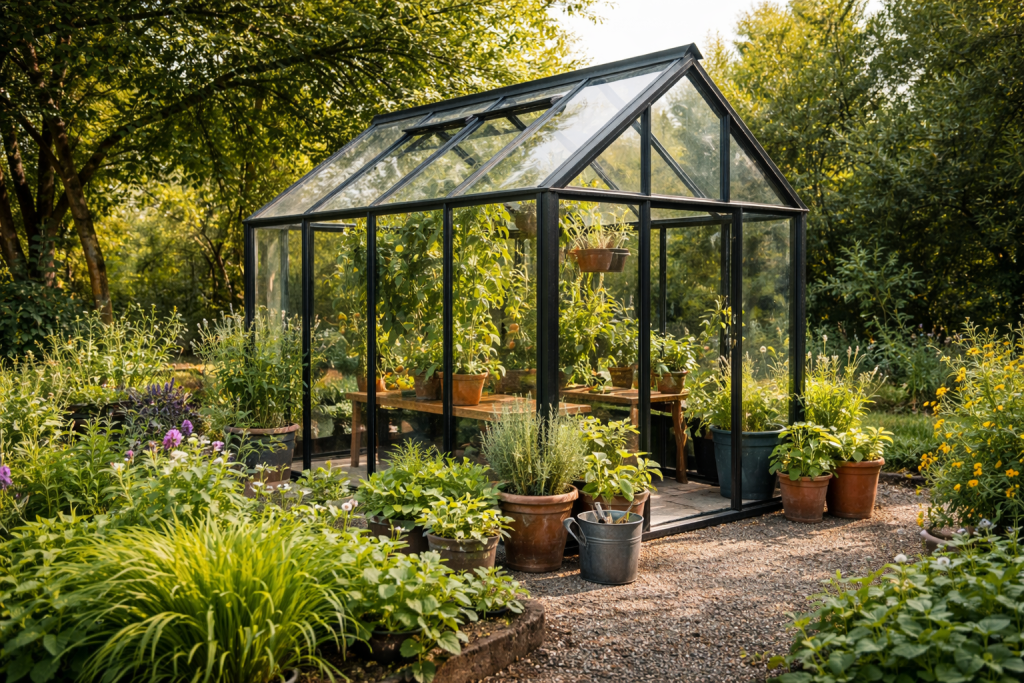
Hanging baskets are another overhead option most small greenhouse owners completely ignore. By attaching three or four baskets to the ridge bar with S-hooks, you can add growing space without affecting the floor. In this regard, compact chilli plants and trailing tomato varieties like Tumbling Tom are excellent choices. In a typical aluminum greenhouse, the ridge bar supports much more weight than a few planted baskets, which may sound unstable. In a small structure, dead space compounds over the entire growing season, according to the designer’s almost casual observation.
A 60/40 layout on the floor is now the consensus of experts. While running staging along one side’s entire length, or about 60% of its width, keep the other side free for floor-level growth and access. Shade-tolerant crops like parsley and mint are placed on the lower shelf, while sun-loving herbs and seedlings are placed on the top shelf. On the floor side, growbags for tomatoes or cucumbers are trained vertically on strings. The door end remains totally open for airflow and access. At the far end, across from the door, is a propagation tray or potting shelf. Even though it sounds almost too organized to be practical, growers who use this arrangement regularly report harvesting more from a 6×4 than they anticipated from something twice as large.
A design perspective adds a nuanced point that horticultural advice often overlooks: the door. In most small aluminum greenhouses, the swing arc of the door takes up more floor space than anyone considers during planning. Several seasoned installers have reported having to rearrange staging in newly constructed greenhouses due to the owner’s layout not taking the door’s opening direction into account. Mark the entire swing arc on the floor before inserting a single bracket into the wall. In two minutes, it saves an entire afternoon of disassembly.
The grouping of plants according to their needs is another obvious principle that is rarely applied in practice. Water-hungry plants can travel further when grouped together. Those who are positioned where the morning light is strongest perform better without any additional assistance. Hardy, slow-growing herbs are planted in more difficult-to-reach places where they can grow silently and without effort. By lowering the maintenance burden, more ambitious growth is possible. This is more than just efficiency. In well-run small greenhouses, the entire operation feels much more relaxed. There is less scrambling, less doubt, and fewer failures.
The importance of seasonal discipline cannot be overstated. Late summer is the time when a small greenhouse that serves as a storage enclosure for empty pots and unnecessary tools ceases to function. Make plans for the next crop as soon as the spring crop is finished. A structure is only as productive as the thinking behind it. Compact footprints require more intentional thinking than larger ones. Rotating crops, quickly removing dead plants, and getting rid of anything that isn’t actively growing set apart a productive small greenhouse from one that feels overcrowded and never delivers.
Both the designer and the horticulturist are saying the same thing in different languages. It is more than just your possessions that make up your space. You decide what to do with what’s above the soil line.