
Around the third week of February, a gardener notices the first green thread emerging from the compost on the front panel of a small greenhouse. I don’t think it’s a big deal. It is barely noticeable. When the season begins indoors before the rest of the garden realizes winter is loosening its grip, however, it’s a unique satisfaction that is impossible to describe to one who hasn’t experienced it.
A small greenhouse seems like a sensible place to grow tomatoes all year round. Most people are unprepared for the change in perspective that it requires. It doesn’t take long before the idea that a greenhouse is similar to a slow cooker-put the plants in, close the door, and gather the tomatoes-collides with reality. There is instability in small greenhouses. Morning and afternoon temperatures can vary significantly. Humidity increases in corners. A sunny April day can bring interior temperatures above 35°C before lunch. In fact, managing all of this without becoming fixated is the main challenge.
Everything else is influenced by variety selection. The cordon type-tall, single-stem growers like Sungold and Gardener’s Delight-perform well in small spaces because they grow vertically rather than sprawling outward. It is ideal for smaller buildings or circumstances where height is limited to plant Tiny Tim and other compact bush varieties. Generally, seasoned growers avoid large beefsteak varieties because the weight of the fruit and the size of the plant require more space and management time than a small structure can provide. Planting a few seeds every three or four weeks instead of all at once prevents the situation where six plants ripen at the same time in August and there aren’t enough hours in the day to use them.
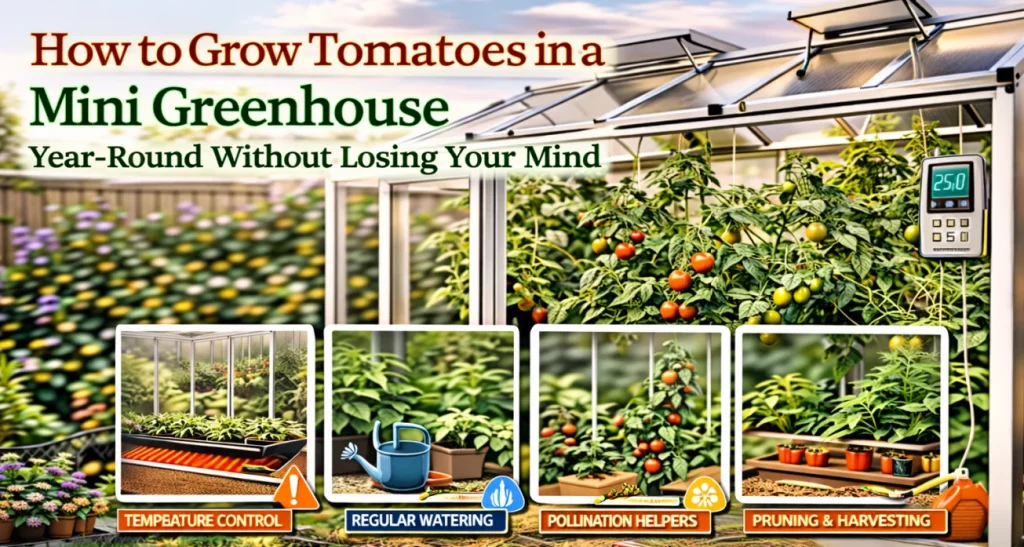
The size of the container is one of those details that doesn’t seem important at first. Water stress often occurs in pots smaller than 30 cm in diameter in summer, resulting in erratic moisture levels that split fruit and cause blossom end rot to appear as dark, leathery patches at the base of developing tomatoes. A large pot (30 to 45 cm, one plant per pot) protects against the effects of missing a day’s watering and allows the root system to properly establish. The performance of growbags is similar, but they require closer observation and dry out more quickly. Watering can be automated with a drip system, and in a small greenhouse during the summer, this is more of a luxury than an insurance policy.
Hand pollination is the most surprising task for novice growers. Bumblebees do most of the work outside, vibrating the flowers at precisely the right frequency to release pollen. When a greenhouse is sealed or partially sealed, that service disappears. Every day around noon, when pollen is most mobile and temperatures are high, gently shake or tap the flowering trusses. Fruit set is improved when an electric toothbrush is pressed against the truss; the vibration mimics bumblebee buzz-pollination. It takes about thirty seconds for each plant. A few days later, thin trusses with gaps where fruit should have set are the result of missing it during a crucial flowering period.
Controlling the temperature throughout the year is the most challenging part of year-round gardening. During the summer, it’s important to keep the area cool. To encourage evaporative cooling, open everything, use shade cloth rated between 40 and 50%, and moisten the floor surfaces with water in the morning. As winter approaches, the goal is to keep the area sufficiently warm without breaking the bank on heating. A temperature of 10 to 12°C at night is necessary for tomatoes to survive. This can be achieved fairly effectively with a small electric tube heater on a thermostat in a sheltered location. The shortening of daylight after autumn necessitates additional lighting. In winter, full-spectrum LEDs run 12 to 16 hours a day to provide sufficient light for fruiting varieties to continue growing, but yields slow significantly and the economics of winter tomatoes should be carefully considered.
When feeding is initiated too early, plants grow vigorously but refuse to bear fruit. Wait until the first fruit truss has set before switching to a high-potash liquid fertilizer. Prior to that, a general-purpose feed with a low concentration will suffice. Nitrogen overfeeding redirects energy into leaves and stems, which look promising but yield nothing edible.
Seeing a well-maintained miniature greenhouse in late July, with plants tied to string supports, trusses full of green fruit beginning to blush, the interior warm and slightly humid, and the distinct sharp green scent of tomato leaves, it seems that the effort required to get there was more than worth it. In a suitable container, a well-fed cordon variety can produce four or five kilograms of fruit over the course of the season. That is a lot of tomatoes for a building that occupies maybe one square meter of patio space. It requires focus and the occasional reconsideration when things go wrong. Nevertheless, if expectations are set early and plants are viewed as living beings that need active management rather than passive optimism, it rarely requires going insane.