
A small greenhouse requires a certain amount of optimism. A long, warm autumn brings ripe tomatoes in August, peppers turning red, and cucumbers climbing strings. For many novice growers, the reality is more yellowed leaves and empty flower trusses than they had anticipated. Mini greenhouses rarely cause problems. The most common mistakes are small containers, inadequate ventilation, and an early or late feeding schedule. Even a simple six-by-eight-foot structure can produce truly remarkable yields when those three factors are met.
The best time to begin is in February, which is earlier than most novices believe is necessary. Planting in mid-February and waiting until late April results in months of lost production at the other end of summer for tomatoes, cucumbers, and peppers. The propagator should be set between 21 and 25°C at this point, since windowsill temperatures vary too much overnight for consistent germination, particularly with peppers, which can take up to three weeks to sprout and will not go below 18°C. The propagator is also important for cucumbers, which grow quickly but are still sensitive to cold. Even tomatoes benefit from regulated warmth, taking seven to ten days to germinate in hot conditions.
The wrong container size is the most common mistake that undermines mini greenhouse harvests. In addition, following overly optimistic instructions on a growbag label or using whatever pots are available can result in plants spending the entire summer chasing water instead of producing fruit. For all three crops—tomatoes, cucumbers, and peppers—a pot that can hold 15 to 20 liters of compost and is at least 30 centimeters deep and wide is essential. On a warm July morning in a hot greenhouse, a plant in a smaller container can run out of moisture in a few hours. Roots that are constantly stressed don’t produce much. They are resilient.
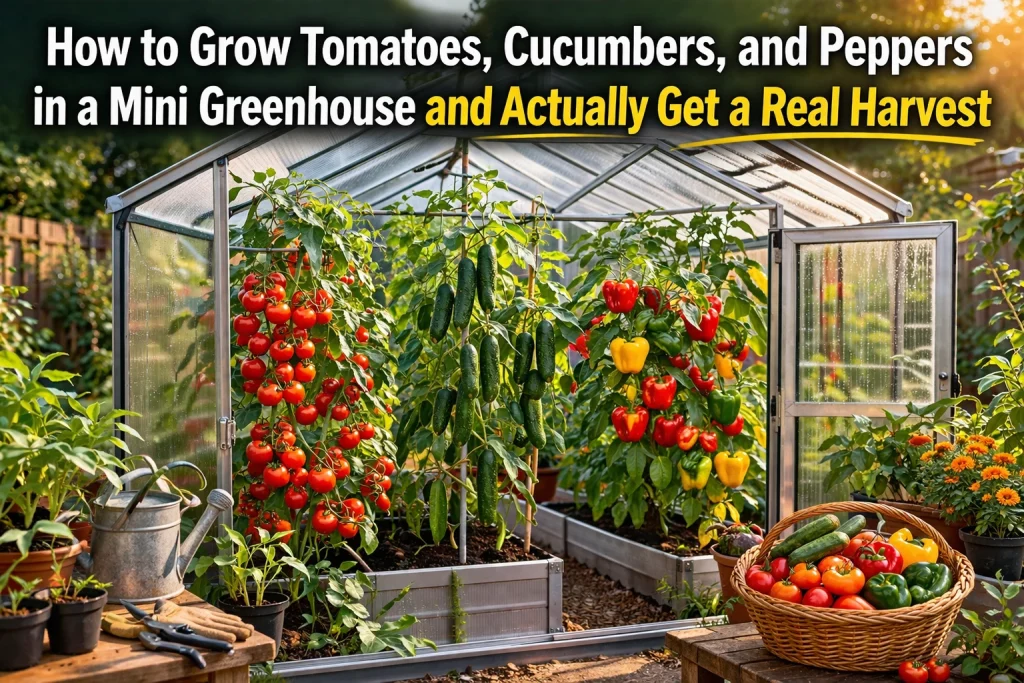
Training and pruning differentiate ornamental greenhouse plants from productive ones. Gardener’s Delight or Sungold tomato cordons require weekly pinching out of their side shoots throughout the growing season. As a result, a plant that directs its energy into fruit trusses produces much more than one that becomes a sprawling green tangle. Vertically training them improves airflow, keeps the canopy open, and makes it much easier to identify problems early. All-female F1 hybrid cucumbers like Mini Munch and Bella should climb trellises to keep fruit straight and air flowing around stems. At about the eight-leaf stage, peppers benefit from a pinch that removes the main growing tip when they are about 30 centimeters tall. As a result, the plant branches sideways and produces more fruit.
The pollination question often throws new growers for a loop.
Outdoors, the wind does the work. In a sealed mini greenhouse, there is no wind. Pollen can only be released from the flower when it vibrates, even though tomatoes are self-fertile. In just a week, the fruit set across every truss improves noticeably when you tap the flowering trusses gently around noon, when pollen is driest. Peppers can also be treated in the same way. There are all-female F1 varieties of cucumbers because they require no assistance.
Feeding should not begin with planting. A common mistake results in lush, leafy growth with little fruit. The first green tomatoes or peppers should be fed a high-potash liquid feed. You can either use a homemade comfrey solution or tomorite. Twice a week is not too much in July and August. Cucumbers require weekly feeding once fruits begin to form. Even an unintentional switch to a high-nitrogen feed at this point will result in the plant going completely in the wrong direction. A high-potash strategy encourages fruiting and flowering rather than foliage.
When it comes to temperature control, the mini greenhouse either succeeds or fails miserably. Above 30°C, tomato pollen becomes sterile. The flowers open, appear healthy, and fall without producing fruit. In September, growers wonder why they have six tomatoes on four plants when they assume the plant is doing well based on the flowers. Installing automatic vent openers is the most reliable option. There is no need for memory, batteries, or wiring. A wax cylinder expands with heat and opens the vent at a predetermined temperature. For those who work away from home during the day, they are not a luxury. The system’s overall operation is their responsibility.
Properly run greenhouses can be extremely productive. Three to five kilograms of tomatoes, fifteen to twenty cucumbers, and twenty to forty peppers can be produced per plant. In summer, they need daily care, such as watering in the morning, checking vents, tapping trusses, and harvesting the first cucumbers quickly. A miniature greenhouse provides a controlled environment. Habits fill most of it.