
Picking ripe lemons from your own tree has a certain quiet satisfaction, especially when six inches of snow accumulate outside the window. This seems unlikely. Most people assume lemons grow in hot climates, on the hillsides of Sicily or in backyards in California where they bake in the summer heat. A well-kept greenhouse in Rhode Island in January might have a seven-foot lemon tree that is so full of fruit the owner is begging neighbors to share it with him. There is a possibility. Knowing what the tree needs and being reliable enough to provide it is the challenge.
Variety selection matters more than most people realize. It is not possible for every lemon tree to thrive in a glass enclosure. There is a good reason why serious greenhouse growers often choose Improved Meyer Lemon. The fruit is somewhat sweeter and more fragrant than typical lemons, and it can withstand lower nighttime temperatures better than most citrus fruits. The Lisbon and Eureka varieties grow larger and require more space, but they produce the tart, traditional lemons most people envision. A grafted tree is also better than one grown from seed. Grafted trees can bear fruit within a year or two. Seed-grown trees may take three years or more to grow, and patience has its limits.
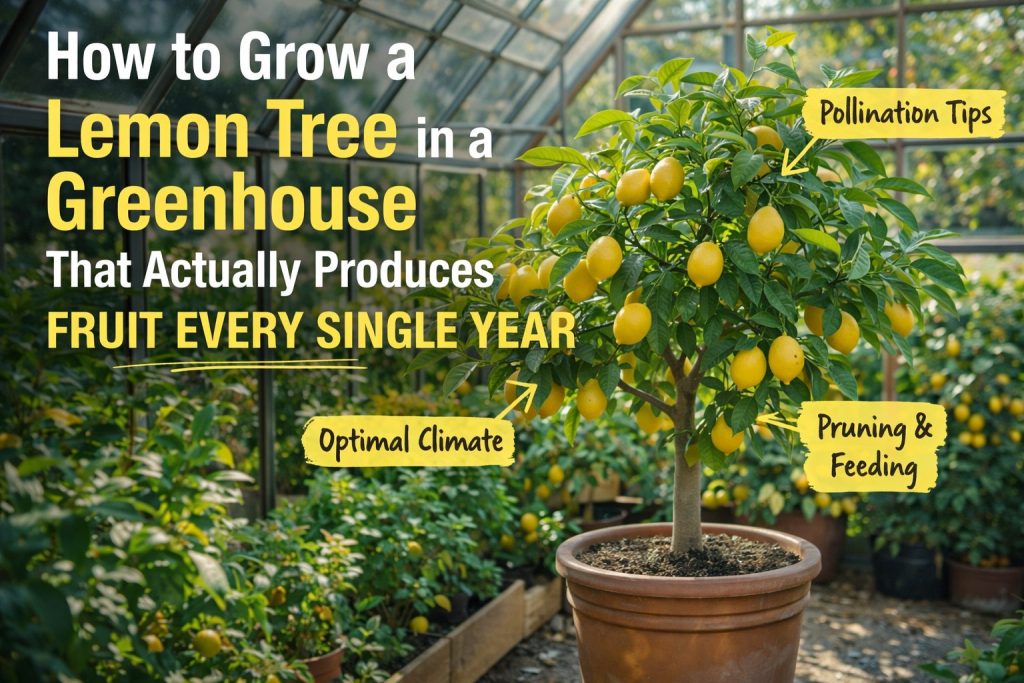
It is common for novices to make subtle mistakes when setting up the environment. Lemon trees require eight to twelve hours of full sun every day during December and January, which a typical greenhouse window cannot provide. During the darker months, adding full-spectrum LED grow lights is essential for consistent fruiting. Temperature also matters, even if not in the way most people expect. It is important to maintain a constant temperature in the greenhouse between 55°F and 85°F, but people are most confused by the minimum nighttime temperature. The tree starts losing its leaves when the temperature consistently drops below 50°F, as it is more concerned with surviving than blooming. Most seasoned growers compromise at 50°F, but it’s a fine line, and heating expenses are significant.
Hand pollination, feeding, and watering are the cornerstones of the entire business. It’s no secret that lemon trees are heavy feeders; if fertilizer is not applied, the leaves turn yellow, growth stagnates, and fruit production plummets. Every other time the tree is watered, a high-nitrogen citrus fertilizer is applied to maintain its health. Changing to a balanced, lower-nitrogen formula in the fall and winter prevents pushing soft new growth at the wrong time. Allow the top inch or two of soil to dry out before watering again after thoroughly watering. Fill the pot with water until it drains freely. Wet feet are the enemy. It is silent, quick, and difficult to stop root rot.
Pollination poses a challenge for many greenhouse growers. It may seem comforting to know that lemon trees are self-fertile, but this implies that pollen is transported between flowers by wind or insects, neither of which are consistently present in a greenhouse. A tiny paintbrush applied gently from flower to flower accomplishes the task effectively during bloom. Shaking the branches is all some growers do. It is effective to use both strategies. The most common reason for a tree covered in blossoms not producing fruit is skipping it.
By pruning in late winter or early spring, after harvest but before the new growth surge, the greenhouse is kept open, air circulation is improved, and the vertical suckers that grow beneath the graft union are removed without bearing fruit. When young trees produce a lot of undersized lemons, thinning the fruit to about twenty per tree allows what remains to mature properly.
Citrus growers often mention that the trees reward attention. A regular, consistent observation regime is more effective than compulsive intervention, such as noticing when leaves become pale, catching spider mites before they establish themselves, and modifying the humidity in the greenhouse when the air becomes dry during the winter. Developing an understanding of what the tree is telling you is more important than adhering to a strict checklist. A greenhouse lemon tree can bear fruit continuously for decades, long enough, according to one Rhode Island grower, so that your children eventually tell you they’ve had enough lemon pie.